Missing Numerators
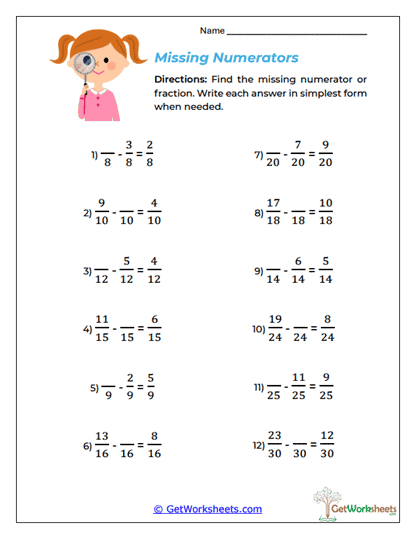
Missing Numerators helps students work backward to find an unknown numerator or missing fraction in a subtraction equation. Students study the starting fraction, the amount being subtracted, and the difference, then determine which numerator makes the equation correct. This practice strengthens missing-number reasoning, inverse operations, fraction subtraction, numerator relationships, denominator recognition, and equation sense. It is especially useful for students in grades 4-5 who are ready to move beyond routine subtraction and think more carefully about how the parts of an equation fit together.
Key Learning Objectives
- Find an unknown numerator: Students determine the number that completes each subtraction equation.
- Use inverse reasoning: Learners may add the known numerator and the difference to recover the missing starting amount.
- Keep denominators consistent: Students recognize that all fractions in each equation describe the same-sized pieces.
- Check the completed equation: Children substitute their answer and subtract to confirm that it produces the stated difference.
Instructional Support
- Builds deeper understanding: Students must think about the relationship among the starting amount, the amount removed, and what remains.
- Connects to fact families: The work uses the same addition-and-subtraction relationships children already know from whole numbers.
- Offers simple parent guidance: Adults can ask, “What number minus this numerator gives the numerator in the answer?”
- Works in many settings: The page fits independent work, small groups, homework, tutoring, intervention, or homeschool practice.
- No-prep design: Teachers and parents can print the worksheet and begin immediately.
Missing-number problems may appear harder than regular subtraction, but the reasoning is familiar. For example, if a blank number of eighths minus three eighths equals two eighths, students can think, “What number minus three equals two?” Because the denominator stays the same, the child only needs to reason about the numerators. This worksheet strengthens fraction fluency, inverse-operation knowledge, equation comprehension, subtraction accuracy, self-checking, and confidence. In classroom and homeschool settings, it reinforces flexible thinking and prepares students for missing addends, algebraic equations, and more advanced fraction problem solving.
Bookmark Us Now!
New, high-quality worksheets are added every week! Do not miss out!