Show the Difference
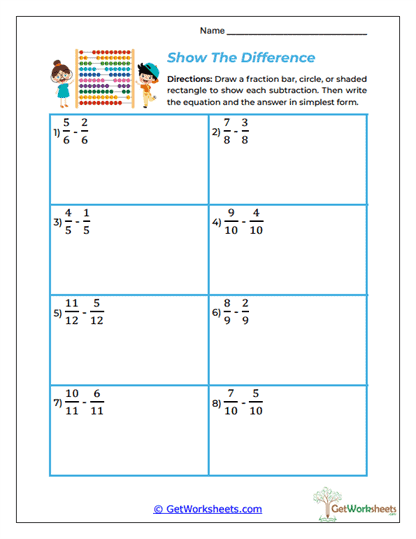
Show the Difference helps students understand fraction subtraction by asking them to draw a model for every problem. Students may use fraction bars, circles, or shaded rectangles to show the starting fraction, cross out the amount being removed, and write the remaining fraction in simplest form. This activity develops visual models, equal partitioning, fraction subtraction, numerators, denominators, simplification, and mathematical reasoning. It is especially useful for students in grades 4-5 who need to see what subtraction means before relying only on a written rule.
Targeted Skills
- Represent the starting amount: Students divide a whole into equal parts and shade the first fraction.
- Show what is removed: Learners cross out or unshade the number of parts represented by the second fraction.
- Count what remains: Students use the model to identify the difference accurately.
- Connect pictures and equations: Children write the subtraction equation and simplify the final answer.
Instructional Benefits
- Makes subtraction visible: Students can actually see the parts being taken away instead of treating the problem as a set of numbers.
- Supports struggling learners: Drawing gives children a dependable way to check their arithmetic.
- Encourages explanation: Parents and teachers can ask, “How many parts were shaded first, and how many did you remove?”
- Offers flexible modeling: Students can choose the type of visual that makes the most sense to them.
- Works anywhere: The worksheet is useful for guided lessons, intervention, homework, tutoring, or homeschool practice.
Some children memorize that they should subtract the top numbers, but they do not yet understand why that rule works. A visual model shows that the denominator names the size of each piece and that those pieces do not change during subtraction. Only the number of pieces changes, which is why the numerators are subtracted while the denominator remains the same. This worksheet strengthens fraction sense, visual reasoning, model accuracy, subtraction fluency, simplification, and confidence. In classroom and homeschool instruction, it gives adults a clear way to see a child’s thinking and gently correct misunderstandings before they become habits.
Bookmark Us Now!
New, high-quality worksheets are added every week! Do not miss out!