Difference Pair-Up
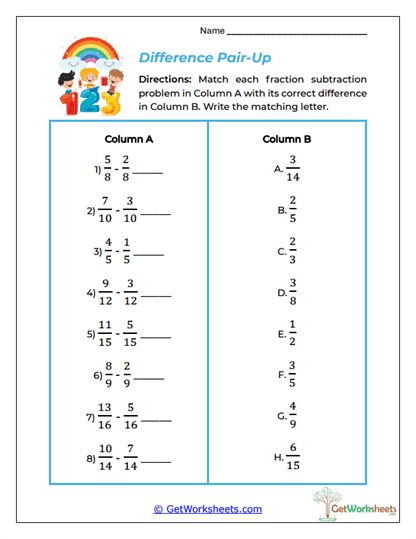
Difference Pair-Up gives students a matching activity that combines fraction subtraction with answer recognition. Students solve each subtraction problem in Column A, simplify the difference when needed, and match it to the correct answer choice in Column B. This practice strengthens like-denominator subtraction, numerator fluency, denominator understanding, equivalent fractions, simplification, and answer comparison. It is especially helpful for students in grades 4-5 who need repeated practice but respond better to a matching format than to a traditional drill page.
Learning Goals
- Subtract like fractions: Students subtract the numerators while keeping the shared denominator unchanged.
- Simplify each difference: Learners reduce answers to lowest terms before looking for a match.
- Recognize equivalent values: Students understand that an unsimplified difference may match an answer written in a simpler form.
- Check work independently: Children review their calculations when a result does not appear among the choices.
Educational Value
- Adds a self-checking feature: The answer bank helps students notice when they may have made a subtraction or simplification mistake.
- Makes practice feel manageable: Matching letters can feel less intimidating than completing a long list of open-response problems.
- Supports parent guidance: Adults can remind children to simplify before deciding that an answer is missing.
- Works in many settings: Use the page for math centers, partner work, homework, tutoring, review, or homeschool practice.
- No-prep format: The worksheet is ready to print and use immediately.
Matching activities still require careful mathematical thinking. Students must first calculate the difference correctly, then decide whether the result should be reduced before searching the answer column. For example, a difference such as six fifteenths may need to be recognized as two fifths. This worksheet builds subtraction fluency, equivalent-fraction knowledge, denominator awareness, simplification accuracy, visual comparison, and confidence. In classroom and homeschool settings, it reinforces the habit of checking whether two differently written fractions represent the same value.
Bookmark Us Now!
New, high-quality worksheets are added every week! Do not miss out!