Sort Smart
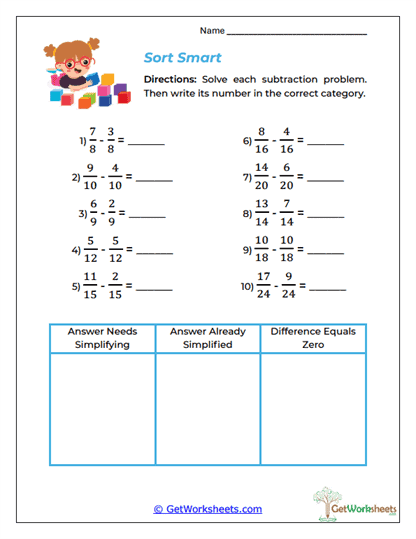
Sort Smart asks students to solve fraction subtraction problems and then organize the results into meaningful categories. After finding each difference, students decide whether the answer needs simplifying, is already in simplest form, or equals zero. The worksheet develops fraction subtraction, simplification, equivalent fractions, zero differences, common factors, classification, and mathematical reasoning. It is a strong grades 4-5 activity for children who are ready to think about the form of an answer instead of stopping as soon as the subtraction is complete.
Key Learning Objectives
- Calculate each difference: Students subtract the numerators and keep the common denominator.
- Identify reducible fractions: Learners determine whether the numerator and denominator share a common factor.
- Recognize simplest form: Students identify answers that cannot be reduced any further.
- Understand zero differences: Children recognize that subtracting equal fractions results in zero.
Instructional Benefits
- Encourages a complete routine: Students learn to solve, inspect, simplify, and classify every answer.
- Builds math vocabulary: The categories reinforce terms such as simplest form, simplify, difference, and zero.
- Reveals student thinking: Teachers and parents can see whether children know why an answer belongs in a particular group.
- Supports flexible use: The page works for independent practice, partner work, review, assessment, or homeschool instruction.
- Print-and-go resource: No cutting, sorting cards, or extra materials are required.
This worksheet teaches children that answers can have different mathematical qualities. Some differences are correct but unfinished because they still need to be reduced, while others are already in lowest terms. When the two starting fractions are equal, the difference is zero because nothing remains after the same amount is taken away. As students sort their results, they strengthen subtraction accuracy, factor recognition, equivalent-fraction understanding, classification skills, mathematical vocabulary, and confidence. In classroom and homeschool settings, this activity reinforces careful finishing habits and helps learners explain not only what an answer is, but also what kind of answer it is.
Bookmark Us Now!
New, high-quality worksheets are added every week! Do not miss out!