Simplify to Lowest
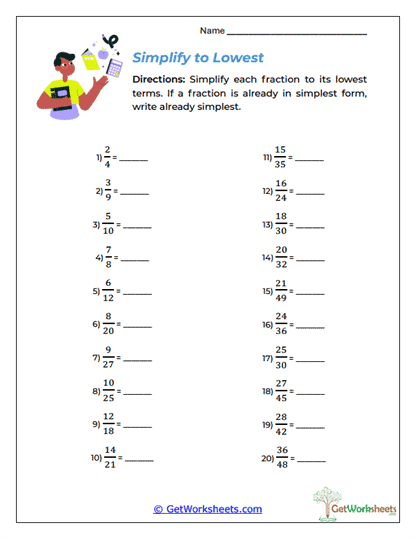
Students simplify twenty fractions by finding a common factor shared by the numerator and denominator and dividing both numbers by that factor. When a fraction cannot be reduced any further, students write that it is already in simplest form. This upper-elementary worksheet strengthens fraction simplification, factor recognition, division, equivalent-fraction understanding, greatest common factor awareness, and mathematical accuracy. It is especially useful for grades 4-5 because students receive broad practice deciding both how to reduce a fraction and when no further reduction is possible.
Learning Goals
- Find Shared Factors: Students identify numbers that divide evenly into both the numerator and denominator.
- Create Equivalent Fractions: Learners divide both parts of the fraction by the same number without changing its value.
- Recognize Simplest Form: Children determine when the numerator and denominator share no factor greater than one.
- Check the Final Answer: Students verify that the reduced fraction cannot be simplified again.
How This Helps
- Builds a Core Fraction Skill: Simplifying is needed when comparing, adding, subtracting, multiplying, and dividing fractions.
- Supports Developing Learners: The problems begin with manageable values and provide plenty of repeated practice.
- Easy for Parents to Explain: Adults can ask, “What number divides evenly into both the top and bottom?”
- Useful as a Skill Check: Teachers can quickly see whether students understand factors and equivalent fractions.
- Ready for Immediate Use: The worksheet fits classwork, homework, tutoring, intervention, review, or homeschool instruction.
Many children divide the numerator and denominator once and assume the fraction is finished, even when it can be reduced again. This worksheet teaches them to keep checking until the two numbers have no common factor other than one. Students strengthen factors, division, equivalent fractions, simplest form, number sense, accuracy, and self-checking through twenty varied examples. Parents can encourage children to look for the greatest common factor when possible, while also reassuring them that repeated smaller divisions will reach the same result. In classroom and homeschool settings, this activity builds confidence and helps learners produce clear, complete fraction answers in the form teachers usually expect.
Bookmark Us Now!
New, high-quality worksheets are added every week! Do not miss out!