Sort and Simplify
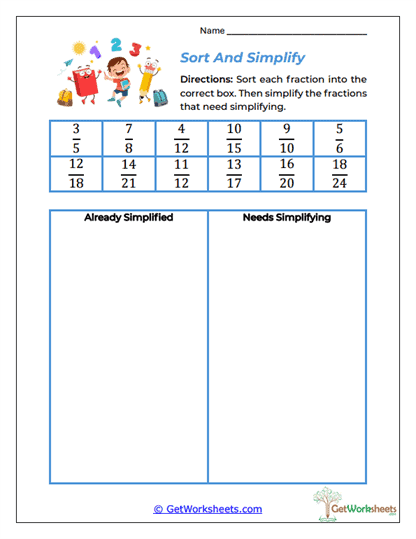
Students examine twelve fractions and sort them into two categories: already simplified or needs simplifying. After placing each fraction in the correct box, they reduce the fractions that are not yet in lowest terms. This upper-elementary worksheet strengthens fraction classification, common-factor recognition, divisibility, simplification, equivalent fractions, and mathematical decision-making. It is especially appropriate for grades 4-5 because students must first judge whether a fraction needs work before applying a reduction procedure.
Key Learning Objectives
- Check for Shared Factors: Students determine whether the numerator and denominator share a factor greater than one.
- Recognize Lowest Terms: Learners identify fractions that should remain unchanged.
- Sort Fractions Correctly: Children place each value in the proper category based on its factor relationship.
- Simplify When Necessary: Students reduce only the fractions that can be rewritten in a simpler equivalent form.
Teaching Advantages
- Builds Judgment Before Procedure: Students learn not to simplify automatically without checking the fraction first.
- Targets Common Confusion: The sorting task separates fractions that merely look complicated from those that actually reduce.
- Helpful for Parent Guidance: Adults can ask, “Do the top and bottom have any factor in common besides one?”
- Supports Hands-On Learning: Fractions may be copied onto cards and physically sorted before being written.
- Low-Prep Practice: The page works well for centers, guided math, review, intervention, or homeschool lessons.
Some students believe that every fraction with large numbers must be simplified, while others assume a fraction is finished after one quick division. This worksheet teaches them to inspect the numerator and denominator carefully before deciding what action is needed. Students strengthen divisibility, factor recognition, fraction reduction, classification, equivalent values, accuracy, and mathematical reasoning through a clear two-category task. Parents can encourage children to test familiar factors such as two, three, five, and seven when they are unsure. In classroom and homeschool settings, this activity builds confidence and helps learners become more independent when deciding whether a fraction is already in simplest form.
Bookmark Us Now!
New, high-quality worksheets are added every week! Do not miss out!