Simplify Check
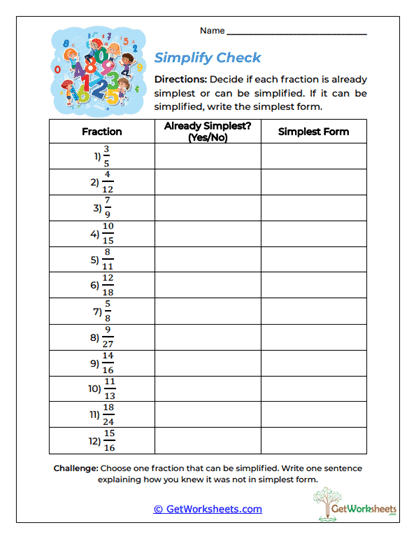
Students review twelve fractions and decide whether each one is already in simplest form. If a fraction can still be reduced, they write the correct simplest form in the final column and explain one example in a short challenge response. This upper-elementary worksheet strengthens greatest common factor awareness, divisibility, fraction simplification, mathematical judgment, equivalent fractions, and written reasoning. It is especially appropriate for grades 4-5 because students must determine when to simplify and when to leave a fraction unchanged.
Key Learning Objectives
- Check for Common Factors: Students decide whether the numerator and denominator share a factor greater than one.
- Recognize Simplest Form: Learners identify fractions that cannot be reduced any further.
- Simplify When Needed: Children divide both numbers by the same common factor to create an equivalent fraction.
- Explain Their Thinking: Students describe how they knew one fraction was not in lowest terms.
- Use the Table Accurately: Learners record yes or no and then complete only the fractions that require reduction.
Teaching Advantages
- Builds Decision-Making: Students do not simplify automatically; they first decide whether the step is necessary.
- Targets a Common Mistake: The worksheet helps children avoid changing fractions that are already in lowest terms.
- Helpful for Parent Guidance: Adults can ask, “Is there any whole number greater than one that divides both numbers?”
- Supports Mathematical Language: The explanation prompt encourages students to use terms such as factor, divide, equivalent, and simplest form.
- Low-Prep Practice: The page fits review, independent work, assessment, tutoring, intervention, or homeschool instruction.
Some students assume every fraction must be changed, while others stop after one reduction even when more work is needed. This worksheet helps them develop the judgment to know when a fraction is truly finished. Students strengthen factor recognition, divisibility, equivalent fractions, simplification, table reading, written explanation, and self-checking through twelve examples. Parents can encourage children to list a few factors when they are unsure rather than guessing. In classroom and homeschool settings, this activity builds confidence and helps learners become more accurate, independent, and thoughtful when writing fractions in simplest form.
Bookmark Us Now!
New, high-quality worksheets are added every week! Do not miss out!