Solve and Simplify
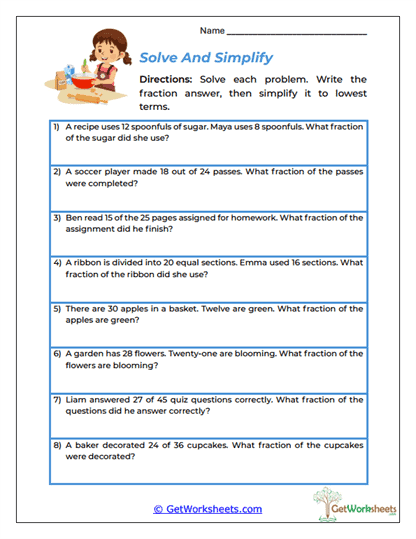
Students read eight practical word problems, write the fraction described by each situation, and simplify the answer to lowest terms. The problems involve sugar, soccer passes, reading pages, ribbon sections, apples, flowers, quiz questions, and cupcakes. This upper-elementary worksheet strengthens word-problem comprehension, fraction formation, simplification, greatest common factor use, part-whole reasoning, and mathematical communication. It is especially useful for grades 4-5 because students must first build the correct fraction from the story and then reduce it accurately.
Key Learning Objectives
- Identify the Part and Whole: Students determine which number belongs in the numerator and which belongs in the denominator.
- Write the Original Fraction: Learners translate each real-life situation into correct fraction notation.
- Find a Common Factor: Children identify a number that divides both values evenly.
- Reduce to Lowest Terms: Students simplify until the numerator and denominator share no factor greater than one.
- Connect the Answer to Context: Learners explain what the reduced fraction means in the situation.
Teaching Advantages
- Connects Reading and Mathematics: Students must understand the wording before they can create the fraction.
- Shows Why Simplifying Matters: Reduced answers communicate the same relationship in a clearer form.
- Helpful for Parent Guidance: Adults can ask, “What is the part, what is the whole, and what divides both numbers?”
- Builds Real-World Fraction Sense: The situations show fractions describing completed work, selected items, and portions used.
- Low-Prep Practice: The page works well for classwork, homework, tutoring, assessment, or homeschool lessons.
Some children can simplify a fraction when it is already written but struggle to create that fraction from a story. This worksheet combines both steps and teaches learners to think carefully about the relationship between the part and the whole. Students strengthen comprehension, fraction notation, greatest common factor reasoning, division, equivalent fractions, vocabulary, and answer accuracy through eight familiar contexts. Parents can encourage children to write the unsimplified fraction first and only then begin reducing it. In classroom and homeschool settings, this activity builds confidence and prepares students to solve more advanced ratio, probability, and data problems.
Bookmark Us Now!
New, high-quality worksheets are added every week! Do not miss out!