Simplified Models
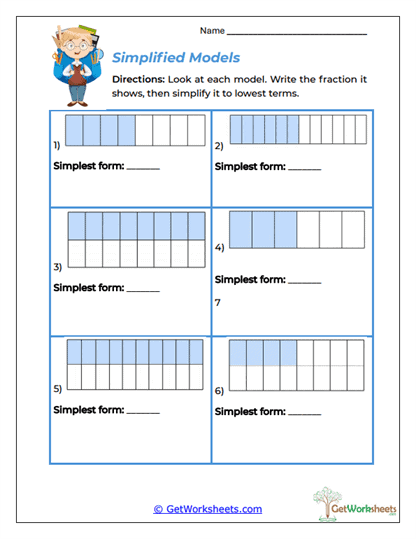
Students examine six shaded fraction models, write the fraction represented by each picture, and then simplify that fraction to lowest terms. The rectangular bars and grids help learners see that several smaller shaded parts can be regrouped into fewer, larger equal parts without changing the amount. This upper-elementary worksheet strengthens visual fraction interpretation, equivalent fractions, simplification, numerator and denominator understanding, greatest common factor reasoning, and mathematical notation. It is especially useful for grades 3-4 because students begin with a picture before moving into the more abstract process of reducing a fraction.
Learning Goals
- Read the Visual Model: Students count the total equal parts and the number of shaded parts in each figure.
- Write the Original Fraction: Learners record the shaded amount using correct numerator and denominator placement.
- Find an Equivalent Fraction: Children regroup the model into fewer equal parts that represent the same value.
- Reduce to Lowest Terms: Students divide the numerator and denominator by a common factor until no further simplification is possible.
How This Helps
- Shows Why Simplifying Works: The pictures make it clear that the amount stays the same even when the numbers become smaller.
- Supports Visual Learners: Students can see equivalent groups instead of memorizing a rule without understanding it.
- Easy for Parents to Explain: Adults can ask, “Can these smaller boxes be grouped into larger equal sections?”
- Builds Fraction Vocabulary: The activity reinforces whole, equal parts, numerator, denominator, equivalent, and simplest form.
- Ready for Immediate Use: The worksheet works well for guided math, centers, intervention, tutoring, homework, or homeschool lessons.
Many children believe that simplifying changes the fraction because both numbers look different afterward. This worksheet helps them see that the shaded amount remains exactly the same while the fraction is renamed with fewer parts. Students strengthen fraction models, equivalence, factors, division, visual reasoning, notation, and self-checking through six clear examples. Parents can encourage children to explain how many smaller sections fit into each larger group. In classroom and homeschool settings, this activity builds confidence and gives learners a strong visual foundation for simplifying fractions without picture support.
Bookmark Us Now!
New, high-quality worksheets are added every week! Do not miss out!