Compare Simply
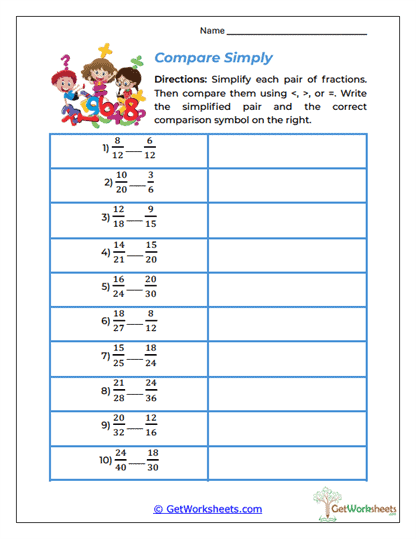
Students simplify ten pairs of fractions and then compare the reduced values using less than, greater than, or equal symbols. Each problem requires learners to write both simplest forms before deciding which fraction is larger or whether the two fractions are equivalent. This upper-elementary worksheet strengthens fraction simplification, comparison, equivalent-fraction recognition, greatest common factor reasoning, symbol use, and multi-step accuracy. It is especially appropriate for grades 4-5 because students must complete two connected skills in the correct order and use the simplified forms to make the comparison easier.
Learning Goals
- Simplify Both Fractions: Students reduce each numerator and denominator by a common factor.
- Recognize Equivalent Values: Learners notice when two different-looking fractions simplify to the same amount.
- Compare Accurately: Children use less than, greater than, or equal symbols after finding the simplest forms.
- Show Complete Work: Students record the reduced fractions and the comparison sign rather than giving only one final symbol.
How This Helps
- Combines Important Skills: Students practice simplification and comparison together instead of treating them as unrelated topics.
- Makes Difficult Pairs Easier: Reduced values are often much simpler to compare than the original fractions.
- Easy for Parents to Explain: Adults can ask, “What does each fraction become in lowest terms, and which value is greater?”
- Supports Careful Work Habits: The two-step format encourages students to organize their calculations.
- Ready for Immediate Use: The worksheet fits review, assessment, tutoring, homework, intervention, or homeschool instruction.
Many students try to compare the original numerators and denominators without first considering whether the fractions can be reduced. This worksheet shows them that simplifying can reveal familiar values and make the correct relationship much easier to see. Students strengthen factors, division, equivalent fractions, comparison symbols, number sense, accuracy, and mathematical reasoning through ten paired examples. Parents can encourage children to compare the simplified forms only after checking that both fractions are fully reduced. In classroom and homeschool settings, this activity builds confidence and helps learners choose efficient strategies when fractions initially look complicated.
Bookmark Us Now!
New, high-quality worksheets are added every week! Do not miss out!