Shade Count
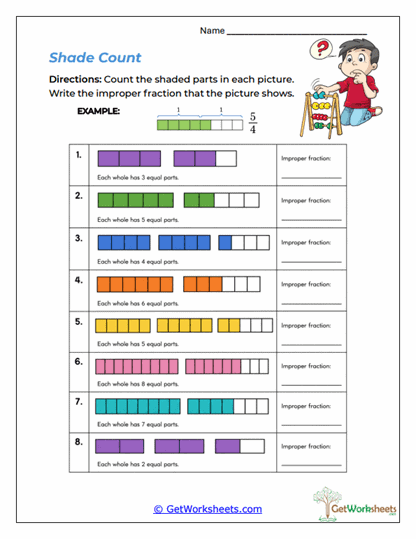
Students examine eight groups of shaded fraction bars and write the improper fraction represented by each picture. Every item tells how many equal parts make one whole, so learners count all shaded pieces across several bars and place that total over the number of parts in one whole. This upper-elementary worksheet strengthens improper-fraction identification, visual counting, numerator and denominator understanding, equal-part recognition, whole-number relationships, and mathematical notation. It is especially appropriate for grades 3-4 because students move from concrete shaded models to symbolic fractions greater than one.
Key Learning Objectives
- Recognize One Whole: Students use the stated number of equal parts to understand how many shaded pieces complete a full bar.
- Count All Shaded Parts: Learners count pieces across every model, including complete wholes and leftover sections.
- Write the Numerator: Children use the total shaded-piece count as the top number.
- Write the Denominator: Students keep the number of equal parts in each whole as the bottom number.
- Identify Values Greater Than One: Learners understand why the numerator is larger than the denominator.
Teaching Advantages
- Builds Meaning Before Rules: Students see where an improper fraction comes from instead of memorizing a definition.
- Supports Visual Learners: Color-coded bars make complete wholes and extra pieces easy to distinguish.
- Helpful for Parent Guidance: Adults can ask, “How many small pieces are shaded altogether, and how many pieces make one whole?”
- Encourages Accurate Counting: The varied denominators require children to examine each model carefully.
- Low-Prep Practice: The page works well for whole-class modeling, independent work, centers, tutoring, or homeschool instruction.
Some students write the number of complete bars as the numerator and forget to count every shaded part. This worksheet teaches them that the numerator represents the total number of selected fractional pieces, including pieces inside all completed wholes. Students practice visual fraction interpretation, counting, improper-fraction notation, equal partitioning, part-whole reasoning, denominator meaning, and self-checking. Parents can encourage children to label the pieces in order as they count across the bars. In classroom and homeschool settings, this activity builds confidence and prepares students to connect improper fractions with equivalent mixed numbers.
Bookmark Us Now!
New, high-quality worksheets are added every week! Do not miss out!