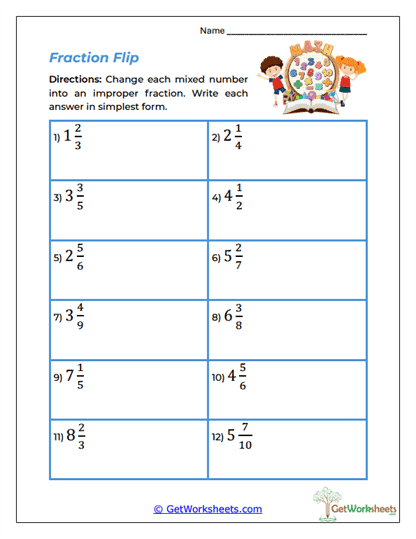
Fraction Flip
Students convert twelve mixed numbers into improper fractions and write each answer in simplest form. They multiply the whole number by the denominator, add the numerator, and place the new total over the original denominator. This upper-elementary worksheet strengthens mixed-number conversion, multiplication, addition, denominator consistency, improper-fraction notation, and procedural fluency. It is especially appropriate for grades 4-5 because students must combine several steps accurately and understand that the value stays the same even though its form changes.
Learning Goals
- Multiply the Whole and Denominator: Students find how many fractional parts are contained in all complete wholes.
- Add the Existing Numerator: Learners include the extra fractional part already shown in the mixed number.
- Keep the Denominator: Children understand that the size of each fractional piece does not change during conversion.
- Write the Improper Fraction: Students record the total number of equal parts over the original denominator.
How This Helps
- Provides a Clear Conversion Routine: The same dependable steps can be used for every problem.
- Builds Fraction Meaning: Students see that a mixed number and improper fraction are two ways to name the same amount.
- Easy for Parents to Explain: Adults can say, “Multiply, add, and keep the denominator.”
- Supports Future Operations: Converting forms is important before adding, subtracting, multiplying, or comparing mixed numbers.
- Ready for Immediate Use: The worksheet fits direct instruction, independent practice, review, tutoring, homework, or homeschool lessons.
Many students remember part of the rule but forget either to add the numerator or keep the denominator unchanged. This worksheet gives them repeated practice with the full process so each step becomes more automatic. Students strengthen multiplication, addition, mixed-number reasoning, improper-fraction notation, accuracy, self-checking, and mathematical vocabulary through twelve varied examples. Parents can encourage children to draw one model and count all of the fractional parts to prove why the method works. In classroom and homeschool settings, this activity builds confidence and prepares learners to work more efficiently with mixed numbers in later fraction problems.
Bookmark Us Now!
New, high-quality worksheets are added every week! Do not miss out!