Fraction Chart Fill
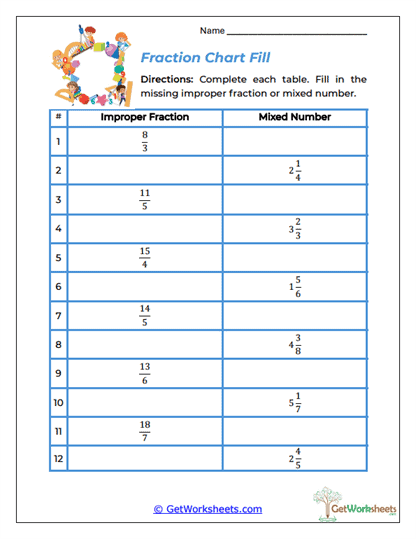
Students complete a twelve-row chart by filling in either the missing improper fraction or the missing mixed number. Some rows provide the improper fraction first, while others begin with a mixed number, so learners must convert in both directions. This upper-elementary worksheet strengthens improper-fraction conversion, mixed-number conversion, division, multiplication, addition, equivalence, and table organization. It is best suited for grades 4-5 because students must choose the correct process based on which form is missing.
Academic Focus
- Convert Improper Fractions: Students divide the numerator by the denominator to find the whole number and remainder.
- Convert Mixed Numbers: Learners multiply the whole number by the denominator and add the numerator.
- Preserve the Denominator: Children keep the size of the fractional parts consistent in both forms.
- Recognize Equivalent Values: Students understand that both entries in each row represent the same quantity.
- Organize Work Clearly: Learners place each conversion in the correct column.
Instructional Benefits
- Practices Both Directions: Students do not rely on only one conversion rule.
- Builds Flexible Thinking: Learners must first identify which form is given and which form is needed.
- Easy for Parents to Guide: Adults can ask, “Are we breaking the fraction into wholes, or combining the wholes into parts?”
- Useful for Assessment: The chart makes it easy to see which conversion direction needs more practice.
- Ready for Multiple Settings: The worksheet fits class review, centers, homework, tutoring, intervention, or homeschool lessons.
Students sometimes know one conversion method well but become confused when the problem is presented in the opposite direction. This worksheet strengthens both processes and helps learners compare how they are related. Students develop fluency with improper fractions, mixed numbers, multiplication, division, remainders, equivalence, and mathematical organization through twelve balanced examples. Parents can encourage children to check each row by converting the answer back to the starting form. In classroom and homeschool settings, this activity builds confidence and gives students the flexible fraction skills needed for more advanced operations and problem solving.
Bookmark Us Now!
New, high-quality worksheets are added every week! Do not miss out!