Fraction Points
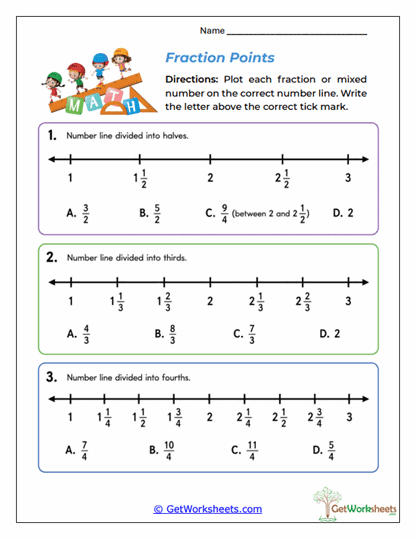
Students place improper fractions and mixed numbers on three number lines divided into halves, thirds, and fourths. They write each letter above the correct tick mark, using the interval size to decide where values such as three-halves, eight-thirds, and ten-fourths belong. This upper-elementary worksheet strengthens improper-fraction understanding, mixed-number equivalence, number-line placement, fraction magnitude, equal intervals, and spatial reasoning. It is especially appropriate for grades 4-5 because students must interpret values greater than one and locate them precisely between whole numbers.
Learning Goals
- Read Number-Line Intervals: Students identify whether each line is divided into halves, thirds, or fourths.
- Convert When Helpful: Learners change improper fractions into mixed numbers to make placement easier.
- Plot Values Greater Than One: Children locate fractions between one and three rather than only between zero and one.
- Recognize Equivalent Forms: Students understand that values such as four-thirds and one and one-third name the same point.
How This Helps
- Makes Larger Fractions Visible: Number lines show that improper fractions are ordinary numbers with exact locations.
- Supports Visual Learners: Equal intervals help children see the relationship between whole numbers and fractional parts.
- Easy for Parents to Explain: Adults can ask, “How many full wholes are included, and how far do you move after that?”
- Builds Measurement Readiness: Plotting halves, thirds, and fourths supports later work with rulers, time, and mixed-unit measurements.
- Ready for Immediate Use: The worksheet fits guided math, centers, review, tutoring, homework, or homeschool lessons.
Many students can convert an improper fraction but still have trouble picturing its actual size. This worksheet helps them connect the conversion with a physical point on a number line. Students strengthen fraction magnitude, mixed numbers, improper fractions, interval counting, equivalence, spatial reasoning, and mathematical accuracy through three structured models. Parents can encourage children to label each fractional tick before placing the letters. In classroom and homeschool settings, this activity builds confidence and helps learners understand that fractions greater than one fit naturally into the same number system as whole numbers.
Bookmark Us Now!
New, high-quality worksheets are added every week! Do not miss out!