Conversion Errors
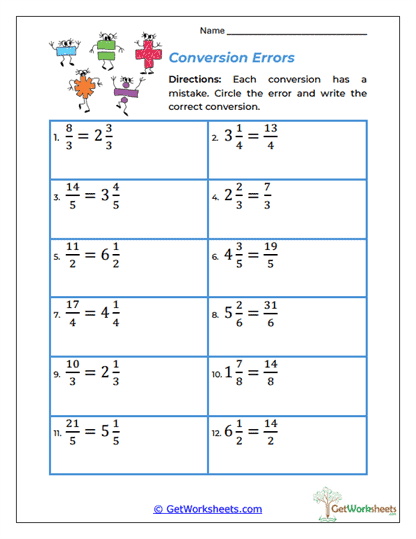
Students examine twelve incorrect conversions involving improper fractions and mixed numbers. They locate the mistake in each statement, circle the error, and write a correct equivalent form. This upper-elementary worksheet strengthens fraction conversion, error analysis, multiplication, division with remainders, mixed-number notation, improper-fraction notation, and mathematical reasoning. It is best suited for grades 4-5 because students must diagnose different types of mistakes rather than repeat one simple conversion process.
Key Learning Objectives
- Recognize Incorrect Conversions: Students determine why the two forms shown do not represent the same value.
- Apply the Correct Procedure: Learners use division for improper fractions and multiplication plus addition for mixed numbers.
- Preserve the Denominator: Children understand that the denominator remains the same during a standard conversion.
- Rewrite the Equivalent Value: Students produce a correct mixed number or improper fraction.
- Explain the Mistake: Learners identify whether the error involved the whole number, numerator, remainder, or operation.
Teaching Advantages
- Makes Misconceptions Visible: Students see realistic errors that often occur during fraction conversion.
- Builds Independent Review Skills: Learners practice checking work without waiting for an adult to identify the problem.
- Helpful for Parent Guidance: Adults can ask the child to solve the conversion independently before studying the incorrect answer.
- Encourages Precise Language: Students can explain whether the quotient, remainder, numerator, or denominator is wrong.
- Low-Prep Practice: The page works well for reteaching, centers, assessment, tutoring, intervention, or homeschool lessons.
Children often repeat the same conversion error because they only see whether an answer was marked wrong, not why it was wrong. This worksheet turns each mistake into a teaching opportunity and asks students to repair the reasoning behind it. Learners strengthen fraction equivalence, improper fractions, mixed numbers, multiplication, division, remainders, accuracy, and mathematical communication through twelve focused corrections. Parents can remind children that a quick estimate can also help; for example, a fraction slightly greater than three should not convert to a number greater than six. In classroom and homeschool settings, this activity builds confidence and helps learners become more careful, reflective, and accurate with fraction forms.
Bookmark Us Now!
New, high-quality worksheets are added every week! Do not miss out!