Greater Together
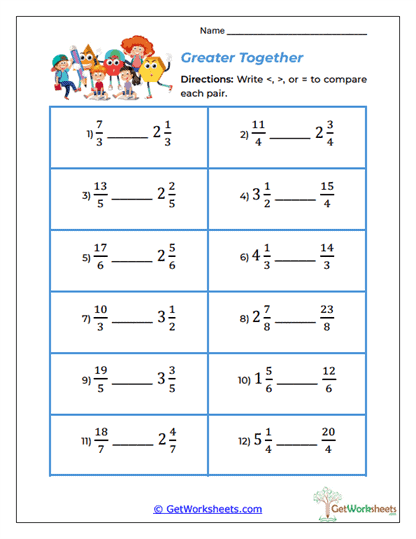
Students compare twelve pairs containing improper fractions, mixed numbers, or one of each form. They write the correct less than, greater than, or equal symbol after converting values or using another reliable comparison strategy. This upper-elementary worksheet strengthens fraction magnitude, improper-fraction conversion, mixed-number reasoning, equivalence, comparison symbols, and mathematical accuracy. It is especially useful for grades 4-5 because students must compare quantities that look different but may represent equal or closely related amounts.
Key Learning Objectives
- Convert Between Forms: Students change improper fractions into mixed numbers when that makes comparison easier.
- Compare Whole-Number Parts: Learners first examine how many complete wholes each value contains.
- Compare Fractional Remainders: Children analyze the leftover parts when the whole-number portions match.
- Recognize Equality: Students identify pairs that use different notation but represent the same quantity.
- Use Symbols Correctly: Learners record each relationship with less than, greater than, or equal signs.
Teaching Advantages
- Builds Flexible Fraction Thinking: Students learn that conversion is a tool for understanding, not merely a separate procedure.
- Targets Common Confusion: The page helps children compare mixed numbers with improper fractions without judging by appearance alone.
- Helpful for Parent Support: Adults can ask the child to rename both values in the same form before comparing.
- Encourages Verbal Reasoning: Students can explain which value contains more wholes or larger remaining parts.
- Low-Prep Practice: The worksheet works well for review, independent work, tutoring, intervention, or homeschool instruction.
Some children assume that a fraction with a larger numerator must always be greater, even when the denominators and whole-number values differ. This worksheet teaches them to compare the actual amounts rather than isolated digits. Students practice improper fractions, mixed numbers, equivalence, fraction magnitude, symbol direction, conversion, and self-checking through twelve varied pairs. Parents can remind children that putting both numbers into the same form often makes the relationship much easier to see. In classroom and homeschool settings, this activity builds confidence and prepares learners to order, estimate, and calculate with fractions greater than one.
Bookmark Us Now!
New, high-quality worksheets are added every week! Do not miss out!