Estimating Quotients (Division) Worksheets
About This Worksheet Collection
Estimating quotients asks students to think about division before they calculate it exactly. Instead of forcing awkward numbers through long division, learners look for nearby values that divide cleanly, use known multiplication facts, and judge the likely size of the answer. That shift from procedure to numerical judgment helps students see division as a relationship among dividends, divisors, multiples, and quotients rather than as a sequence of written steps.
Across this collection, students approach quotient estimation from several different angles. Some activities emphasize compatible numbers and rounding, while others ask learners to compare strategies, match useful dividends, inspect mistakes, work with benchmarks, or apply estimation inside packing and field-trip situations. Together, the worksheets give students repeated opportunities to estimate mentally, explain why an approximation is sensible, and decide when one strategy is more useful than another.
The broader goal is to develop students who can look at a division problem and form an informed expectation before reaching for an exact algorithm. As they work, learners strengthen multiplication-fact recall, divisibility sense, magnitude, flexible computation, error detection, and interpretation of quotients in context. Estimation becomes more than a shortcut; it becomes a way to plan, predict, check, and make sense of division.
Detailed Descriptions Of These Worksheets
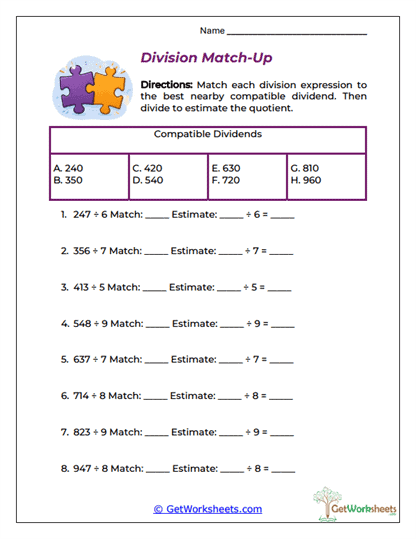
Division Match-Up
Students begin by pairing each difficult dividend with a nearby number that divides evenly by the given divisor. Only after choosing the compatible value do they calculate the estimated quotient. The matching structure makes the choice of replacement number part of the mathematical challenge rather than giving students the easier number in advance. It is particularly useful for strengthening the connection between known multiplication facts and efficient division estimation.
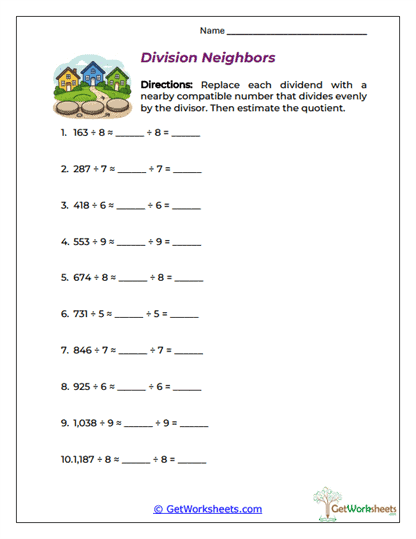
Division Neighbors
This activity centers on the idea that a nearby multiple can make an intimidating division problem much easier to reason through. Students examine the original dividend, search for a close value that works cleanly with the divisor, and use that number to estimate the quotient. Because more than one nearby number may sometimes seem possible, learners must weigh convenience against closeness. The worksheet promotes flexible number sense instead of rigid dependence on one rounding rule.
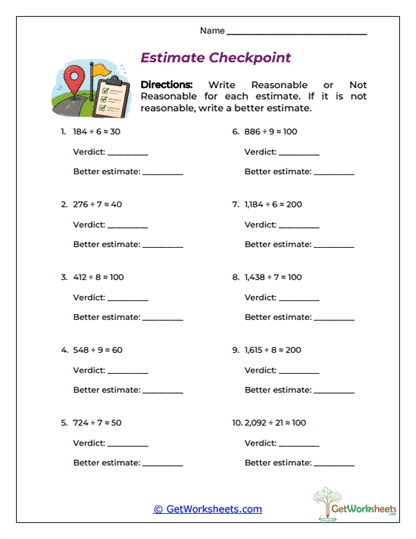
Estimate Checkpoint
Rather than generating every estimate from scratch, students are given proposed quotients and asked to judge whether they are believable. Multiplication can be used in reverse as a quick test: if the estimated quotient times the divisor does not come close to the original dividend, the answer deserves another look. When a result is unreasonable, students replace it with a stronger estimate. This format develops the habit of evaluating answers instead of accepting them simply because they are already written.
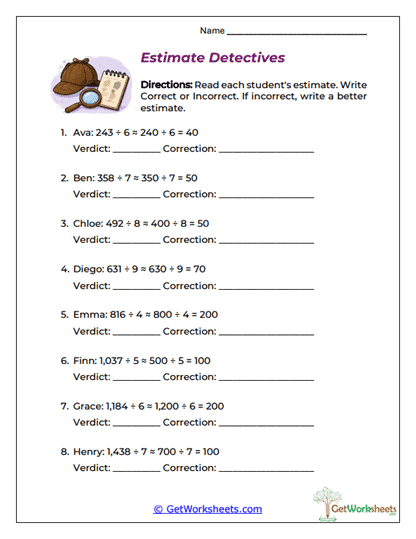
Estimate Detectives
Students investigate completed division estimates as if they were examining mathematical evidence. Each example requires them to consider whether the chosen compatible number is close enough, whether it divides evenly, and whether the quotient itself was calculated correctly. Incorrect work must be repaired, so students trace an error back to its source rather than merely labeling it wrong. The process makes estimation mistakes useful teaching tools and encourages careful self-checking.
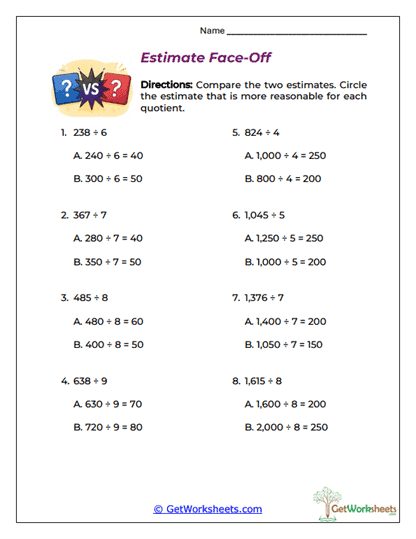
Estimate Face-Off
Two possible estimation strategies compete for the same division problem. Students compare the proposed compatible dividends, consider how far each one sits from the original number, and decide which route gives the stronger approximation. The goal is not simply to find an easy calculation, but to recognize that some easy calculations represent the original problem more faithfully than others. This activity adds an important layer of strategic judgment to quotient estimation.
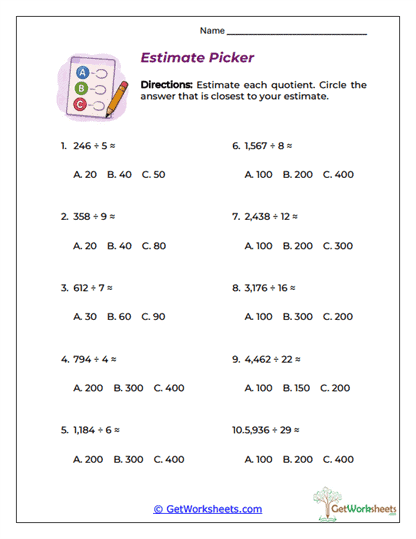
Estimate Picker
Students survey several possible quotients and identify the one that best fits the original division expression. Exact long division is unnecessary; instead, learners draw on compatible numbers, multiplication facts, and their sense of magnitude to narrow the field. Choices that are ten times too large or too small become easier to reject when students understand the general neighborhood of the answer. The worksheet is an effective way to develop quotient sense alongside efficient mental reasoning.
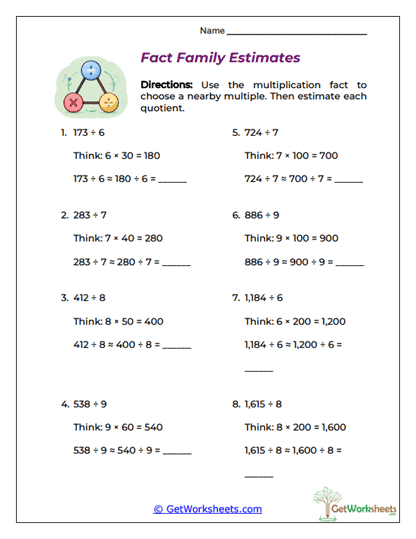
Fact Family Estimates
Familiar multiplication relationships serve as the entry point for estimating larger division problems. Students use a supplied fact to locate a nearby multiple and then reverse that relationship to form an easier division expression. This scaffold makes the inverse relationship between multiplication and division especially visible. It is a strong bridge for students who know their basic facts but are still learning how to use them strategically with larger numbers.
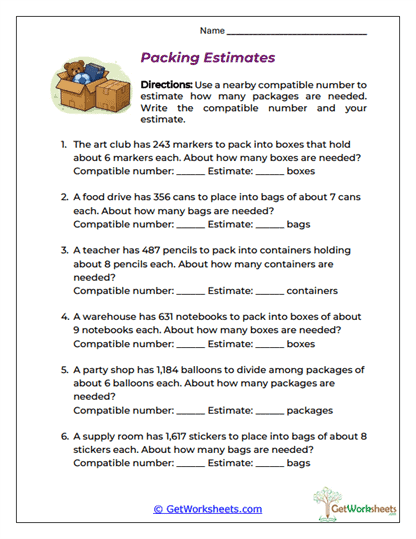
Packing Estimates
Markers, notebooks, cans, balloons, pencils, and other items are organized into equal groups, giving quotient estimation a practical purpose. Students replace awkward totals with nearby compatible numbers and estimate how many containers, packages, or groups will be needed. Because the quotient represents something concrete, learners must interpret their answer instead of treating it as an isolated number. The worksheet blends number sense with real-world grouping situations.
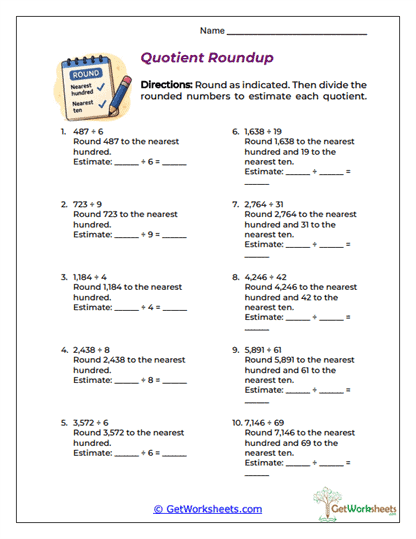
Quotient Roundup
Students simplify division expressions through rounding before attempting to estimate the quotient. Early problems provide a clear place value for rounding, while later examples require more judgment when both the dividend and divisor become larger. This progression helps learners see how place value can make division more manageable without losing sight of the original quantities. The activity develops a structured pathway from basic rounding to broader estimation reasoning.
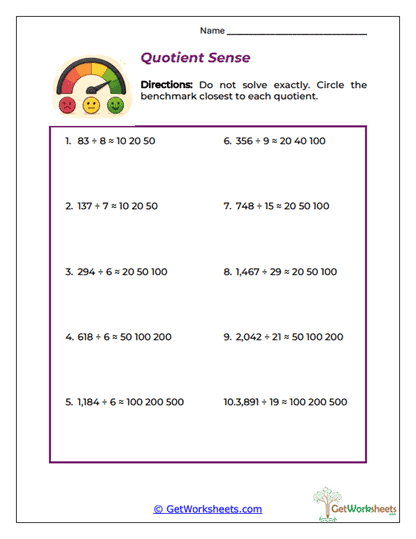
Quotient Sense
Here, the emphasis is not on an exact or even carefully calculated estimate, but on recognizing the general size of a quotient. Students compare each division expression with benchmark answers such as 20, 50, 100, or 200 and decide which value is the closest fit. One useful strategy is to multiply the benchmark by the divisor and see how closely it returns to the dividend. The worksheet builds an internal sense of scale that can later help students catch major division errors quickly.
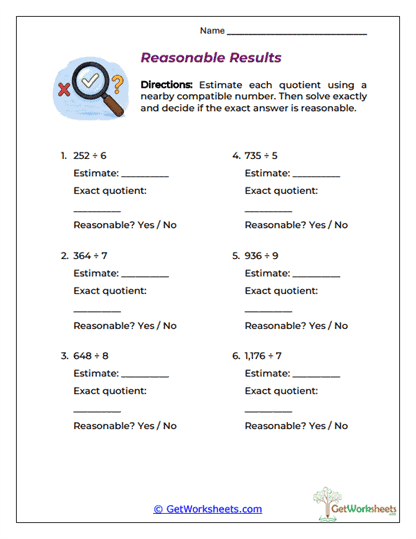
Reasonable Results
Estimation and exact computation are deliberately paired in this activity. Students first select a compatible number and predict the quotient, then solve the original problem exactly and compare the two results. The contrast helps them judge whether the exact answer belongs in the range they expected. Over time, this routine turns estimation into a built-in checking tool rather than a separate skill practiced only during estimation lessons.
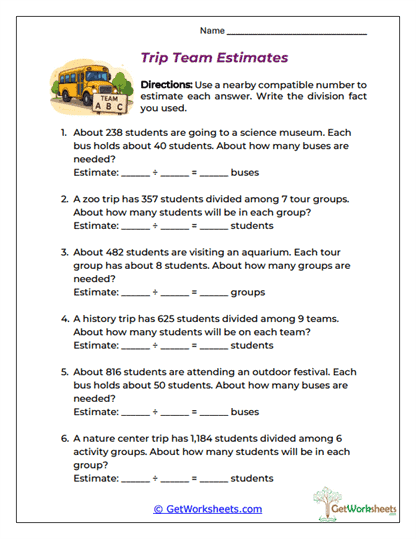
Trip Team Estimates
School-trip situations place division inside decisions about buses, teams, tour groups, and activity groups. Students identify what is being divided, choose a nearby compatible total, estimate the quotient, and record the easier division fact that supports their answer. Because some problems ask for the number of groups while others ask for the number in each group, students must interpret the meaning of the quotient carefully. The activity combines estimation, reading comprehension, equal-group reasoning, and practical planning.
Bookmark Us Now!
New, high-quality worksheets are added every week! Do not miss out!