Estimating Products (Multiplication) Worksheets
About This Worksheet Collection
Estimating products helps students find a reasonable multiplication answer without always calculating the exact result. Learners use rounding, friendly numbers, place value, and mental math to simplify factors before multiplying. These skills strengthen multiplication fluency, number sense, mathematical judgment, and the ability to recognize whether an answer is reasonable.
This collection gives upper elementary students several ways to practice estimating multiplication products. Activities include rounding factors, matching estimates, comparing estimates with exact products, judging product size, choosing friendly factors, evaluating competing strategies, correcting estimation errors, solving word problems, comparing products to benchmarks, choosing useful rounding methods, and estimating shopping costs. The worksheets are especially well suited for grades 4-5 and can be used for classwork, homework, math centers, intervention, review, tutoring, or homeschool instruction.
As students work through the collection, they strengthen rounding, multiplication, place value, mental computation, estimation, and problem-solving skills. They also practice comparing product magnitude, selecting efficient strategies, checking answers for reasonableness, interpreting multiplication situations, and analyzing mathematical errors. These activities help learners become more flexible with larger numbers and more confident using estimation as a practical multiplication tool.
Detailed Descriptions Of These Worksheets
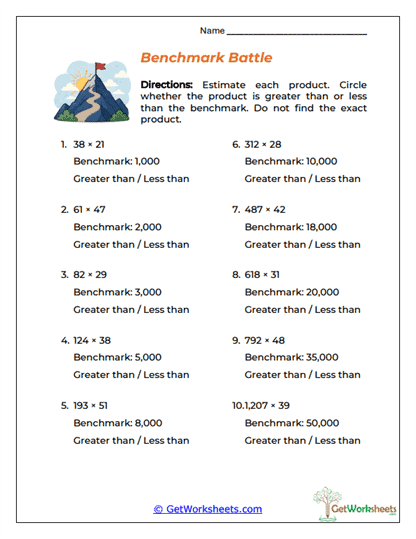
Benchmark Battle
Students estimate multiplication products and compare each approximate result with a given benchmark. Rather than calculating exact answers, they decide whether the product should be greater than or less than the target number. The activity strengthens product magnitude, place value, comparison, and mental estimation. It helps learners make quick mathematical judgments about the size of an answer.
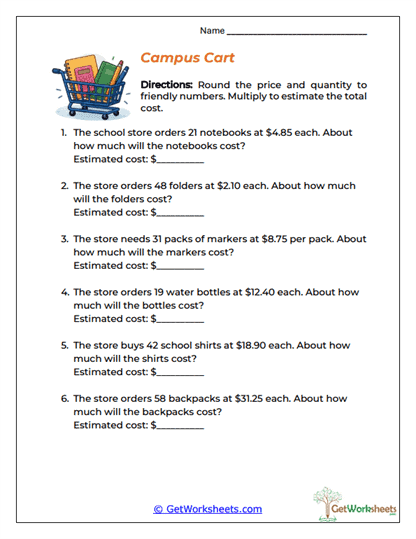
Campus Cart
School-store shopping situations ask students to estimate the total cost of buying several identical items. Learners adjust prices and quantities to friendly numbers and multiply those values to predict an approximate cost. The real-world context connects multiplication estimation with money and budgeting. This activity strengthens practical number sense and mental multiplication.
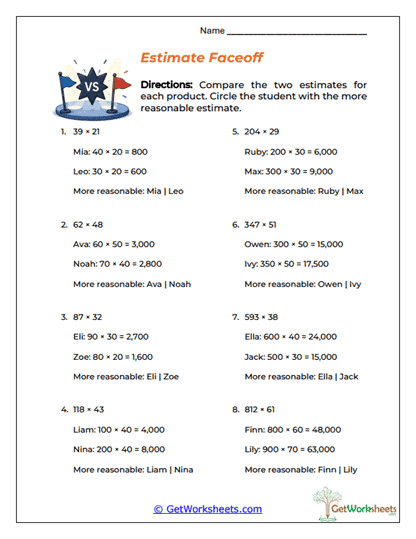
Estimate Faceoff
Two different estimation strategies are presented for the same multiplication problem. Students compare the rounded factors and decide which approach produces the more reasonable estimate. The activity encourages learners to think about how close the rounded values remain to the original numbers. It develops stronger reasoning about the quality of an estimate rather than simply whether rounding was performed.
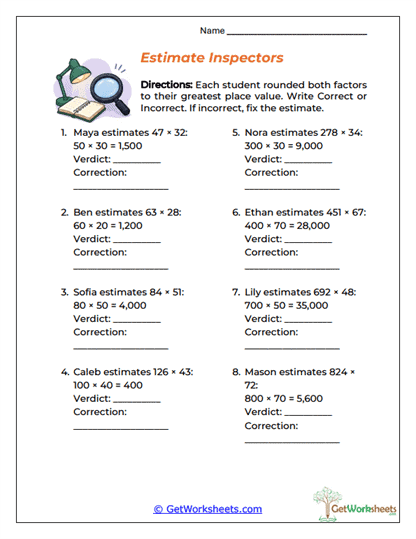
Estimate Inspectors
Students review another person's multiplication estimates and determine whether the work is correct. They check the rounding of each factor, verify the multiplication, and correct any mistakes. The error-analysis format encourages careful attention to both place value and computation. This activity strengthens self-checking and mathematical explanation.
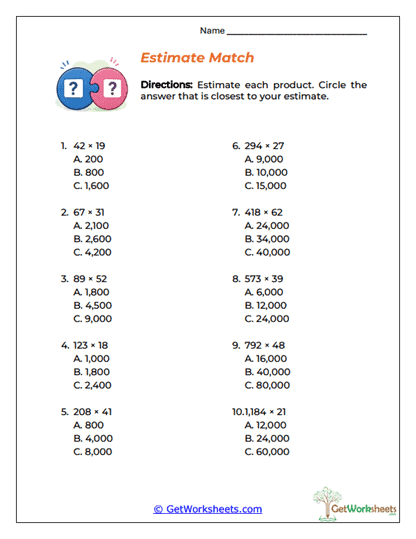
Estimate Match
Students estimate products and choose the answer that is closest to a reasonable result. Multiple-choice options may differ greatly in size, requiring learners to think about whether a product belongs in the hundreds, thousands, or larger ranges. The activity reinforces rounding, multiplication, comparison, and magnitude. It also helps students reject answers that are clearly too large or too small.
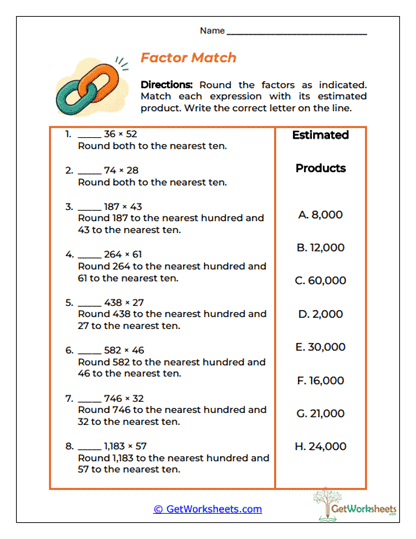
Factor Match
Students round factors according to the directions, multiply the simplified numbers, and match the estimated product with an answer bank. Different problems require rounding to tens or hundreds, so learners must read each direction carefully. The multi-step format connects place value, multiplication, estimation, and answer checking. It also provides natural feedback when a result does not appear among the choices.
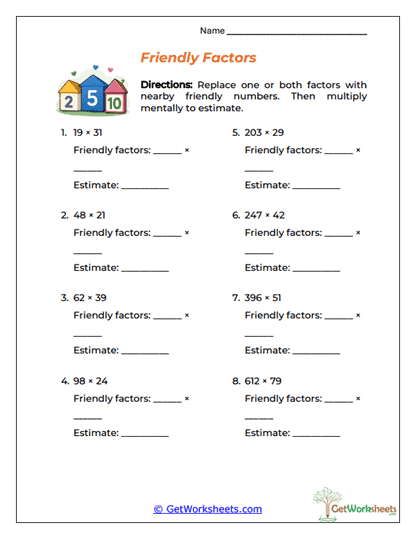
Friendly Factors
Students replace difficult factors with nearby numbers that are easier to multiply mentally. Instead of following one fixed rounding rule, learners make their own reasonable choices about compatible numbers. This encourages flexible thinking and shows that different estimation strategies can still produce useful answers. The worksheet strengthens mental multiplication, approximation, and independent strategy selection.
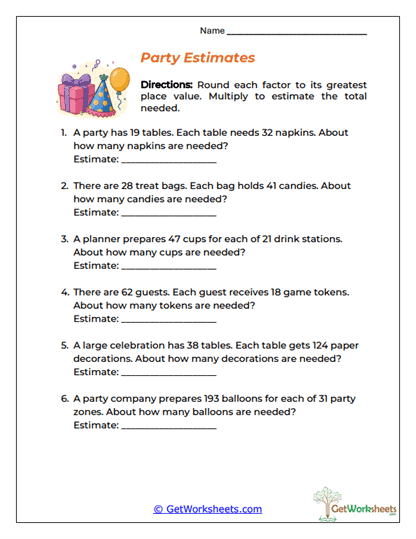
Party Estimates
Party-planning word problems ask students to estimate quantities for tables, treats, decorations, supplies, and other repeated groups. Learners identify the multiplication situation, round the factors, and calculate an approximate total. The activity connects estimation with reading comprehension and real-world planning. It also reinforces why multiplication is useful when the same amount is repeated many times.
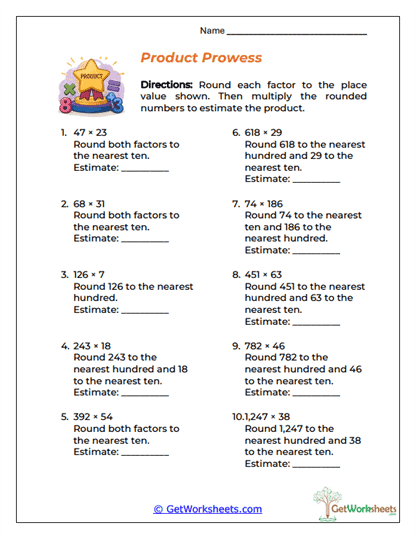
Product Prowess
Students estimate multiplication products by rounding one or both factors before multiplying. Problems progress from smaller values to larger numbers and may require different rounding places for each factor. The repeated routine helps learners see how rounding makes large products easier to manage mentally. This worksheet provides a strong foundation for product estimation and reasonableness checking.
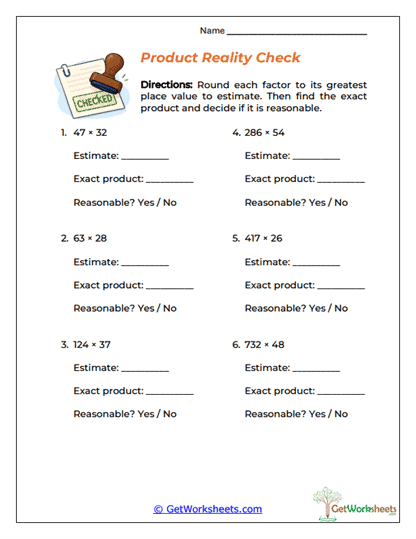
Product Reality Check
Students first estimate a product and then calculate the exact multiplication answer. Comparing the two values helps them decide whether the exact result is believable. The activity demonstrates how estimation can be used as a checking strategy rather than only as a shortcut. It strengthens multiplication accuracy, number sense, and independent self-checking.
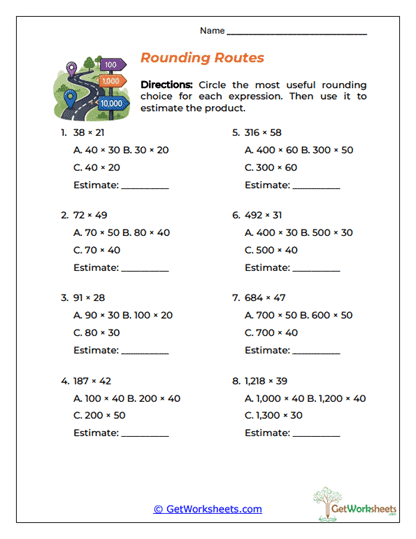
Rounding Routes
Students choose the most useful rounded factors from several options before finding an estimated product. They must balance two goals: keeping the numbers easy to multiply while staying reasonably close to the original factors. The activity makes strategy selection part of the mathematical work. It helps learners become more thoughtful and flexible when estimating products.
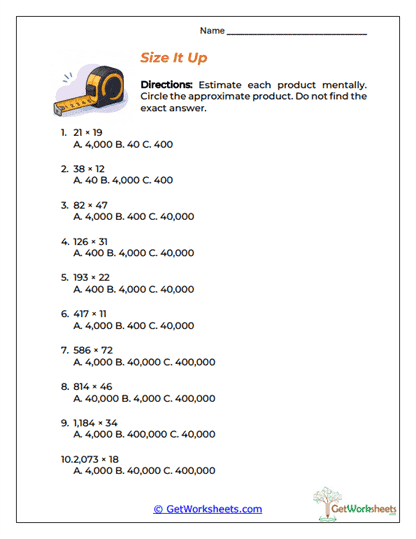
Size It Up
Students focus on the approximate magnitude of multiplication answers rather than exact products. They choose among values that may differ by powers of ten, such as hundreds, thousands, or tens of thousands. This requires careful attention to place value and the general size of the factors. The activity builds strong product sense and helps prevent common place-value mistakes.
Bookmark Us Now!
New, high-quality worksheets are added every week! Do not miss out!