Estimation Word Problems Worksheets
About This Worksheet Collection
Estimation word problems ask students to do something more demanding than round numbers correctly: they must first understand the situation, decide what operation belongs, and then choose an estimation approach that makes sense for the quantities involved. That means reading comprehension, operation sense, number magnitude, and strategy selection all matter before any arithmetic begins. The result is a richer kind of practice that helps students see estimation as a tool for thinking through real decisions rather than as a separate rounding exercise.
This collection deliberately varies the type of reasoning students must use. Some problems involve combining or comparing amounts, while others require multiplication, division, budgeting, grouping, supply planning, or deciding whether a quantity is sufficient. Students also encounter compatible numbers, benchmark thinking, rounding choices, error analysis, exact-answer checks, and strategy comparisons. For grades 4-5 learners, that range provides valuable practice moving between operations and choosing methods based on context rather than waiting for the worksheet to announce the procedure.
Across the collection, students become more comfortable asking the questions strong problem solvers ask naturally: What is happening here? What kind of answer should I expect? Which numbers can I simplify without losing the meaning of the problem? Does my result fit the situation? Those habits strengthen mental computation, estimation fluency, mathematical judgment, and independence while preparing learners for increasingly complex multi-step problems.
Detailed Descriptions Of These Worksheets
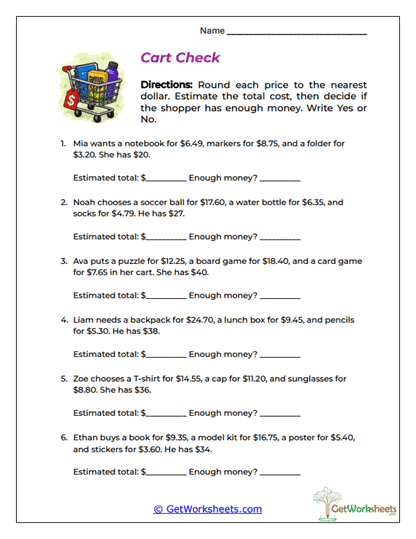
Cart Check
Students estimate the cost of several items and compare that approximate total with the amount of money available. Prices are rounded to convenient whole-dollar values, allowing learners to focus on whether the shopper is likely to stay within budget rather than calculate every cent. The task turns estimation into a financial decision with an immediate purpose. It also builds early budgeting sense by connecting approximate totals with spending limits.
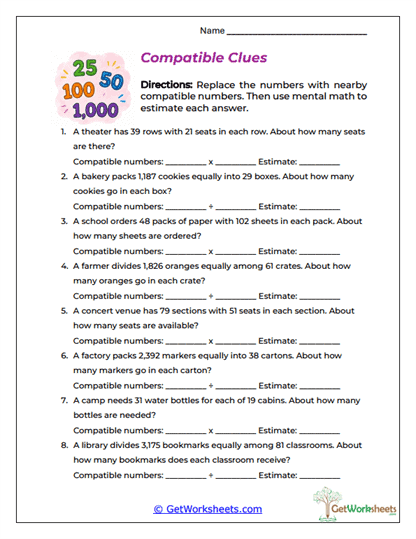
Compatible Clues
Awkward multiplication and division problems are reshaped with compatible numbers that work cleanly with known facts. Students must notice which nearby values make the arithmetic easier while still representing the original situation reasonably well. Because multiplication and division appear together, the activity encourages learners to think about factors, multiples, and inverse relationships rather than rely on one fixed procedure. It is especially useful for developing flexible mental computation with larger numbers.
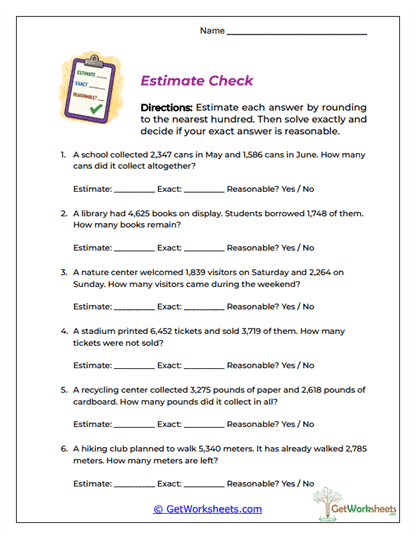
Estimate Check
Students establish an expected answer before solving a word problem exactly. After rounding and estimating, they complete the original addition or subtraction and compare the two results. This creates a built-in reasonableness test that can expose regrouping errors, misplaced digits, or even an incorrect operation choice. The worksheet reinforces the idea that exact calculation should be checked against numerical expectations, not accepted automatically.
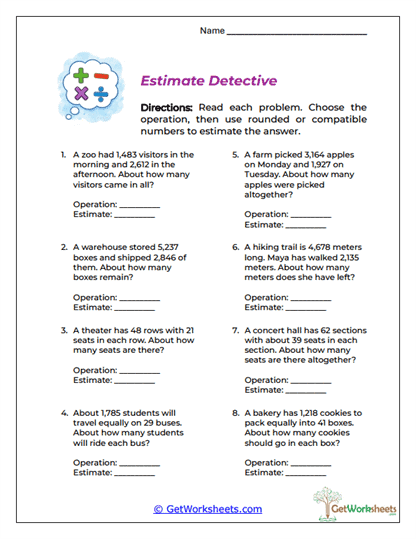
Estimate Detective
Mixed-operation situations require students to determine what the story is actually asking before they choose an estimation method. Addition, subtraction, multiplication, and division all appear, so learners must interpret clues about combining, removing, repeating, or sharing quantities. Only after identifying the operation do they select rounded or compatible values that make the calculation manageable. This makes the worksheet a strong exercise in operation sense as well as estimation.
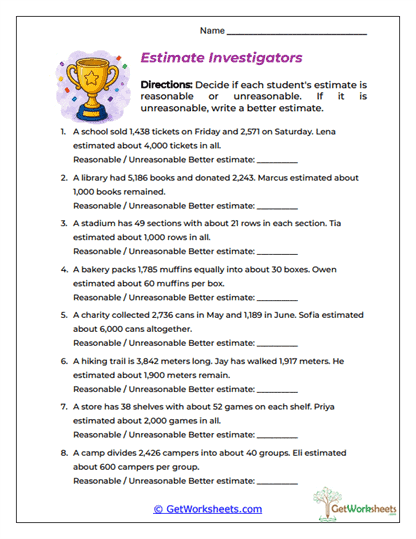
Estimate Investigators
Students critique proposed estimates rather than generate every answer from scratch. Each scenario must be understood, the likely operation identified, and the completed estimate judged for both mathematical and contextual reasonableness. When a solution falls short, learners repair it with a better approximation. The activity turns errors into evidence and encourages students to explain why an estimate does or does not fit.
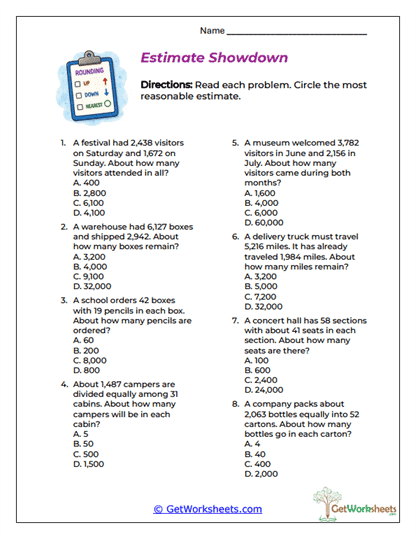
Estimate Showdown
Several possible estimates compete for each mixed-operation word problem. Students first determine what operation the situation requires and then use rounding, compatible numbers, or magnitude reasoning to decide which answer belongs in the right range. The format rewards efficient thinking because obviously weak choices can often be eliminated without exact computation. It gives learners practice making quick but defensible judgments across all four operations.
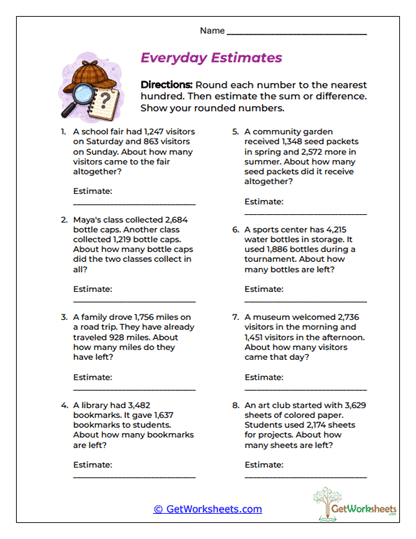
Everyday Estimates
Students work with familiar situations involving travel, collections, attendance, supplies, and inventories. Each problem requires them to decide whether quantities should be combined or compared before rounding to the nearest hundred and estimating the result. The consistent rounding structure keeps the arithmetic accessible while leaving the interpretation work to the student. This makes it a useful bridge between basic estimation lessons and more independent word-problem reasoning.
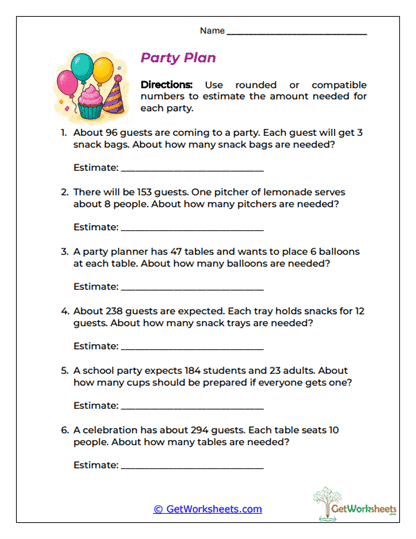
Party Plan
Event-planning scenarios give estimated answers a clear job to do. Students determine about how many snack bags, cups, tables, balloons, or other supplies may be needed, selecting multiplication, division, or addition depending on the structure of the situation. Rounded and compatible numbers help make the calculations manageable without stripping away the real-world meaning. The activity shows how estimation can support planning before exact counts are available.
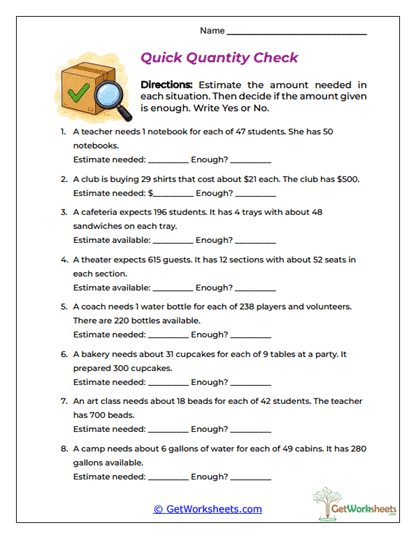
Quick Quantity Check
Students estimate how much is needed and then compare that amount with the supply already available. Instead of stopping at an approximate product, they must use the estimate to make a practical Yes-or-No decision. This makes comparison an essential final step in the reasoning process. The worksheet is especially effective for showing why estimation matters in planning situations where knowing whether something is sufficient can be more useful than knowing an exact total.
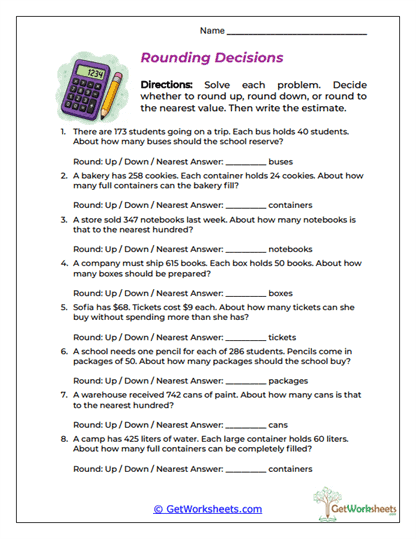
Rounding Decisions
Context determines the rounding direction in this activity. Students must decide whether a situation calls for rounding up, rounding down, or rounding to the nearest value, particularly when division produces partial groups or leftovers. A bus problem, for example, may require one more whole bus even when the numerical quotient is only slightly above four. The worksheet develops the important idea that a mathematically calculated value still has to be interpreted in light of what the answer represents.
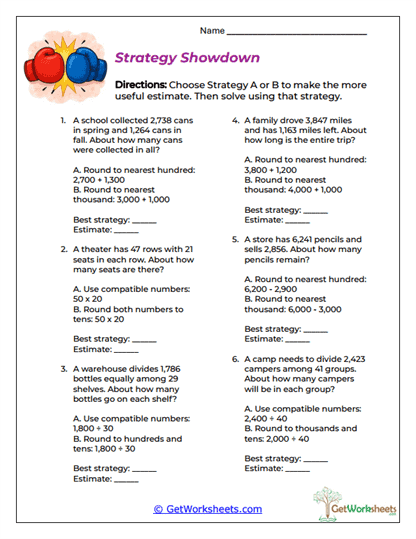
Strategy Showdown
Students compare two possible estimation methods before choosing the one that best suits the problem. Depending on the numbers and operation, rounding to a place value may be useful in one situation while compatible numbers may be far more efficient in another. The activity makes strategy selection visible and deliberate rather than automatic. It is a strong higher-level review for learners who are ready to treat estimation as a flexible toolbox instead of a single procedure.
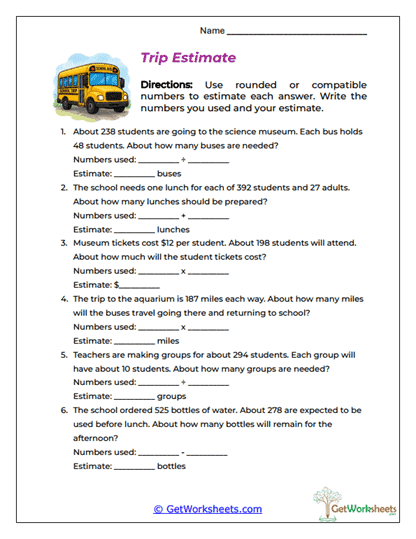
Trip Estimate
Field-trip planning creates a natural setting for mixed estimation. Problems involving buses, food, ticket costs, distances, groups, and supplies require students to identify the operation, simplify the numbers, and record the strategy they used. Because the situations vary widely, learners cannot depend on one repeated pattern from question to question. The worksheet develops adaptability and helps students connect approximate answers with real planning decisions.
Bookmark Us Now!
New, high-quality worksheets are added every week! Do not miss out!