Estimating Sums (Addition) Worksheets
About This Worksheet Collection
Estimating sums gives students a way to predict the size of an addition answer before they work out every digit. Instead of treating estimation as a stripped-down version of exact addition, these worksheets encourage learners to think about place value, useful approximations, number size, and how much precision a situation really needs. That kind of reasoning helps students become more comfortable with large numbers while also giving them a practical method for spotting answers that do not belong anywhere near the expected range.
The collection approaches estimated addition from several directions rather than repeating one rounding routine. Students round to stated places, choose their own level of precision, use front-end estimation, replace awkward addends with friendlier values, compare totals with benchmarks, investigate flawed reasoning, and apply estimation to shopping and attendance situations. Matching, multiple-choice, verification, and word-problem formats give grades 4-5 learners different reasons to think about approximate sums instead of simply filling a page with nearly identical calculations.
Throughout these activities, students develop a stronger sense of magnitude and a more deliberate approach to computation. They learn to anticipate totals, defend an estimation choice, distinguish a useful approximation from a poor one, and use an estimate as a check on exact arithmetic. The result is practice that supports addition and rounding while also building the broader habits of flexibility, judgment, and numerical awareness that students need as mathematics becomes more complex.
Detailed Descriptions Of These Worksheets
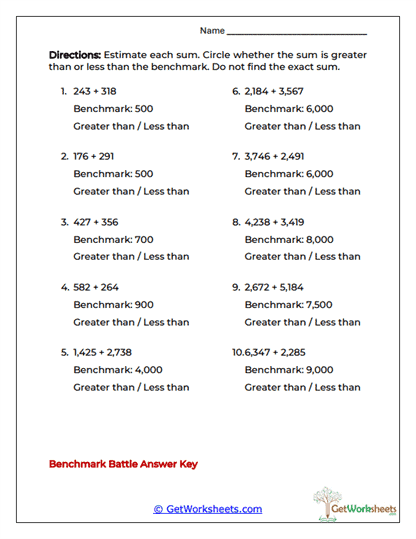
Benchmark Battle
Students estimate each addition expression and decide whether the approximate total lies above or below a given benchmark. The target values create a reason to think about magnitude rather than carry out exact addition unnecessarily. Learners can simplify the addends mentally, form a quick expectation, and then use that expectation to make the comparison. This develops an efficient style of numerical reasoning that is especially useful when only a general range matters.
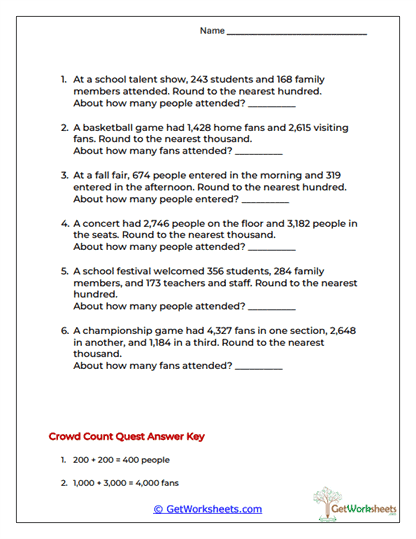
Crowd Count Quest
Attendance figures from fairs, games, concerts, and other events become the basis for estimating combined crowds. Students round each group according to the stated place value and then join the approximations to find an overall attendance estimate. Working with hundreds and thousands helps large quantities feel more manageable and meaningful. The word-problem setting also reinforces the idea that "altogether" signals a combination of groups rather than an isolated calculation.
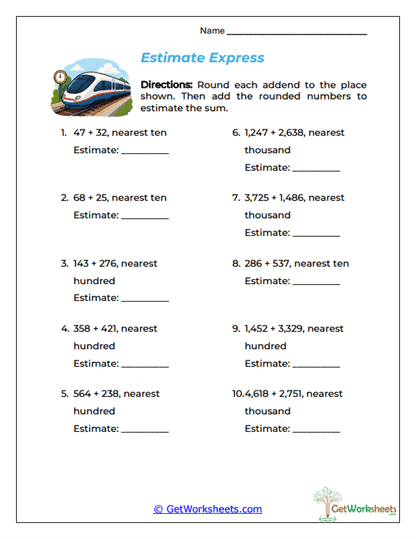
Estimate Express
This activity establishes a dependable estimation routine by having students round each addend to a named place before adding. The number sizes grow from two-digit values into the thousands, so the same underlying strategy must be adapted across changing place values. Because the rounding direction is supplied, students can concentrate on understanding how simplified numbers produce a useful approximate total. The worksheet works well as an early step before students are asked to choose estimation strategies independently.
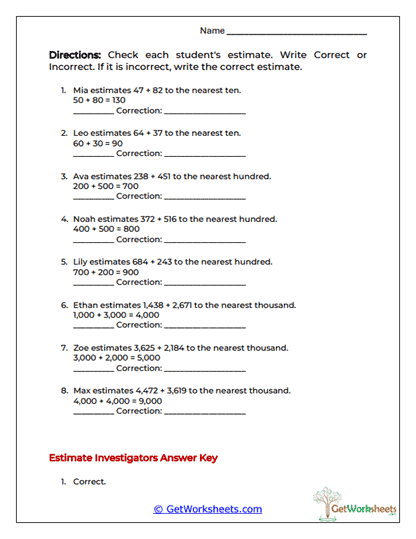
Estimate Investigators
Students examine another learner's work and determine whether the estimated sum was produced correctly. Each case requires them to inspect the rounding separately from the addition so they can identify exactly where the reasoning went off course. When an estimate is wrong, they replace it with a corrected one rather than simply marking the response incorrect. This makes error analysis a vehicle for deeper understanding instead of treating mistakes as something to skip over.
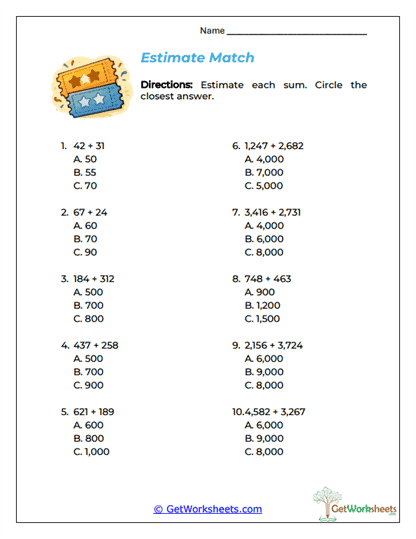
Estimate Match
Several possible totals are offered for each addition problem, and students decide which one best represents a sensible estimate. The activity shifts attention away from exact arithmetic and toward the general size of the sum. As the numbers become larger, learners must rely increasingly on place-value awareness and mental simplification to eliminate choices that are far too high or low. This format is especially effective for building confidence in judging what an answer should roughly look like.
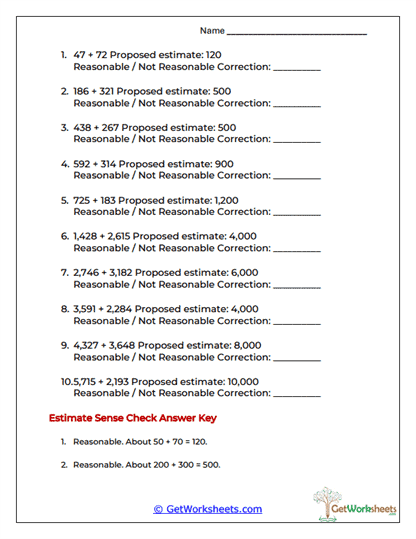
Estimate Sense Check
Proposed addition estimates are placed under scrutiny so students can decide whether each one is reasonable. Learners mentally approximate the original addends, compare that expectation with the stated result, and replace poor estimates with stronger alternatives. The emphasis is on mathematical trustworthiness rather than on following one prescribed procedure. Over time, this kind of checking can help students develop the instinct to question totals that do not fit the numbers involved.
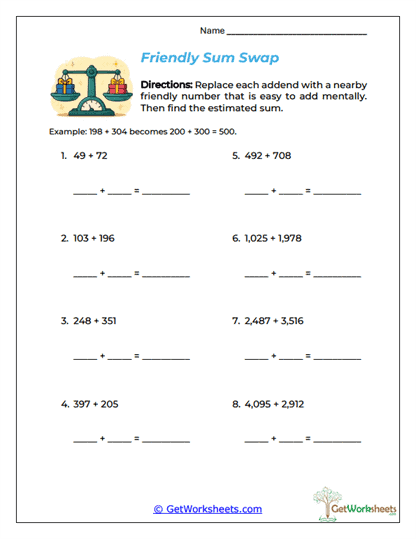
Friendly Sum Swap
Students reshape difficult addends into nearby values that are more convenient to combine mentally. Since there is no single required rounding place, learners have room to select friendly hundreds, thousands, or other useful numbers that keep the estimate manageable. Different students may choose slightly different approximations and still arrive at defensible results. That openness makes the worksheet particularly useful for developing flexibility and showing that estimation can involve thoughtful choice.
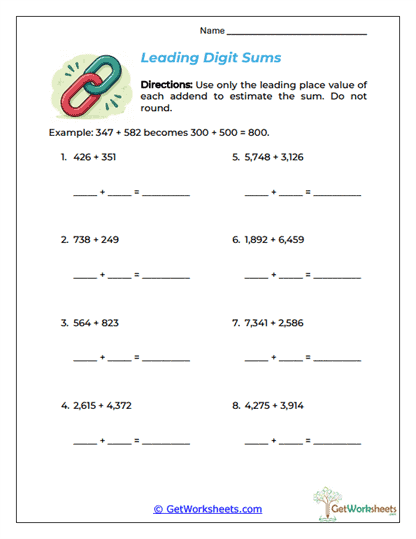
Leading Digit Sums
Front-end estimation takes center stage as students focus on the greatest place-value portion of each addend. Instead of conventional rounding, they preserve the leading value and temporarily set aside the smaller digits to form a quick rough total. This gives learners another way to simplify large-number addition and highlights the influence of the highest place value on overall magnitude. The strategy is especially helpful for fast mental estimates when a close approximation is less important than a quick sense of scale.
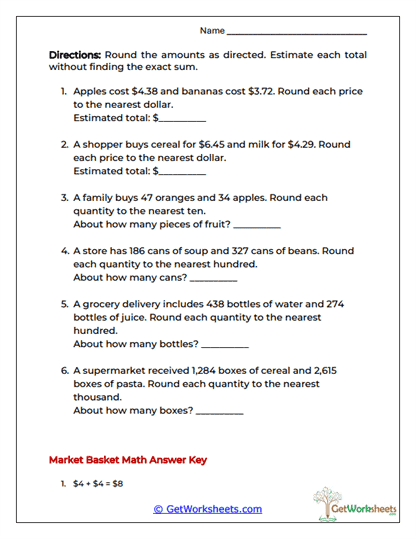
Market Basket Math
Grocery prices, store quantities, and inventory counts provide a familiar setting for estimating totals. Students interpret what needs to be combined, simplify the numbers according to the directions, and produce an approximate shopping or quantity total. The problems make estimation feel like a planning tool rather than a classroom-only exercise. They also strengthen the connection among reading comprehension, money sense, place value, and addition.
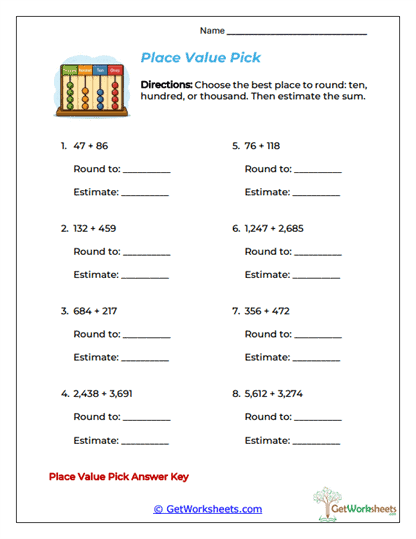
Place Value Pick
Here, students must decide how much rounding is appropriate before they estimate. They examine the size of the addends, choose whether tens, hundreds, or thousands make the most sense, and then use that decision to produce a manageable total. The mathematical work begins before the calculation because learners must think about precision and efficiency. This is an important step toward independent strategy selection rather than waiting for every method to be supplied.
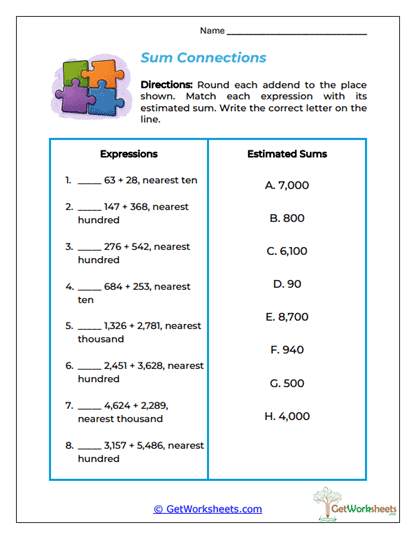
Sum Connections
Students move through a sequence of rounding, mental addition, and matching as they connect each problem with its estimated total. Because different items call for different place values, careful reading becomes part of the mathematical task. The answer bank provides a built-in checkpoint: a result that does not appear among the choices is a cue to revisit the earlier reasoning. The format gives multi-step estimation a puzzle-like structure while still demanding accurate place-value thinking.
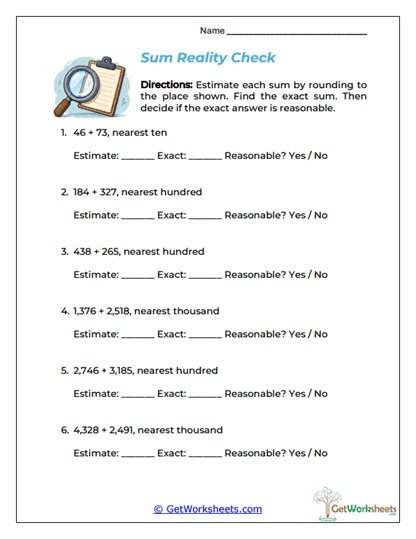
Sum Reality Check
Approximate and exact addition are intentionally placed side by side so students can see how the two support one another. Learners estimate first, calculate the original sum, and then compare the results to decide whether the exact answer is believable. That sequence teaches estimation as a verification tool rather than as an isolated chapter skill. It also encourages students to take greater ownership of checking their own multi-digit addition.
Bookmark Us Now!
New, high-quality worksheets are added every week! Do not miss out!