Front-End Estimation Worksheets
About This Worksheet Collection
Front-end estimation teaches students to look at the most influential part of a number first. By focusing on the leading place value and temporarily setting aside smaller digits, learners can form a quick picture of size without completing an exact calculation. That approach strengthens place-value understanding while showing students that estimation can be both fast and purposeful.
The worksheets in this collection move well beyond simple "keep the first digit" practice. Students estimate sums and differences, solve missing-value puzzles, compare rough estimates with exact answers, use front-end values with money and crowds, inspect incorrect work, compare front-end estimation with traditional rounding, and refine rough estimates with adjustments. This variety helps grades 4-5 students see the strategy from several perspectives instead of treating it as one repeated procedure.
As learners progress, they begin to understand front-end estimation as a flexible numerical tool rather than a shortcut with no deeper purpose. They practice recognizing magnitude, anticipating answers, checking exact work, judging estimation quality, and deciding when a quick approximation is enough or when a closer estimate would be more useful. Those habits support stronger mental math, more confident work with large numbers, and a deeper awareness of how place value controls the structure of a number.
Detailed Descriptions Of These Worksheets
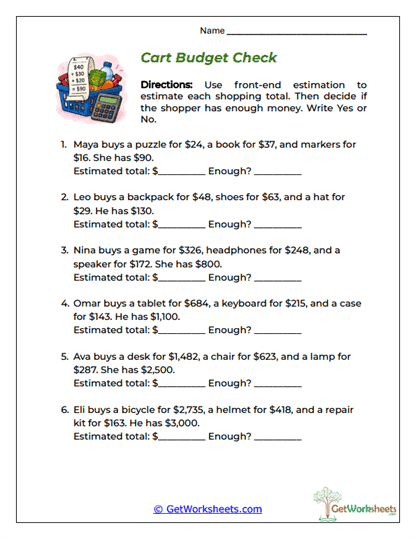
Cart Budget Check
Students use front-end values to form quick shopping totals and decide whether a given budget is likely to cover the purchase. Because several prices must be combined, the activity asks learners to keep track of magnitude across multiple items instead of estimating one number at a time. The budget comparison gives the approximation an immediate purpose. It also introduces a practical connection between place value, spending, and financial decision-making.
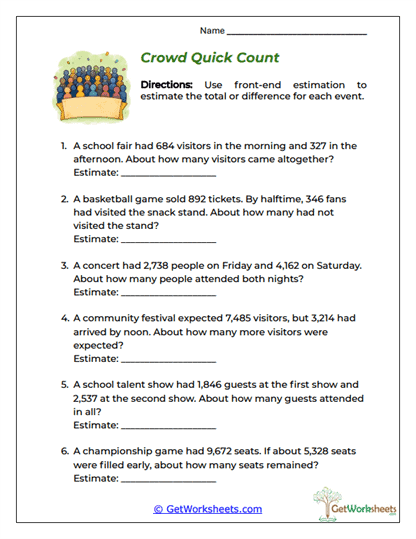
Crowd Quick Count
Large attendance figures become easier to manage when students strip each number down to its leading place value. Depending on the story, learners either combine crowds or compare them to estimate totals and differences. The event-based context makes front-end estimation feel especially natural because exact headcounts are not always necessary for a useful first impression. Students also strengthen their ability to read for whether addition or subtraction is required.
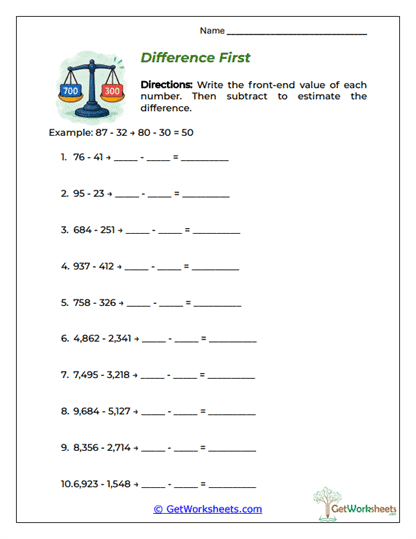
Difference First
Students estimate subtraction problems by preserving the front portion of each number and setting aside the remaining digits. This lets them focus on the broad distance between two quantities before dealing with exact regrouping. Problems gradually increase in size, helping learners transfer the same reasoning from tens to hundreds and thousands. The activity is especially useful for building an expected range against which an exact difference can later be checked.
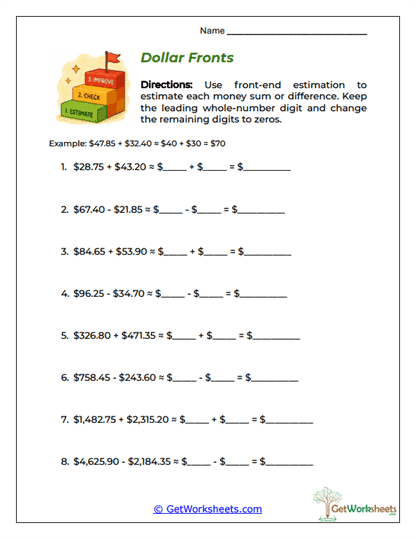
Dollar Fronts
Money problems give front-end estimation a familiar and practical setting. Students simplify prices and dollar amounts to their leading values, then use those approximations to estimate totals or differences. Working with amounts that range from small purchases to values in the thousands strengthens both place-value fluency and financial number sense. The worksheet reinforces the idea that a fast money estimate can be useful even when exact cents or dollars will eventually matter.
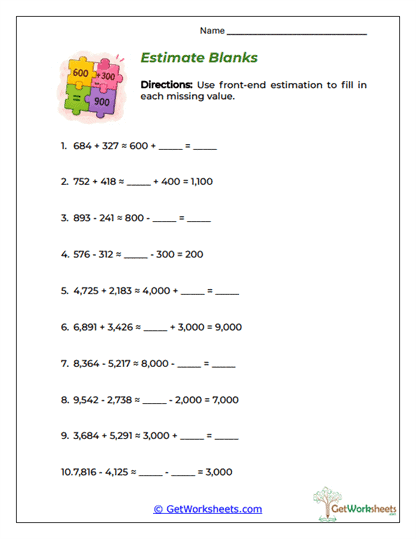
Estimate Blanks
Partially completed equations turn front-end estimation into a missing-number challenge. Students must infer which simplified value belongs in a blank, then use that information to complete an estimated sum or difference. Because the structure is incomplete, learners cannot rely on copying a routine from left to right. The activity encourages backward reasoning and helps reveal whether students truly understand how front-end values are formed.
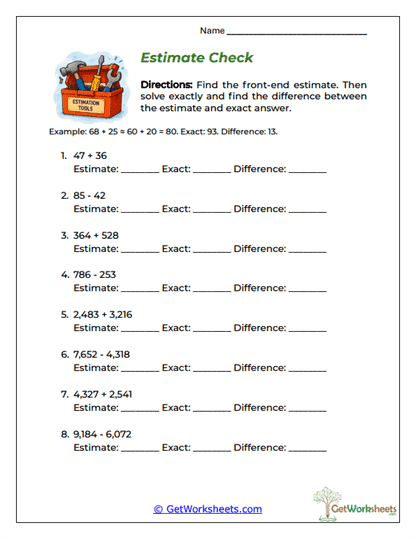
Estimate Check
Students place an approximation beside an exact answer and then measure how far apart the two results are. This makes estimation accuracy visible rather than leaving "close enough" as a vague idea. Addition and subtraction appear together, requiring students to stay aware of both the operation and the place-value structure of the numbers. The worksheet helps learners see front-end estimation as a useful prediction tool while also recognizing its limitations.
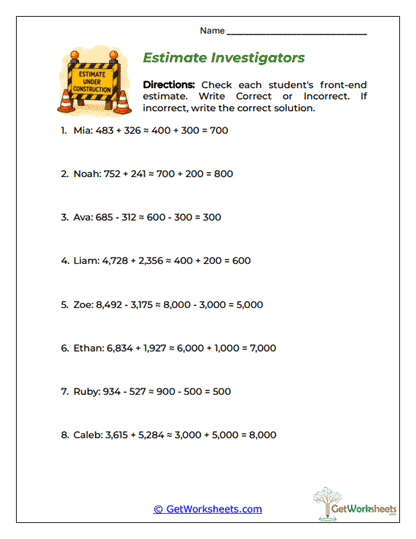
Estimate Investigators
Completed front-end estimates are treated as evidence to inspect. Students verify the leading values, check the operation, and repair any work that does not hold together mathematically. Because they must diagnose the source of an error, they practice more than simple correction. This format develops careful place-value reasoning and gives students experience challenging an answer when the underlying logic is weak.
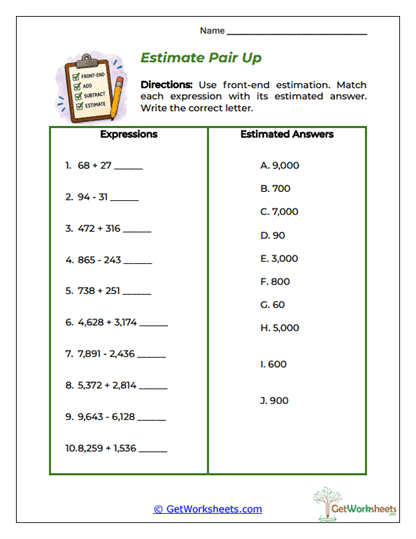
Estimate Pair Up
Students simplify addition and subtraction expressions to their front-end values and then match each one with the correct approximate result. The answer bank gives the activity a puzzle-like rhythm while also creating a natural checkpoint for mistakes. If a result does not appear, students have a reason to reconsider their place-value choices or arithmetic. The mix of operations prevents the page from becoming mechanical.
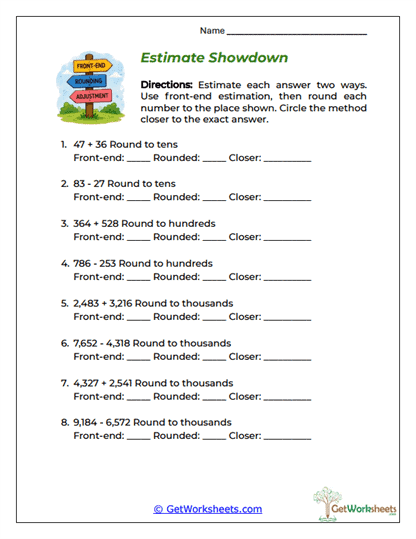
Estimate Showdown
Front-end estimation and traditional rounding are applied to the same problems so students can compare the results directly. The purpose is not to declare one method universally better, but to notice how the two strategies preserve different amounts of information from the original numbers. Learners consider which estimate lands closer to the exact answer and why. This makes strategy comparison an explicit part of the mathematics and encourages a more mature view of approximation.
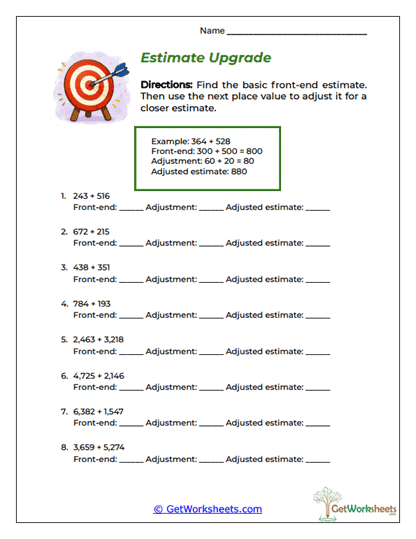
Estimate Upgrade
Students begin with a rough front-end estimate and then deliberately improve it. After keeping the leading place values, they return to the next important place and use that information to create an adjustment. The revised estimate is usually closer to the exact total while still avoiding full computation. This activity shows that estimation can be layered and refined depending on how much accuracy a situation requires.
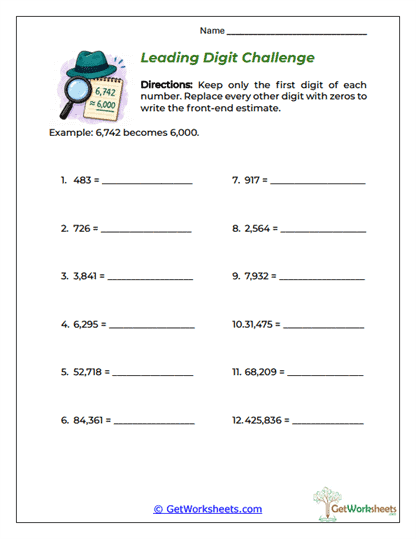
Leading Digit Challenge
This worksheet isolates the core idea of front-end estimation before operations are introduced. Students identify the leading digit, preserve its full place-value amount, and replace the remaining digits with zeros. As the numbers grow from three digits to much larger values, learners see how the same principle applies across different magnitudes. The activity builds the place-value foundation needed for every later front-end strategy.
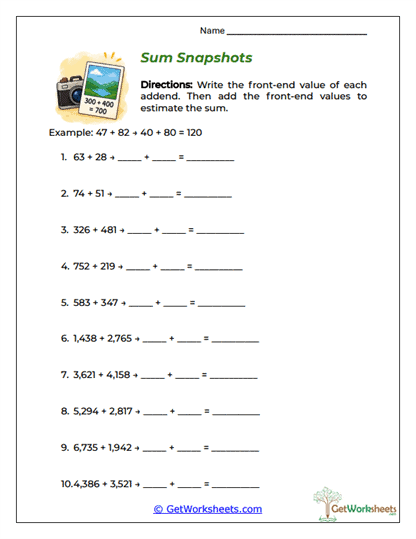
Sum Snapshots
Students use leading place values to create quick estimates of addition problems. Each pair of addends is reduced to its largest place-value contribution, producing totals that can be combined mentally with very little effort. The "snapshot" nature of the method helps learners focus on the overall scale of the sum rather than its exact detail. This worksheet is especially helpful for building confidence with larger-number addition and for developing a first-check strategy before exact computation.
Bookmark Us Now!
New, high-quality worksheets are added every week! Do not miss out!