Estimation in Measurement Worksheets
About This Worksheet Collection
Estimation in measurement asks students to do more than recognize units or read a ruler. It challenges them to form a sensible expectation before measuring, compare that expectation with reality, and decide whether a number truly fits the object or situation being described. By working with length, mass, capacity, and time, students gradually build an internal sense of scale that makes formal measurement far more meaningful.
The activities in this collection approach measurement judgment from many directions. Students estimate and then measure, choose suitable units, compare realistic and unrealistic values, match everyday objects with benchmarks, sort items by size, reason about weight and capacity, evaluate time durations, and correct measurements that clearly do not make sense. This variety gives grades 2-5 learners repeated opportunities to connect numerical measurements with things they can actually picture, hold, carry, pour, or experience.
As students progress through the collection, they develop more than procedural measurement skills. They learn to use familiar objects as reference points, distinguish between metric and customary units, recognize when an estimate is wildly out of scale, and explain why one measurement is more believable than another. Those habits create stronger measurement intuition and prepare students for later work with conversions, precision, elapsed time, multi-step problems, and real-world quantitative reasoning.
Detailed Descriptions Of These Worksheets
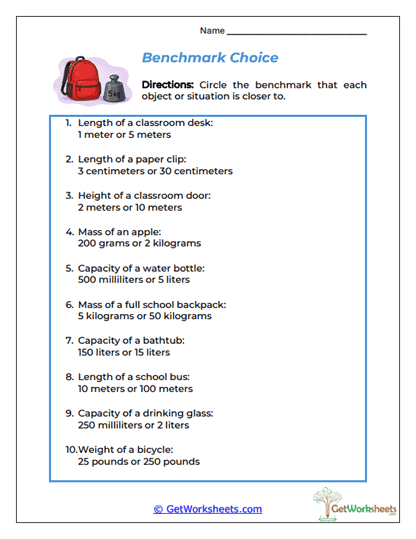
Benchmark Choice
Students compare two possible benchmark measurements and decide which one is closer to what they would expect for a familiar object. The limited choices keep the emphasis on judgment rather than calculation, making students think carefully about both unit size and numerical magnitude. Objects such as desks, bicycles, water bottles, and backpacks become useful mental anchors for future estimates. Over time, this kind of comparison helps students build an internal sense of what different measurements should feel like.
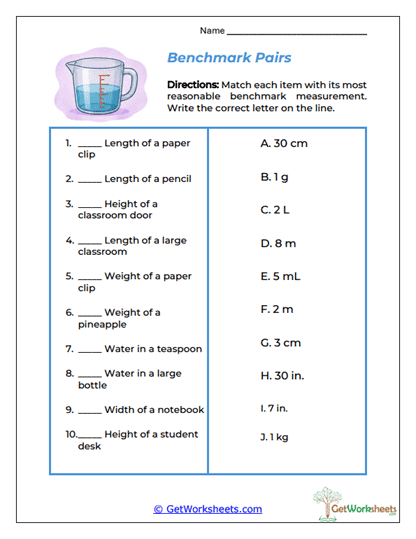
Benchmark Pairs
Everyday objects are matched with measurements that fit their likely length, mass, or capacity. Instead of treating units as isolated vocabulary, students connect centimeters, meters, grams, kilograms, milliliters, and liters with things they already know. The matching structure encourages comparison across several possibilities before a choice is made. This helps transform measurement benchmarks into memorable real-world reference points.
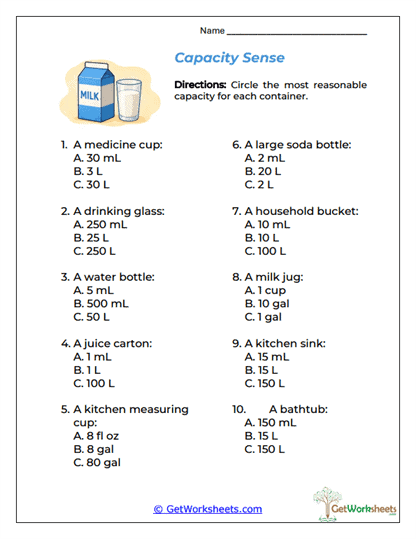
Capacity Sense
Students judge how much liquid familiar containers could reasonably hold. Medicine cups, bottles, pitchers, sinks, and bathtubs prompt them to think about whether milliliters, liters, fluid ounces, or gallons make sense for the situation. No conversion formula is necessary because the task centers on scale and plausibility. The activity develops a more intuitive understanding of capacity by tying abstract units to recognizable containers.
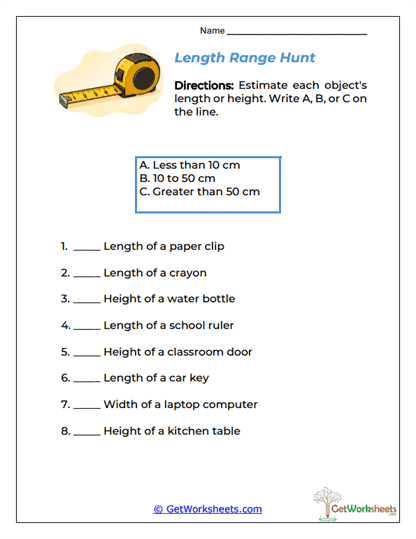
Length Range Hunt
Rather than guessing an exact measurement, students place common objects into broad centimeter ranges. A paper clip, ruler, laptop, door, and other items must be considered in relation to boundaries such as less than 10 centimeters or more than 50 centimeters. This reduces the pressure of precision and lets learners concentrate on relative size. It is a useful bridge between informal comparison and exact ruler measurement.
Measure Match
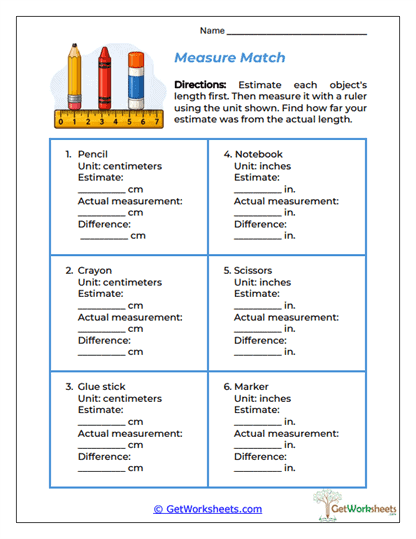
Students predict the length of familiar school objects before checking their ideas with a ruler. After measuring in inches or centimeters, they compare the estimate with the actual value and determine how far apart the two are. That cycle of prediction, measurement, and reflection gives immediate feedback on the quality of their judgment. The worksheet turns ordinary ruler practice into a small investigation of accuracy and estimation.
Measure Mysteries
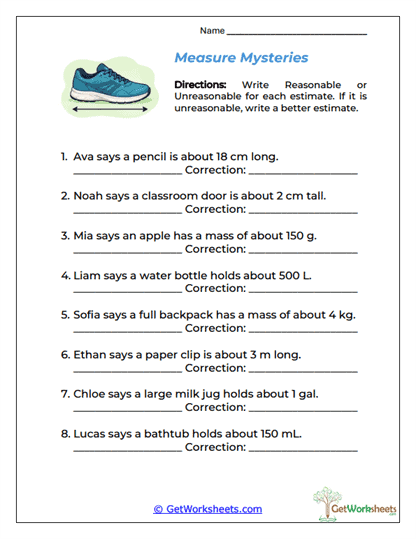
Unreasonable measurements become clues for students to investigate and repair. Learners decide whether statements about doors, apples, bottles, backpacks, or bathtubs make sense and then replace faulty values or units with better ones. Because they must explain what is wrong rather than simply select an answer, the activity encourages deeper reasoning. It also reveals whether students truly understand the difference among length, mass, and capacity.
Measure Sense
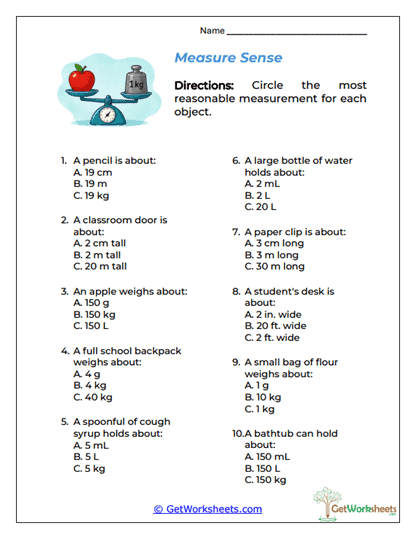
Each problem presents several possible measurements for an everyday object, and students select the one that seems believable. The number and unit must be considered together, so a value that looks reasonable numerically may still be inappropriate if paired with the wrong unit. Familiar objects provide a strong basis for eliminating extreme choices. This worksheet strengthens the practical habit of asking whether a measurement makes sense in the real world.
School Measure Quest
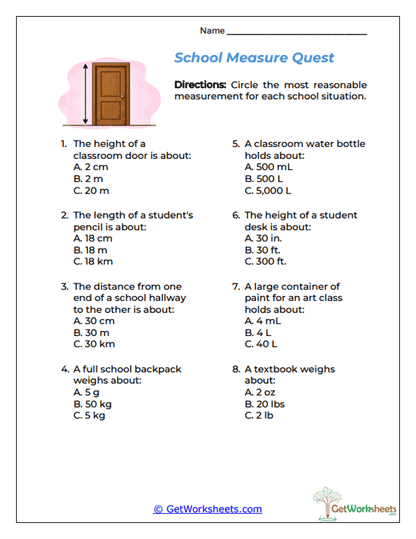
Measurement estimation is placed inside a familiar school setting. Students evaluate possible measurements for desks, doors, hallways, backpacks, textbooks, bottles, and other items they can easily imagine. Because several measurement types appear together, learners must first decide whether the situation concerns length, mass, or capacity before judging the options. The school context makes abstract unit choices much easier to visualize and discuss.
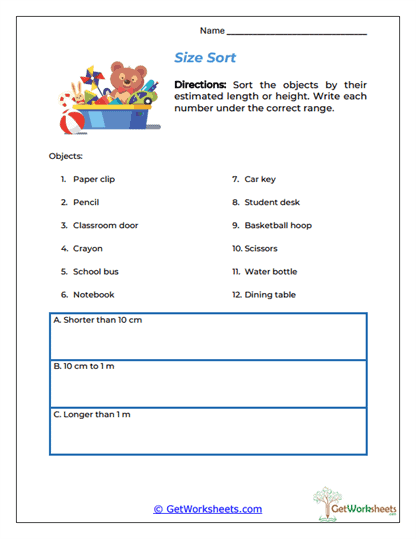
Size Sort
Students classify objects into broad length categories instead of trying to determine exact dimensions. Items ranging from paper clips to school buses are sorted according to whether they are very short, moderate in length, or longer than a meter. The range-based format encourages comparison and spatial reasoning while reinforcing the relationship between centimeters and meters. It also provides a natural setup for follow-up measuring activities.
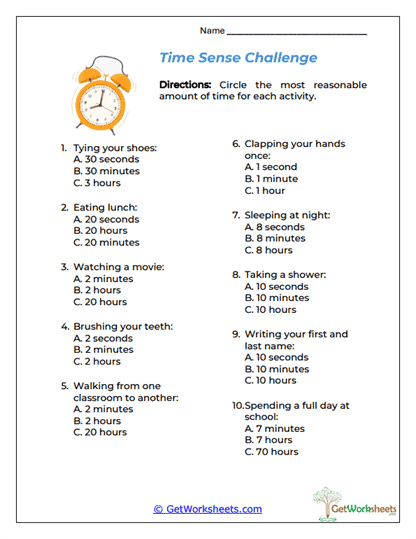
Time Sense Challenge
This activity extends measurement estimation into duration. Students think about how long familiar actions such as brushing teeth, eating lunch, tying shoes, watching a movie, or spending a day at school would reasonably take. Their choices require an understanding of the enormous differences among seconds, minutes, and hours. The worksheet builds everyday time awareness without relying on formal elapsed-time calculations.
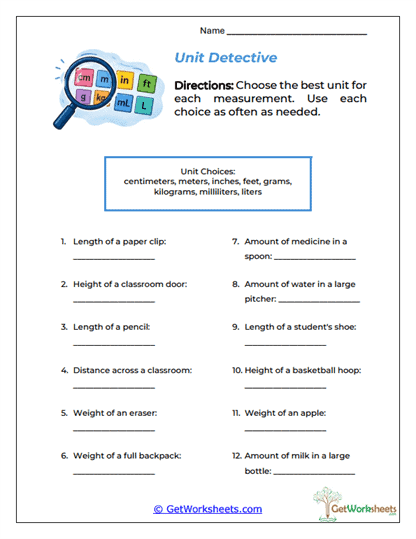
Unit Detective
Students decide which measurement unit best belongs with a particular object or situation. They move among centimeters, meters, inches, feet, grams, kilograms, milliliters, and liters while considering what is being measured and the likely scale involved. The task makes unit selection a reasoning exercise rather than a memorization exercise. It is especially effective for revealing whether students can distinguish small and large units across length, mass, and capacity.
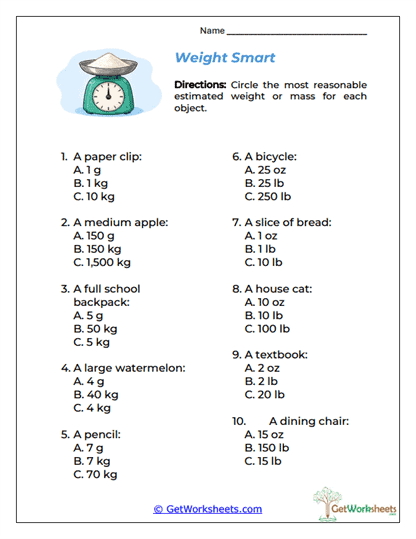
Weight Smart
Students estimate believable weights and masses for familiar objects using both metric and customary units. A paper clip, apple, bicycle, cat, backpack, and chair invite them to think about what each object would actually feel like to lift or carry. Deliberately unrealistic options help make scale differences clear. The activity builds practical intuition for grams, kilograms, ounces, and pounds without requiring conversions.
Bookmark Us Now!
New, high-quality worksheets are added every week! Do not miss out!