Estimating Differences (Subtraction) Worksheets
About This Worksheet Collection
Estimating differences helps students find a reasonable subtraction answer without always calculating the exact result. Learners use rounding, compatible numbers, place value, and mental math to decide about how far apart two numbers are. These skills strengthen subtraction fluency, number sense, mathematical judgment, and the ability to check whether an answer makes sense.
This collection gives upper elementary students several ways to practice estimating subtraction answers. Activities include rounding before subtracting, matching estimated differences, comparing estimates with exact answers, choosing reasonable estimates, using friendly numbers, finding and correcting estimation mistakes, solving money and sports word problems, and deciding which place value is best for rounding. The worksheets are especially well suited for grades 4-5 and can be used for classwork, homework, math centers, intervention, review, tutoring, or homeschool instruction.
As students work through the collection, they strengthen rounding, subtraction, place value, mental computation, estimation, and problem-solving skills. They also practice judging reasonableness, choosing efficient strategies, comparing quantities, interpreting subtraction language, and checking mathematical work for errors. These activities help learners become more flexible with numbers and more confident using estimation as a practical tool in both school and everyday situations.
Detailed Descriptions Of These Worksheets
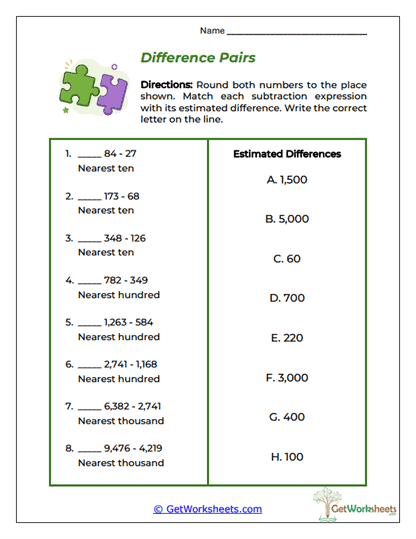
Difference Pairs
Students round each pair of numbers to a stated place value before subtracting and matching the estimated difference with the correct answer. Problems include rounding to tens, hundreds, and thousands, giving learners practice across several number sizes. The matching format provides a natural way to check whether an estimate fits. This activity strengthens place value, subtraction, estimation, and multi-step reasoning.
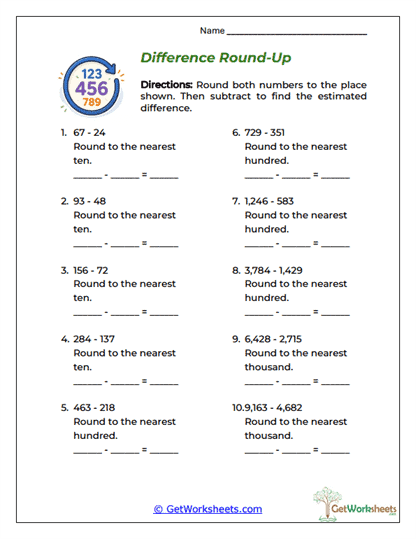
Difference Round-Up
Students estimate subtraction answers by rounding both numbers before finding the difference. The problems progress through rounding to tens, hundreds, and thousands so learners can see how place value affects an estimate. The repeated routine helps students understand why an approximate answer can still be useful even when it is not exact. This worksheet builds a strong foundation for mental subtraction and answer checking.
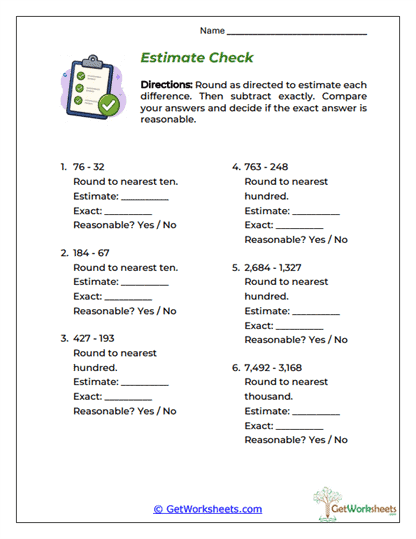
Estimate Check
Students first estimate a difference and then solve the original subtraction problem exactly. Comparing the two results helps them decide whether the exact answer is reasonable. The activity shows how estimation can be used as a checking strategy rather than only as a shortcut. It strengthens rounding, exact computation, number sense, and self-checking habits.
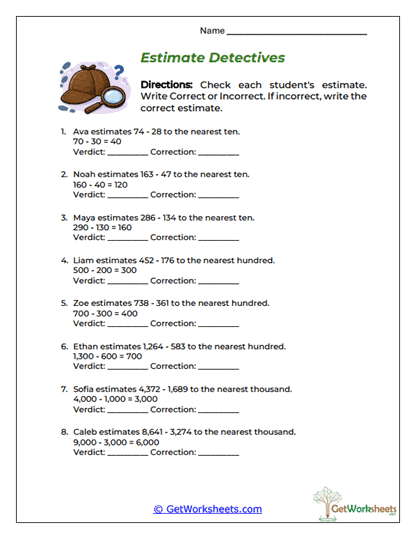
Estimate Detectives
Completed subtraction estimates are examined for possible mistakes. Students check whether the numbers were rounded correctly, decide whether the estimated difference is accurate, and correct any errors they find. The detective-style format encourages learners to study the reasoning behind an answer instead of trusting it automatically. This activity develops error analysis and careful mathematical thinking.
Estimate Match
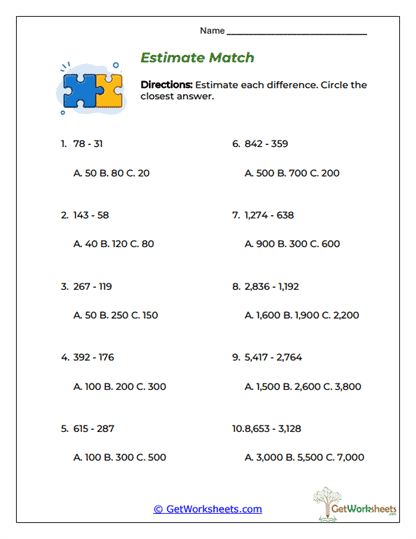
Students estimate subtraction problems and choose the answer that is closest to a reasonable difference. Because the worksheet does not always tell them exactly how to round, learners must think about number size and use flexible estimation strategies. Multiple-choice answers encourage them to reject results that are clearly too large or too small. This worksheet strengthens magnitude, mental math, and reasonableness.
Estimate Showdown
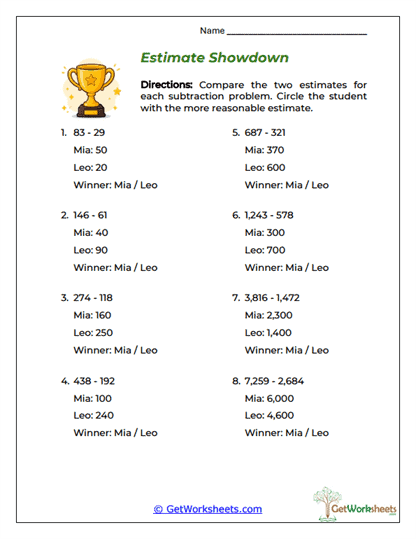
Two possible estimates are presented for the same subtraction problem, and students decide which is more reasonable. Learners use rounding, number magnitude, and mental subtraction to evaluate the competing answers. The activity focuses more on mathematical judgment than written computation. It provides useful practice explaining why one estimate fits the original numbers better than another.
Estimate Verdicts
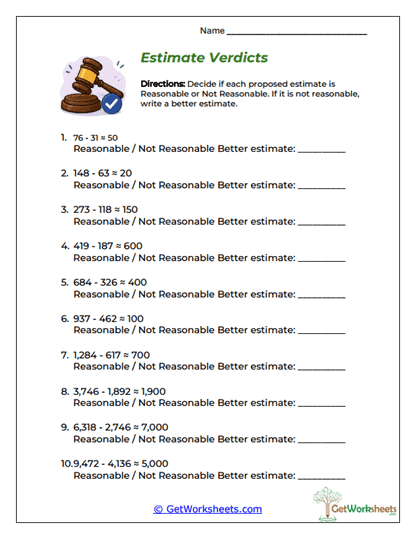
Students act as mathematical judges by deciding whether proposed subtraction estimates are reasonable or unreasonable. When an estimate does not make sense, they create a better approximate answer. This requires learners to think about place value, number size, and how far apart the original quantities are. The activity builds strong answer-checking and error-analysis habits.
Friendly Difference Hunt
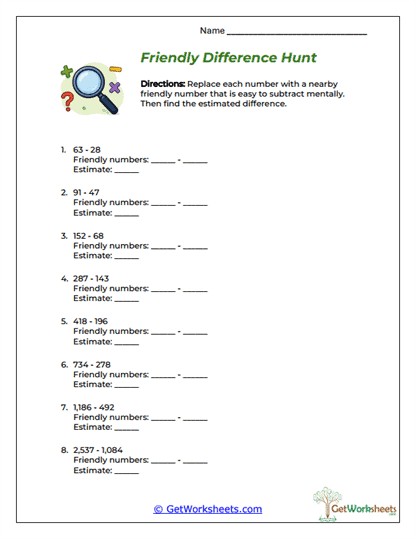
Students replace difficult numbers with nearby compatible values that are easier to subtract mentally. Rather than following one fixed rounding rule, learners choose friendly numbers that produce a sensible estimate. This encourages flexible thinking and shows that more than one estimation strategy can work. The worksheet strengthens mental math, approximation, and independent problem solving.
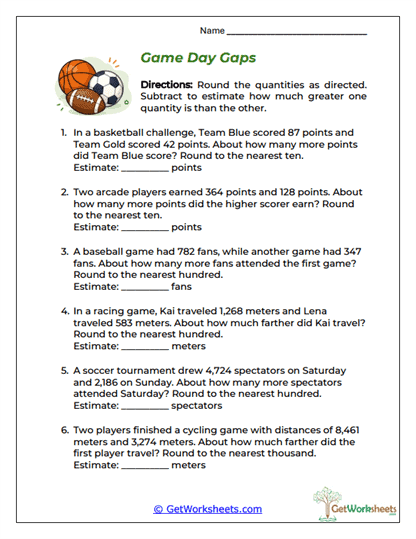
Game Day Gaps
Sports-themed word problems ask students to estimate differences involving scores, attendance, distances, points, and spectators. Learners identify comparison language, round the quantities as directed, and subtract to find an approximate difference. The problems progress from smaller values to numbers in the hundreds and thousands. This activity connects estimation with reading comprehension and real-world comparison.
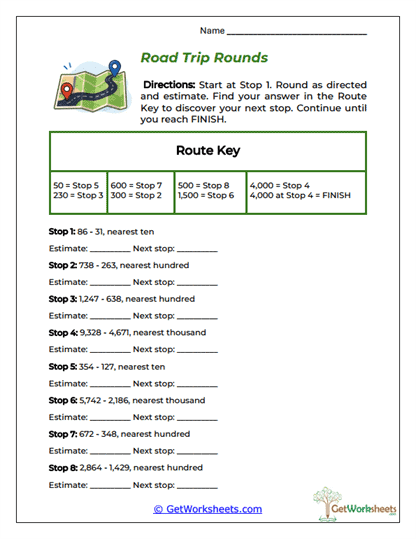
Road Trip Rounds
Students follow a road-trip path in which each estimated difference determines which problem they solve next. They round numbers to different place values, subtract, and use a route key to continue through the activity. Because an incorrect estimate can send them to the wrong stop, students have a natural reason to check their work. This worksheet adds sequencing and decision-making to estimation practice.
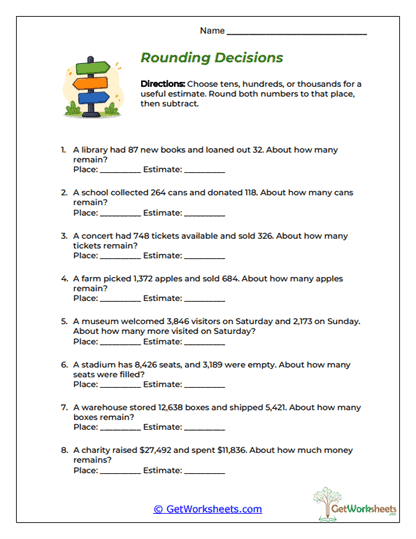
Rounding Decisions
Real-world subtraction situations require students to decide whether rounding to tens, hundreds, or thousands will produce the most useful estimate. They then round the numbers and calculate the approximate difference. Choosing the rounding place themselves helps learners understand that estimation depends on the size of the numbers and the level of precision needed. The activity develops independence and stronger mathematical judgment.
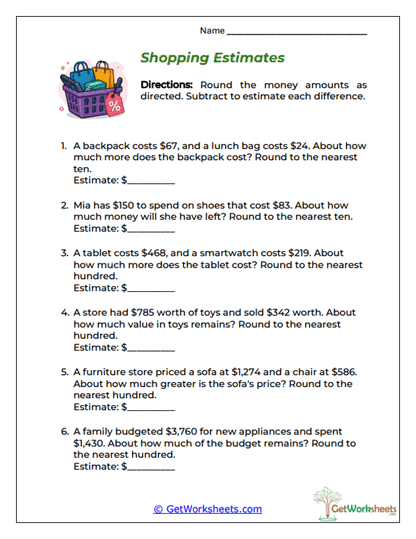
Shopping Estimates
Students use estimation to solve shopping and budgeting situations involving prices, spending, and amounts remaining. They round money values and subtract to determine about how much more something costs or how much money is left. The familiar contexts help students see why approximate answers can be useful in everyday decisions. This worksheet connects rounding, subtraction, money math, and word-problem comprehension.
Bookmark Us Now!
New, high-quality worksheets are added every week! Do not miss out!