Worker Timecards Worksheets
About This Worksheet Collection
Work timecards are an important part of business mathematics because they document employee working hours and provide the information needed to calculate wages accurately. Understanding how to read and complete a timecard requires more than recognizing clock times; it involves calculating elapsed time, subtracting unpaid breaks, converting hours and minutes into decimal values, and determining how many hours qualify as regular or overtime work. These calculations connect fundamental arithmetic skills to practical workplace responsibilities, helping learners understand how businesses track employee attendance, maintain payroll records, and determine compensation. Developing confidence with timecard mathematics also strengthens financial literacy by showing how recorded working hours translate into earnings and why small calculation errors can affect payroll accuracy.
This collection of Work Timecard Worksheets introduces timekeeping concepts through a variety of realistic employee schedules, payroll exercises, and workplace problem-solving activities. Learners calculate shift lengths from clock-in and clock-out times, determine missing time entries, deduct unpaid breaks, and combine daily hours to find weekly totals. Additional activities explore matching work schedules with their correct durations, converting between conventional time notation and decimal payroll hours, identifying errors in employee records, and distinguishing regular hours from overtime under a stated 40-hour rule. A café-based activity provides a familiar business setting, while hourly wage problems demonstrate how timecard information contributes to gross pay calculations. Teachers, homeschool educators, and tutors can use these resources for direct instruction, guided practice, independent assignments, homework, or reinforcement of essential business math procedures.
Working through these activities develops numerical fluency, decimal computation, time measurement, mathematical reasoning, and the ability to interpret information presented in workplace records. Repeated calculations encourage students to organize multistep solutions, check the accuracy of their answers, recognize common timekeeping mistakes, and select appropriate mathematical operations for different payroll situations. Learners also strengthen their understanding of the relationships among minutes, hours, decimal fractions, weekly totals, and hourly compensation. As the exercises progress from straightforward shift calculations to payroll conversions and employee earnings, they build practical problem-solving skills that extend into personal finance, business administration, employment preparation, and everyday financial decision-making.
Detailed Descriptions Of These Worksheets
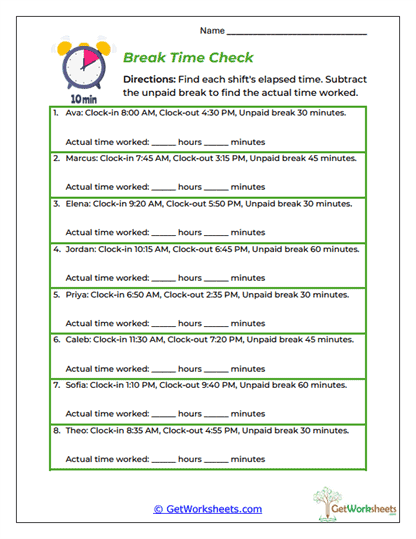
Break Time Check
Calculating paid working time involves more than finding the difference between two clock readings, and Break Time Check introduces this distinction through eight employee scheduling scenarios. Each problem provides a starting time, ending time, and unpaid break of 30, 45, or 60 minutes that must be deducted from the complete shift duration. Learners practice elapsed-time subtraction, minute regrouping, and multistep calculations while recording the resulting net work hours. The exercises help establish why scheduled shift length and actual working time are not always identical, an important concept in employee timekeeping and payroll preparation.
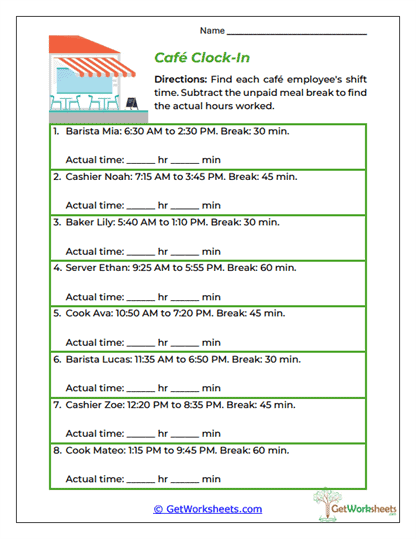
Café Clock-In
A busy café provides the workplace setting for eight timecard problems featuring employees such as baristas, cashiers, bakers, servers, and a cook. Using each employee's clock-in time, clock-out time, and designated unpaid break, learners calculate the actual number of hours and minutes worked. Different shift schedules and break lengths create opportunities to practice time subtraction, hour-and-minute regrouping, and accurate work-hour reporting. The familiar food-service examples make payroll mathematics more relatable while demonstrating how businesses maintain dependable employee scheduling and attendance records.
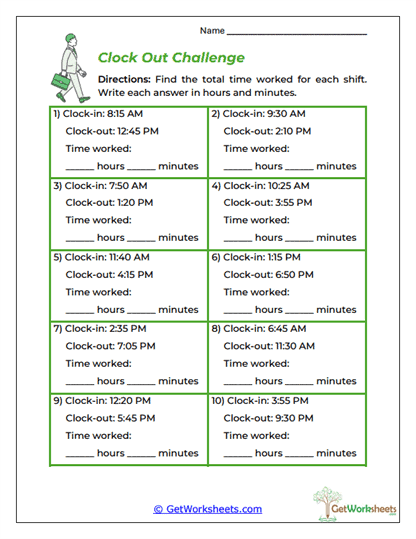
Clock Out Challenge
How many hours did an employee actually spend working between clocking in and clocking out? Clock Out Challenge develops this foundational timekeeping skill through ten problems featuring different beginning and ending times. Learners interpret AM and PM notation, calculate elapsed hours and minutes, and use regrouping when the minute values require adjustment. The activity reinforces accurate clock arithmetic while preparing students to approach more complex timecard problems involving breaks, weekly schedules, and payroll calculations.
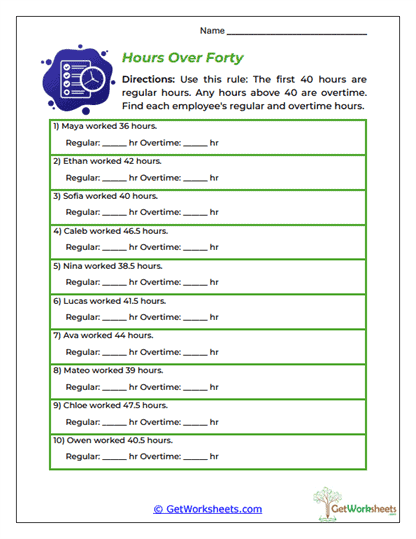
Hours Over Forty
Distinguishing between regular working hours and overtime becomes the focus of this activity, which presents ten employees with different weekly hour totals. Following the worksheet's simplified 40-hour rule, learners identify up to 40 regular hours and calculate any additional hours worked beyond that threshold. Weekly totals include whole numbers and half-hour values, providing practice with decimal subtraction, numerical comparison, and accurate hour classification. By examining schedules below, at, and above 40 hours, students develop a mathematical foundation for understanding overtime calculations and employee compensation.
Paycheck Math
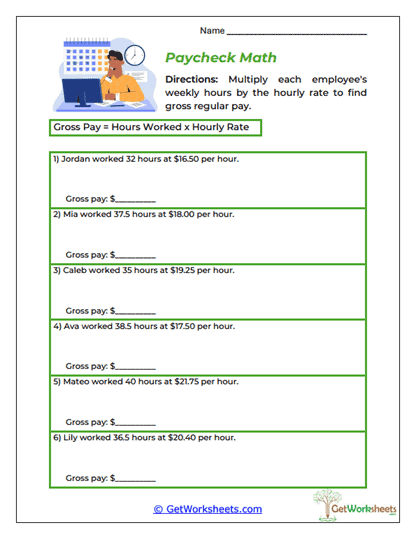
Paycheck Math connects employee work schedules directly to earnings through six practical hourly wage calculations. Given an employee's hours worked and hourly rate, learners apply the formula Hours Worked × Hourly Rate to determine gross regular pay before deductions. The problems incorporate different wage amounts and fractional work-hour totals, requiring careful decimal multiplication and correct currency notation. This activity helps students recognize how time records influence earnings while strengthening financial arithmetic skills useful for payroll calculations, personal budgeting, and understanding hourly employment.
Payroll Corrections
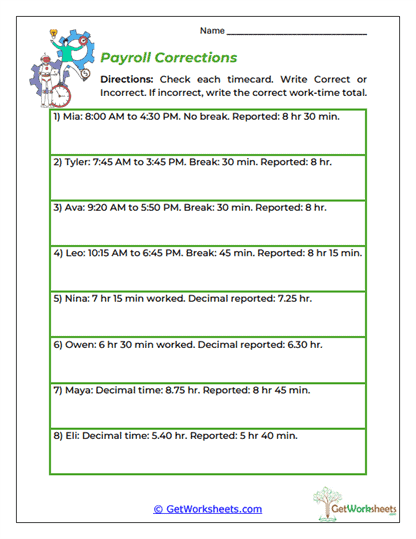
Finding mistakes in employee time records requires careful mathematical reasoning, and Payroll Corrections gives learners eight opportunities to examine reported work durations and payroll values. Each scenario asks whether the existing calculation is correct or incorrect and requires an accurate replacement when an error is discovered. Problems involve elapsed-time calculations, unpaid break deductions, and conversions between hours-and-minutes notation and decimal payroll hours. Rather than simply calculating new totals, students evaluate existing information and practice identifying discrepancies that could affect employee records. This approach reinforces mathematical verification and demonstrates the importance of accuracy in workplace payroll processes.
Payroll Decimal Practice
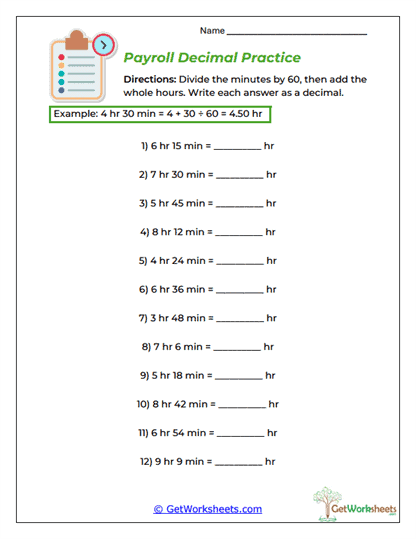
Payroll systems commonly express employee work durations as decimal hours, making accurate conversion an important business math skill. Through twelve exercises, Payroll Decimal Practice asks learners to convert hours-and-minutes measurements into decimal-hour values by dividing the minutes by 60 and combining the result with the whole hours. A worked example illustrates the procedure before students apply it to different time amounts, including values that require more than familiar quarter-hour conversions. The activity reinforces decimal division, place value, fractional-hour relationships, and the numerical accuracy needed for calculating employee earnings.
Payroll Time Decoder
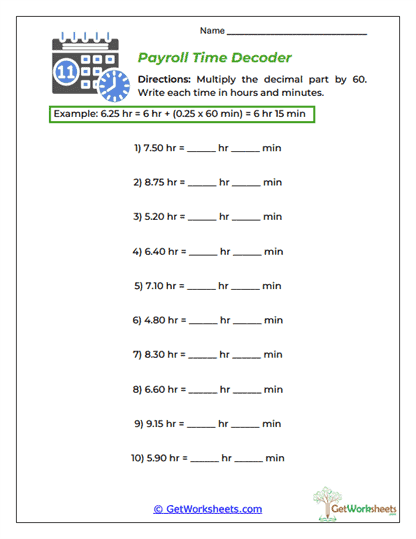
Payroll Time Decoder reverses the usual time conversion process by asking students to translate decimal-hour entries into conventional hours and minutes. Ten exercises present values such as 6.25, 7.50, and 8.75 hours, requiring learners to separate the whole-hour portion and multiply the fractional amount by 60. An example demonstrates the method, helping students distinguish decimal time from standard clock notation. These calculations develop decimal multiplication, fractional-number interpretation, and an understanding of how payroll records represent portions of an hour. The practice also addresses the common misconception that a decimal value such as 5.20 hours automatically represents 5 hours and 20 minutes.
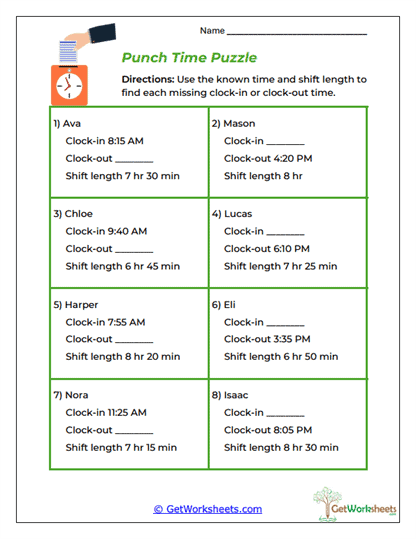
Punch Time Puzzle
Missing information in an employee timecard becomes a mathematical puzzle in this collection of eight workplace scheduling problems. Some exercises provide a clock-in time and shift duration, requiring learners to calculate when the employee finished working, while others supply the ending time and ask students to work backward. Solving the problems involves time addition, subtraction, regrouping minutes, and interpreting AM and PM correctly. By approaching elapsed-time calculations from both directions, learners strengthen their understanding of inverse operations and develop strategies for completing incomplete workplace records.
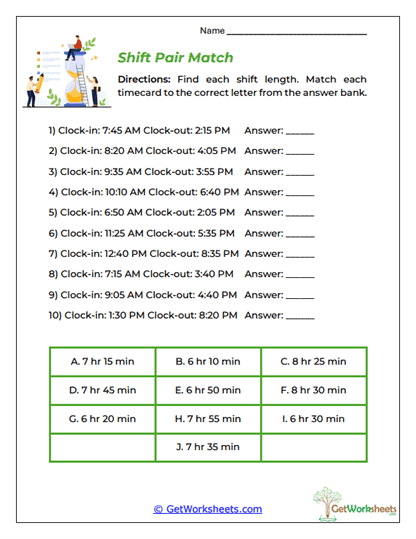
Shift Pair Match
Shift Pair Match combines timecard mathematics with a matching activity that encourages careful computation and answer verification. Ten numbered work schedules provide clock-in and clock-out times, which learners use to calculate each employee's total shift duration. After finding the elapsed hours and minutes, students compare their results with a lettered answer bank and record the corresponding choices. The format reinforces clock reading, time subtraction, minute regrouping, and numerical comparison while encouraging learners to distinguish between similar work-hour totals. It works particularly well as an independent review activity or a classroom exercise for assessing elapsed-time proficiency.
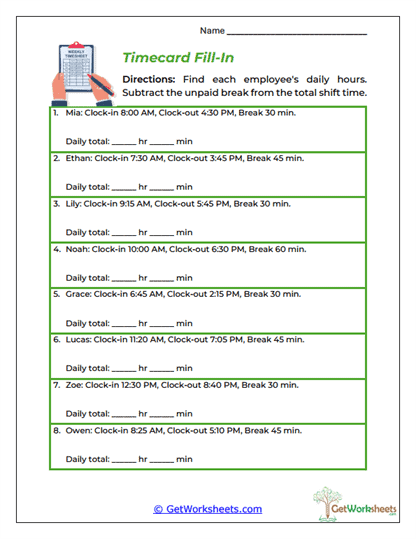
Timecard Fill-In
Completing an employee timecard accurately requires interpreting a work schedule, accounting for breaks, and recording the final duration in the proper format. Timecard Fill-In provides eight employee entries with clock-in times, clock-out times, and unpaid breaks of varying lengths. Learners calculate each shift's elapsed time, subtract the appropriate break, and enter the resulting hours and minutes into designated answer fields. The structured format encourages organized calculations and consistent recordkeeping while reinforcing the mathematical distinction between total scheduled time and actual hours worked.
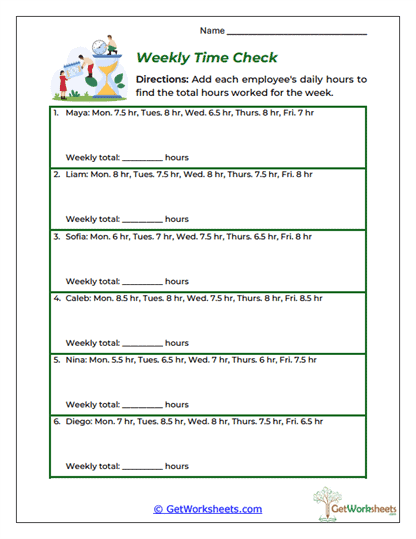
Weekly Time Check
Weekly Time Check moves beyond individual shifts by asking learners to calculate total work hours across a Monday-through-Friday schedule. Six employee scenarios include daily hour amounts expressed as whole numbers and half-hour values, requiring accurate addition to determine each person's weekly total. The activity emphasizes decimal arithmetic, place-value alignment, cumulative calculations, and the interpretation of weekly time records. By combining multiple daily entries into a single result, students develop the organizational and computational skills needed to understand how businesses prepare weekly payroll totals.
Bookmark Us Now!
New, high-quality worksheets are added every week! Do not miss out!