Health Insurance Worksheets
About This Worksheet Collection
Health insurance combines recurring premiums, fixed fees, percentage-based payments, and coverage rules. These business math worksheets introduce students to those costs and show how arithmetic can help people understand insurance plans, payroll deductions, medical bills, and employee benefits.
The collection moves from vocabulary and individual calculations to more involved tasks, such as tracking a deductible, interpreting a plan summary, checking calculations for errors, and comparing plan costs. Students work with matching activities, reference tables, word problems, and fictional healthcare scenarios. The worksheets can support classroom lessons, financial literacy units, homework, tutoring, or homeschool practice.
As they work through the activities, students strengthen money skills, decimal operations, multiplication, division, percentages, and multistep problem-solving. They also practice reading financial information carefully, keeping accurate records, and explaining how costs are divided. These skills can help students make sense of everyday budgeting and workplace benefit decisions.
Detailed Descriptions Of These Worksheets
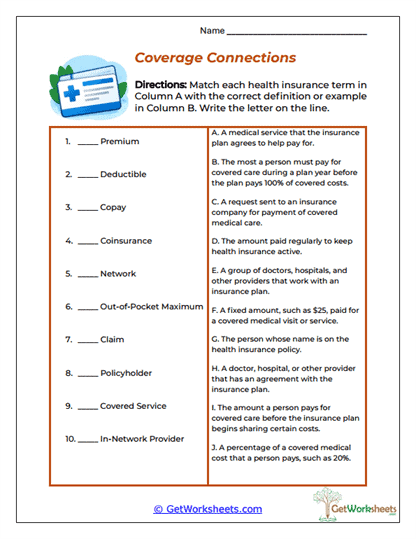
Coverage Connections
Students match ten common health insurance terms with definitions or examples. The activity introduces concepts such as premiums, deductibles, copays, claims, and provider networks without requiring advanced calculations. It builds the vocabulary students need to read basic coverage information and follow healthcare payment discussions.
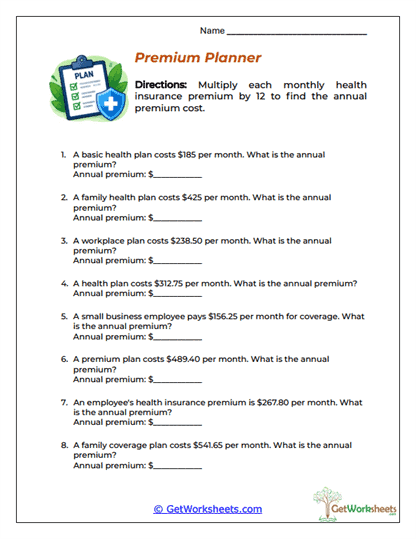
Premium Planner
Students multiply monthly insurance premiums by twelve to find each plan's annual cost. The eight scenarios include individual, family, and workplace coverage, with amounts in whole dollars and dollars and cents. The calculations help learners see how a regular monthly expense adds up over a year and fits into a budget.
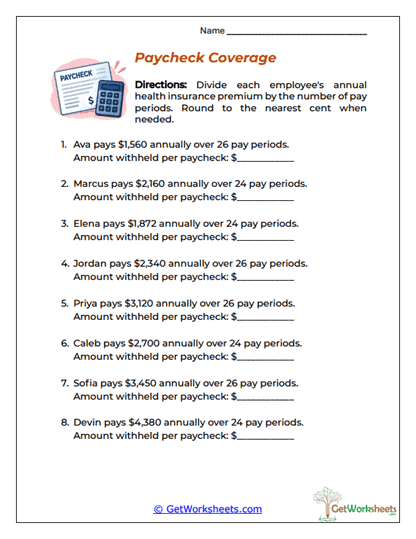
Paycheck Coverage
Students divide annual health insurance premiums across 24 or 26 payroll periods to find the deduction per paycheck. They round results to the nearest cent when needed. The scenarios connect decimal division with employee benefits and help students understand how insurance costs affect take-home pay.
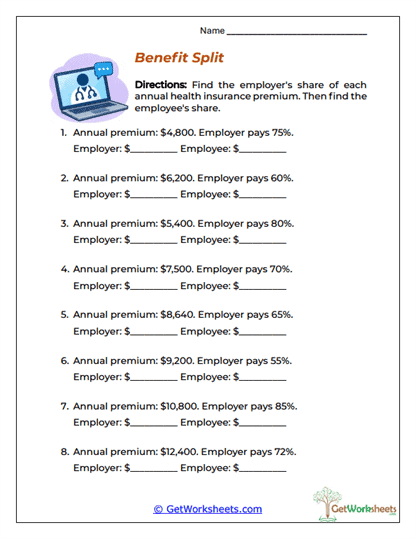
Benefit Split
Each problem gives an annual insurance premium and an employer contribution rate. Students calculate the employer's share, then find the employee's share of the remaining cost. They can check their work by confirming that both amounts add up to the full premium.
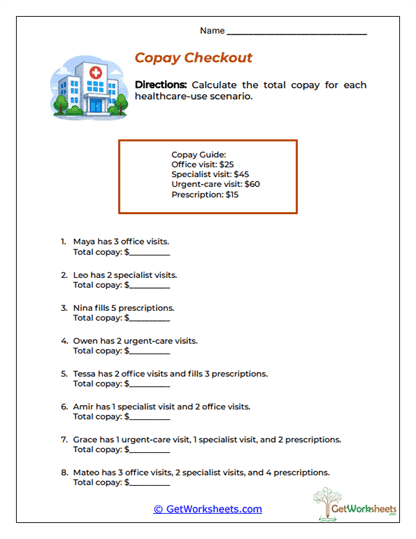
Copay Checkout
Using a copay guide, students calculate costs for office visits, specialist appointments, urgent care, and prescriptions. Some problems involve repeating the same service, while others require adding costs from multiple categories. This practice strengthens multiplication, addition, and the ability to use a financial reference table.
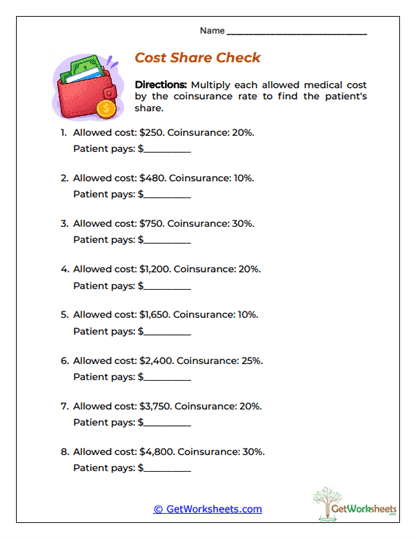
Cost Share Check
Students apply coinsurance rates from 10% to 30% to allowed medical expenses to calculate the patient's share. The eight problems focus on converting percentages to decimals and multiplying accurately with money. Learners also see how a percentage-based charge changes as the underlying medical cost changes.
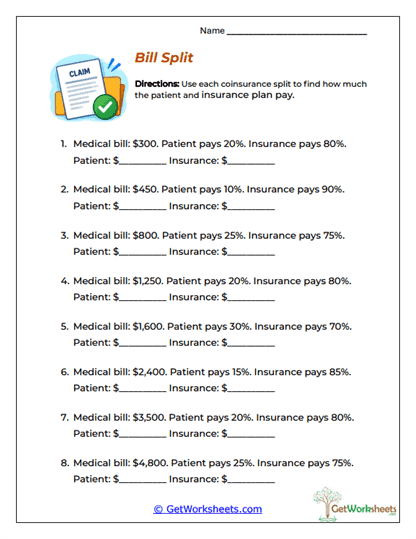
Bill Split
For each medical bill, students calculate the patient's coinsurance payment and the amount paid by the insurance company. They use percentage multiplication and subtraction, then verify that the two shares equal the original charge. The activity connects proportional reasoning with a simplified example of how a healthcare bill can be divided.
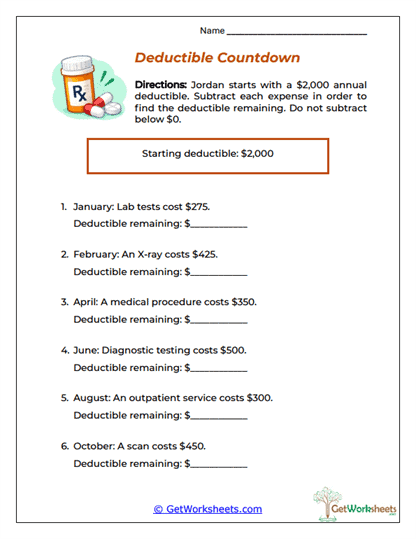
Deductible Countdown
Students follow Jordan's deductible balance as six qualifying expenses are applied over the year. They subtract each expense from the previous balance and record the updated amount, keeping the running total from falling below zero. The activity develops sequential calculation and careful financial recordkeeping.
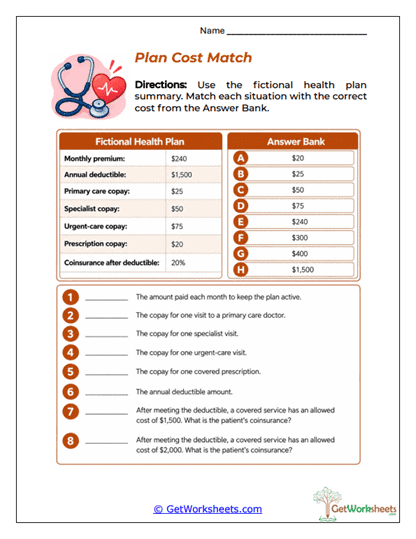
Plan Cost Match
Students use a fictional insurance plan summary to match eight healthcare situations with the correct costs. The plan includes a monthly premium, annual deductible, service copays, and coinsurance after the deductible is met. Reading the summary closely helps learners distinguish between different kinds of insurance expenses as they calculate and compare amounts.
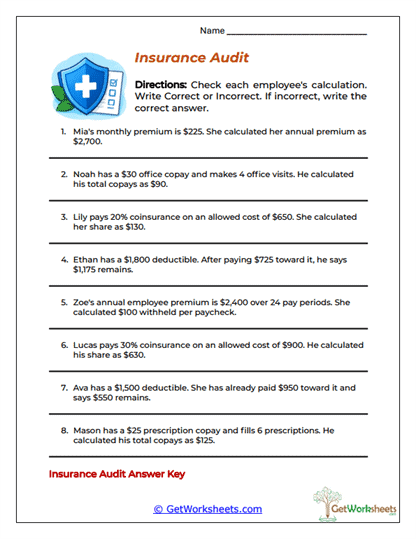
Insurance Audit
Students review eight employee insurance calculations and decide whether each answer is correct. When they find an error, they work out the accurate amount across examples involving premiums, copays, coinsurance, deductibles, payroll deductions, and prescriptions. This investigation encourages students to check their work and explain their financial reasoning.
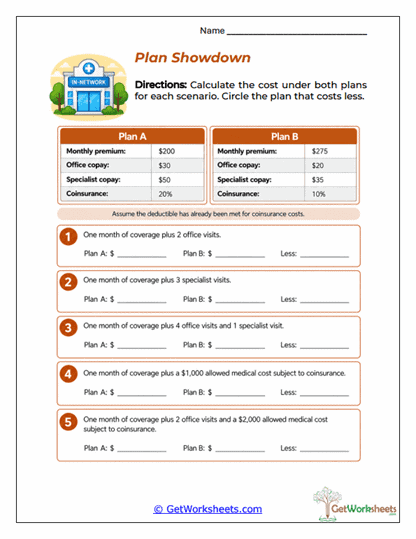
Plan Showdown
Students compare two fictional insurance plans with different premiums, copays, and coinsurance rates. For five healthcare-use scenarios, they calculate the total expense under each plan and identify which costs less for that situation. The activity shows how the more affordable choice can depend on the services a person uses.
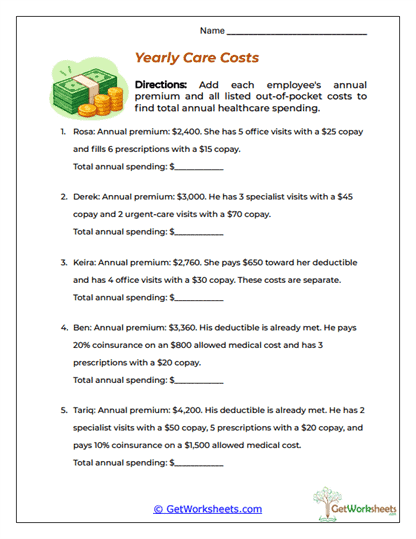
Yearly Care Costs
Students calculate total annual healthcare spending in five employee scenarios. Each problem combines relevant costs such as premiums, visits, prescriptions, deductibles, and coinsurance, requiring students to choose the right operations and organize several amounts. The practice builds multistep problem-solving and helps learners consider how separate expenses contribute to a yearly budget.
Bookmark Us Now!
New, high-quality worksheets are added every week! Do not miss out!