Salaries Worksheets
About This Worksheet Collection
Understanding how salaries work is an important part of business math and financial literacy. A salary represents the amount an employee earns over a specified period, and calculating gross pay helps students understand how annual earnings relate to weekly, biweekly, semimonthly, and monthly paychecks. Learning to convert between these payment schedules gives students practical experience with multiplication, division, percentages, and money calculations. Salary mathematics also includes determining the value of pay raises, calculating new annual earnings, and comparing compensation offers. These skills help students make sense of real-world employment situations and develop a stronger understanding of how income is calculated.
This collection of 12 printable salary worksheets introduces students to a variety of practical calculations involving employee compensation and payroll schedules. Activities begin with straightforward conversions between annual salaries and individual paycheck amounts before progressing to matching exercises, missing-value problems, payroll error detection, and percentage-based raises. Students also compare salary increases, evaluate competing job offers, and solve word problems that combine several financial concepts. The worksheets use realistic workplace scenarios, familiar occupations, and different problem formats to make business mathematics approachable and engaging. Teachers, homeschool families, and tutors can incorporate these resources into financial literacy lessons, business math units, independent practice, homework assignments, or small-group instruction.
Working through these salary worksheets helps students develop essential mathematical and financial reasoning skills that extend beyond the classroom. Learners strengthen their ability to multiply and divide monetary amounts, convert percentages into decimals, calculate salary increases, and compare earnings across different payment schedules. Activities involving incorrect payroll calculations and competing compensation offers also encourage careful analysis, attention to detail, and thoughtful decision-making. As students become more comfortable interpreting salary information, they build confidence in applying mathematics to employment situations, personal budgeting, and financial planning. The collection provides a practical foundation for understanding how people earn, compare, and manage their income.
Detailed Descriptions Of These Worksheets
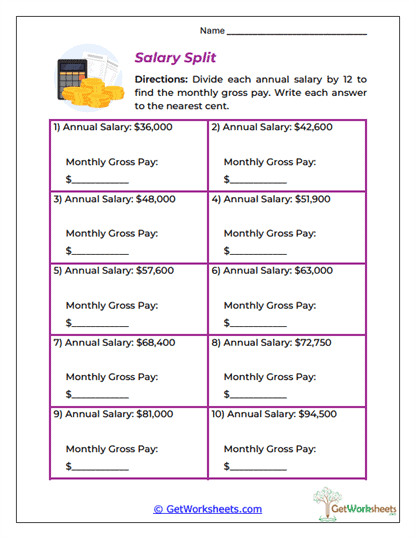
Salary Split
Students practice turning annual salaries into monthly gross earnings by dividing each yearly amount into 12 equal payments. Ten salary conversion problems provide opportunities to work with different income levels while strengthening division skills and decimal accuracy. Each answer must be rounded to the nearest cent, reinforcing proper formatting of monetary values. This straightforward activity helps learners understand the relationship between yearly compensation and monthly income, a useful skill for future budgeting and financial planning.
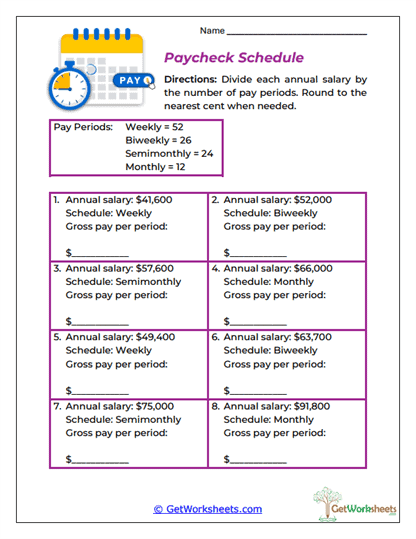
Paycheck Schedule
Explore how payroll frequency determines the amount an employee receives in each paycheck, even when the annual salary remains unchanged. Eight problems require learners to calculate gross earnings using weekly, biweekly, semimonthly, or monthly payment schedules, with a reference chart identifying the appropriate number of yearly pay periods. By applying different divisors, students gain practical experience with salary conversions while learning to distinguish between common payroll arrangements.
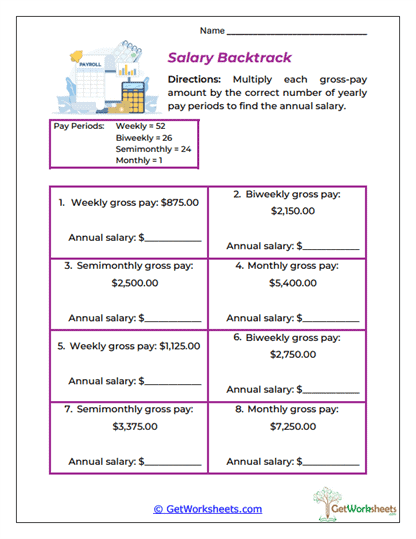
Salary Backtrack
Instead of starting with annual salaries, this activity asks learners to calculate yearly earnings from individual gross-pay amounts. Students encounter eight compensation scenarios involving weekly, biweekly, semimonthly, and monthly payments. Using the correct number of yearly pay periods, they multiply each paycheck amount to determine the corresponding annual salary. A reference chart supports accurate calculations while reinforcing the mathematical relationship between recurring payments and total earnings. The exercises offer meaningful practice with multiplication, financial vocabulary, and interpreting employee compensation.
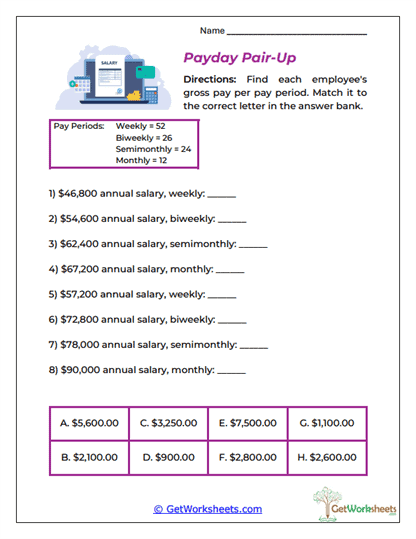
Payday Pair-Up
A matching challenge makes salary conversion practice more interactive as students connect annual earnings with the correct gross-pay amounts. Each of the eight problems presents a yearly salary and a particular payroll schedule, requiring division to determine the value of an individual paycheck. After completing the calculation, learners search a lettered answer bank for the matching amount. This format encourages careful computation and answer verification while reinforcing the differences among weekly, biweekly, semimonthly, and monthly compensation.
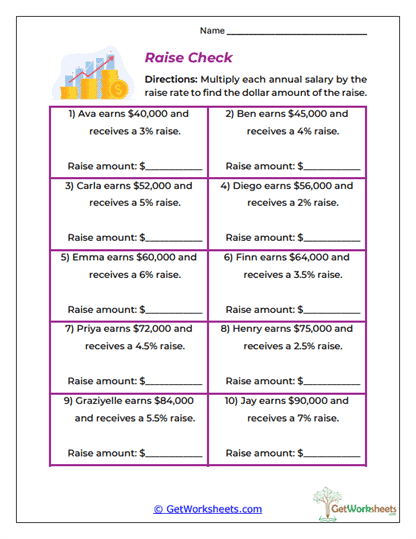
Raise Check
How much extra money does an employee receive when their annual salary increases by a certain percentage? Ten workplace examples guide students through finding the dollar value of salary raises using multiplication and percentage-to-decimal conversions. With both whole-number and decimal percentage rates included, the activity strengthens proportional reasoning and helps learners recognize how the original salary influences the actual amount of a raise.
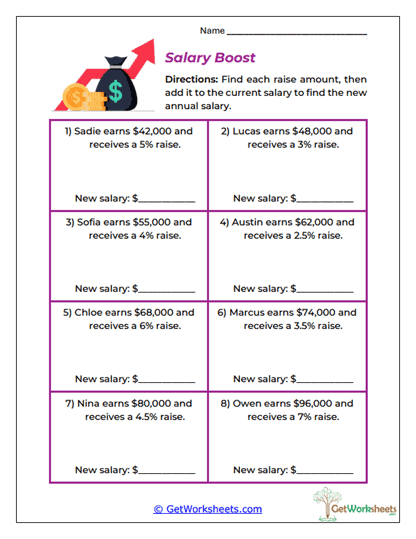
Salary Boost
Calculating a new salary after a percentage increase requires more than finding the value of the raise itself. In eight employee compensation scenarios, students first determine how much additional money each worker earns and then add that amount to the original annual salary. Percentage rates include whole numbers and decimals, giving learners practice with several types of calculations. The two-step process reinforces multiplication, addition, and the proper use of percentages in financial situations. Students also learn to distinguish between the amount of a salary increase and the employee's updated total compensation.
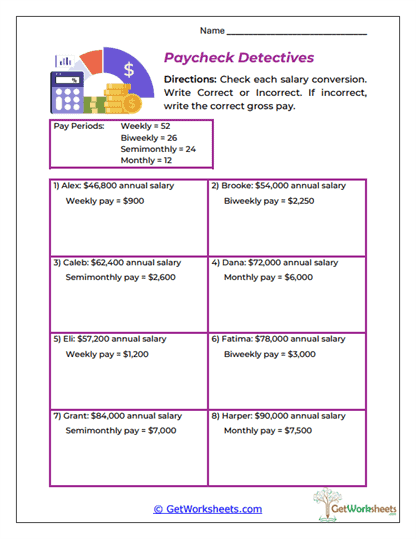
Paycheck Detectives
Put payroll calculations under the microscope as students investigate whether reported gross-pay amounts are correct. Eight employee situations present annual salaries alongside paycheck amounts that must be checked against the stated payment schedules. Learners apply the appropriate salary conversion formulas, identify mathematical mistakes, and provide corrected earnings when necessary. This error-detection approach strengthens computational accuracy, critical thinking, and the valuable habit of verifying financial information rather than accepting calculations without checking them.
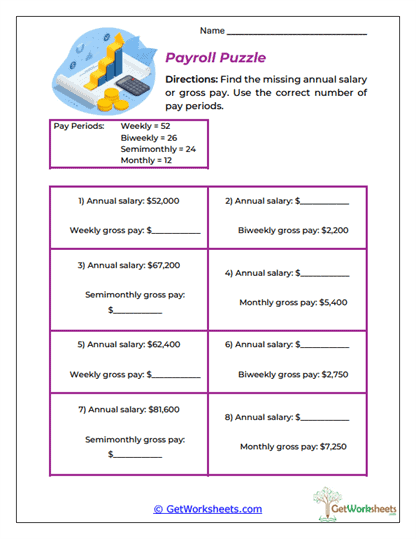
Payroll Puzzle
Missing values turn ordinary salary calculations into a flexible mathematical challenge involving both multiplication and division. Across eight problems, students must determine whether to calculate annual compensation from a recurring paycheck or find gross pay using a provided yearly salary. The mixed format encourages learners to examine the available information carefully, select the correct operation, and apply their understanding of different payroll frequencies.
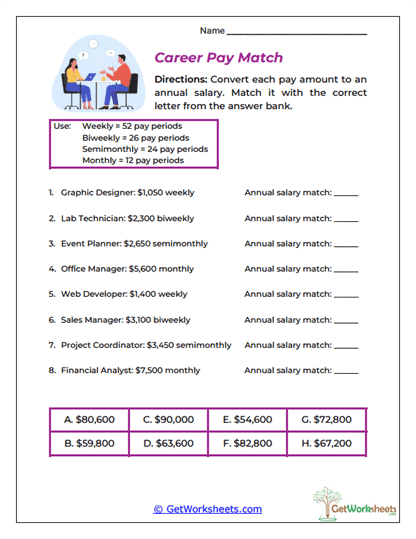
Career Pay Match
Different professions provide the setting for a salary-matching activity that combines career awareness with practical financial mathematics. Students examine gross-pay amounts for eight workers, including professionals in fields such as graphic design, laboratory technology, event planning, and financial analysis. Each employee receives compensation according to a particular payment schedule that must be converted into annual earnings. After calculating the yearly salaries, learners identify the corresponding amounts in a lettered answer bank. The combination of career examples and matching exercises reinforces multiplication, payroll terminology, and accurate interpretation of compensation information.
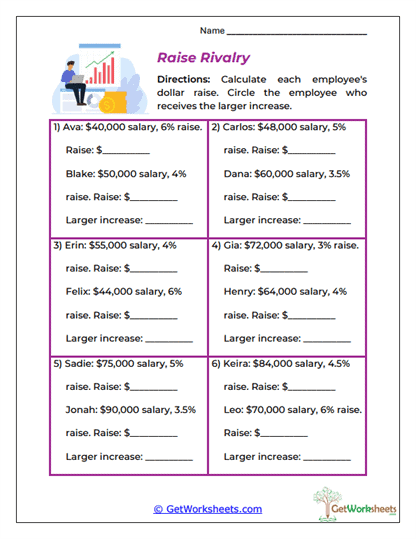
Raise Rivalry
Two employees, two different salaries, and two percentage increases create an interesting comparison challenge in each problem. Across six paired scenarios, students calculate the dollar amount of each worker's raise before deciding who receives the larger increase. Learners discover that a higher percentage does not always result in more additional money because the starting salary also matters. This activity develops percentage fluency, mathematical comparison skills, and a deeper understanding of how salary increases work in real employment situations.
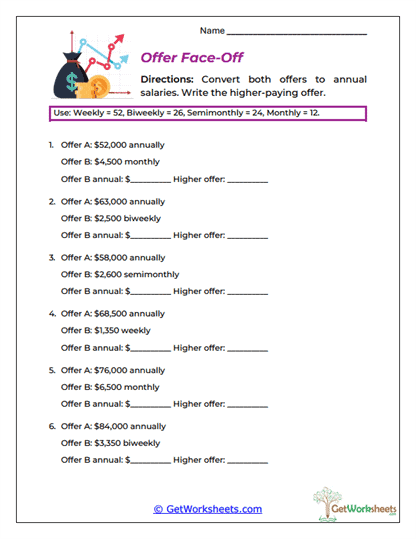
Offer Face-Off
Comparing job offers becomes a practical math exercise as students evaluate positions that advertise earnings using different payroll schedules. Six scenarios require learners to convert compensation amounts into equivalent annual salaries before determining which opportunity pays more. The activity reinforces multiplication and financial reasoning while demonstrating why payment frequency must be considered when making accurate salary comparisons.
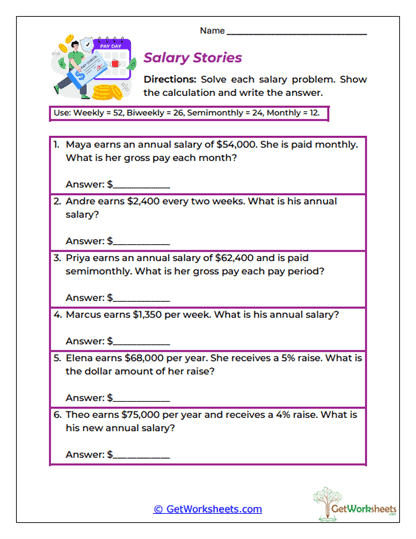
Salary Stories
Realistic workplace situations provide meaningful context for six salary-related word problems that combine several important business math concepts. Learners interpret written information about annual earnings, recurring paychecks, and percentage-based raises before choosing the appropriate mathematical operations. Some questions involve converting salaries into monthly or semimonthly earnings, while others require calculating annual compensation or determining the effects of a pay increase. Students are encouraged to show their calculations, helping them organize their reasoning and communicate how they arrived at each answer. By combining financial literacy with reading comprehension and multistep problem-solving, this activity offers an effective review of salary mathematics in everyday employment situations.
Bookmark Us Now!
New, high-quality worksheets are added every week! Do not miss out!