Business Math Word Problems Worksheets
About This Worksheet Collection
Business math word problems help students apply arithmetic and financial reasoning to situations that resemble real-life money decisions. Instead of solving isolated calculations, learners must read a scenario, identify the important information, decide which operation or process is needed, and use the result to answer a practical question. This approach strengthens both mathematical understanding and financial literacy.
This collection gives middle school students several ways to work with realistic banking and money situations. Activities include reading statements, classifying transactions, maintaining running balances, checking financial claims, solving for missing amounts, comparing account records, identifying cleared and pending items, calculating banking fees, reconciling balances, finding transaction errors, and analyzing income and expenses. The worksheets are well suited for business math, consumer math, financial literacy, tutoring, independent practice, or homeschool instruction.
As students work through the collection, they strengthen decimal computation, transaction analysis, budgeting, record comparison, financial vocabulary, and multi-step problem solving. They also practice using evidence from tables and documents, deciding when to add or subtract, checking work for reasonableness, and explaining how financial records connect. These activities help learners become more confident solving real-world money problems rather than relying on isolated formulas.
Detailed Descriptions Of These Worksheets
Banking Activity Analysis
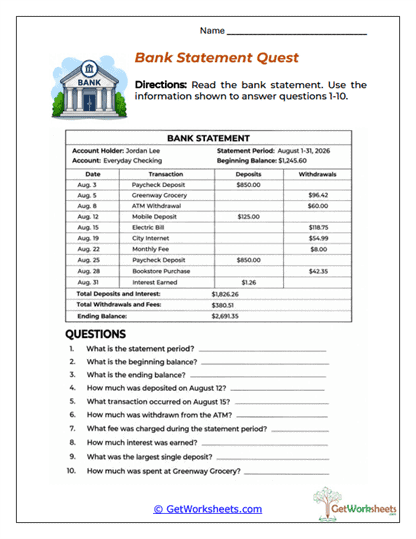
Students read a realistic bank statement and use the information to answer questions about deposits, withdrawals, fees, interest, and balances. The activity requires learners to locate the correct row or amount before deciding what calculation is needed. This combines financial reading with addition, subtraction, and comparison. It is a strong introduction to using business records as evidence in word problems.
Banking Fee Breakdown
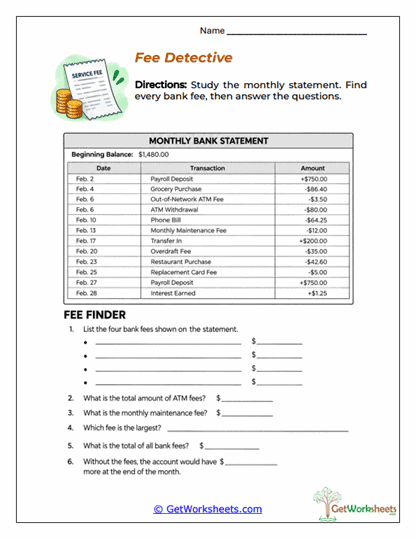
Students examine account charges such as ATM fees, maintenance fees, overdraft costs, and replacement-card charges. They calculate totals, compare fees, and determine how much more money would remain without those deductions. The activity shows how small charges can add up over time. It reinforces decimal operations while also building awareness of real banking costs.
Clearing Status Review
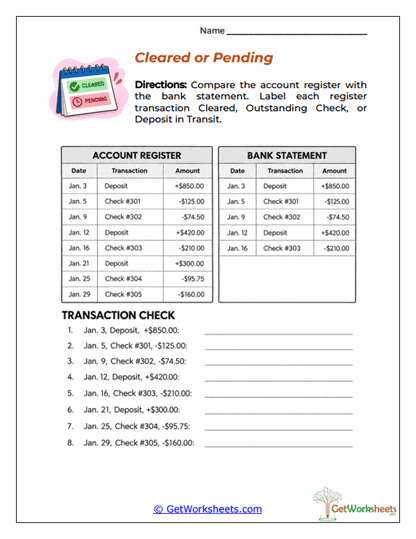
Students compare a personal register with a bank statement and classify transactions as cleared, outstanding, or deposits in transit. Matching dates, amounts, and descriptions helps learners see why two balances may not agree immediately. The worksheet introduces an important reconciliation idea without requiring a full accounting process. It strengthens record comparison and timing awareness.
Dual-Record Audit
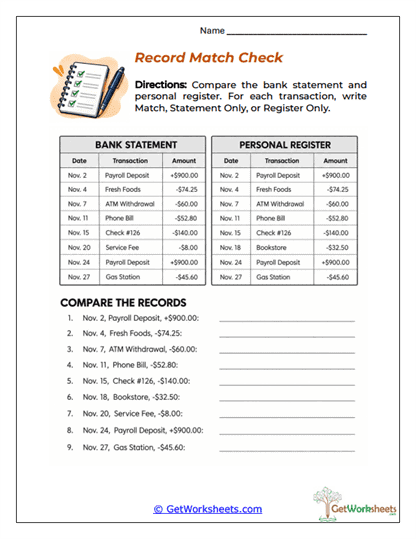
Two financial records are placed side by side so students can determine which entries match and which appear in only one place. Learners compare dates, transaction names, deposits, withdrawals, and amounts. The activity develops close attention to detail while introducing the logic behind reconciliation. It also helps students understand how missing or inconsistent entries affect account accuracy.
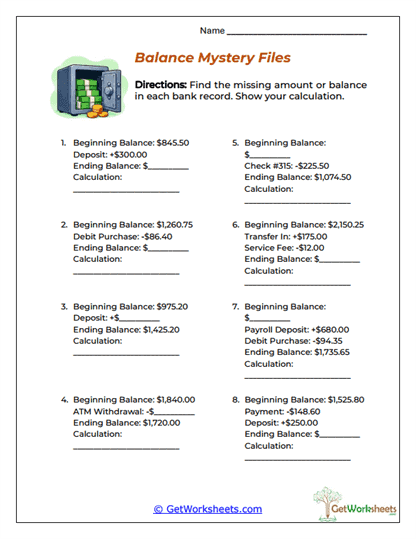
Missing Balance Case Files
Students solve practical money puzzles involving missing deposits, withdrawals, payments, or starting balances. They use the other values provided to work backward and determine the unknown amount. Requiring the calculation to be shown reinforces inverse operations and equation-style thinking. This worksheet builds algebra readiness through realistic financial situations.
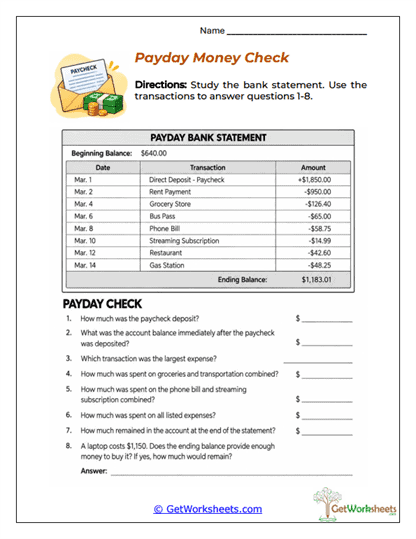
Payday Spending Snapshot
A paycheck deposit and a series of expenses are used to show how income changes after everyday spending. Students compare rent, groceries, transportation, subscriptions, bills, and other costs before determining what remains. They may also decide whether another purchase is affordable. The activity connects arithmetic with budgeting and practical financial decision-making.
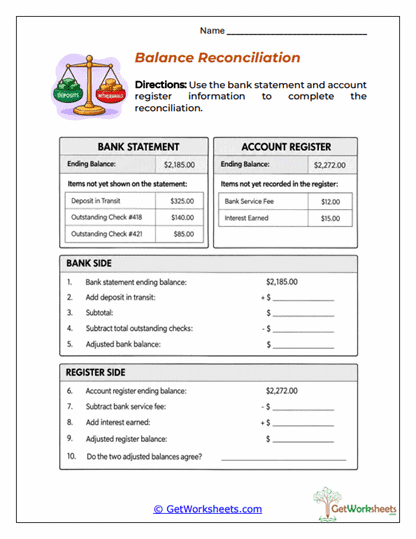
Reconciliation Balance Builder
Students adjust both a bank balance and an account-register balance using deposits in transit, outstanding checks, fees, and interest. The goal is to calculate corrected totals that can be compared fairly. This multi-step process requires learners to decide what should be added or subtracted and on which side. The worksheet provides an authentic introduction to bank reconciliation.
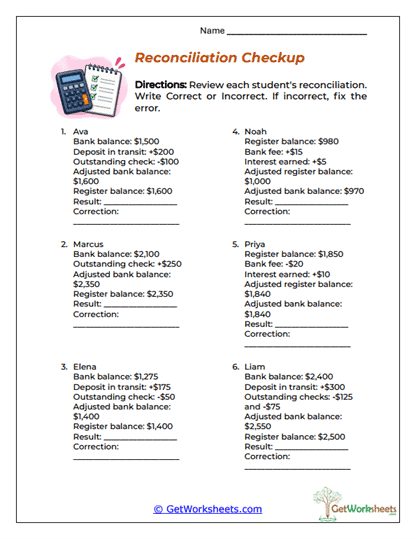
Reconciliation Repair Workshop
Completed reconciliation examples contain possible mistakes for students to identify and correct. Learners examine adjustments involving deposits, checks, fees, interest, and adjusted balances before deciding whether each result is accurate. Correcting another person's work requires deeper understanding than simply following a model. The activity strengthens error analysis and organized financial reasoning.
Running Balance Story Problems
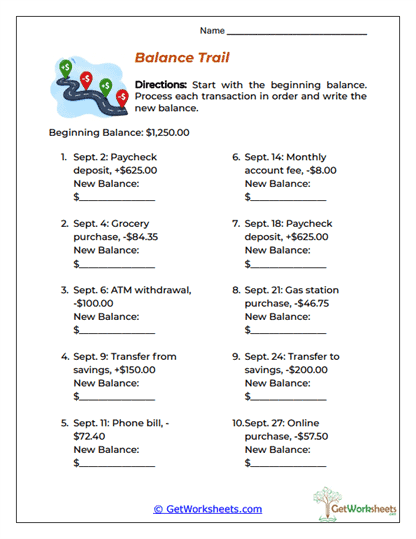
Students begin with a starting account balance and process a sequence of deposits, purchases, withdrawals, bills, fees, and transfers. Each result becomes the starting point for the next transaction, so accuracy and order matter throughout the activity. The worksheet turns decimal addition and subtraction into an ongoing financial story. It also helps students see how repeated expenses affect available money.
Statement Evidence Review
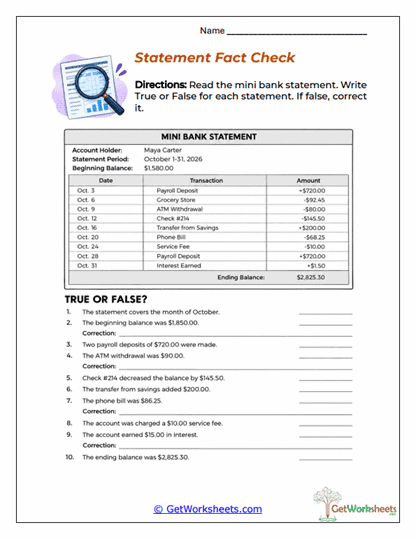
Claims about a bank statement are checked against the actual financial record. Students decide whether each statement is true or false and correct any information that does not match. This encourages learners to use dates, descriptions, and dollar amounts as evidence rather than relying on assumptions. The activity combines financial literacy, reading comprehension, and error correction.
Transaction Error Lab
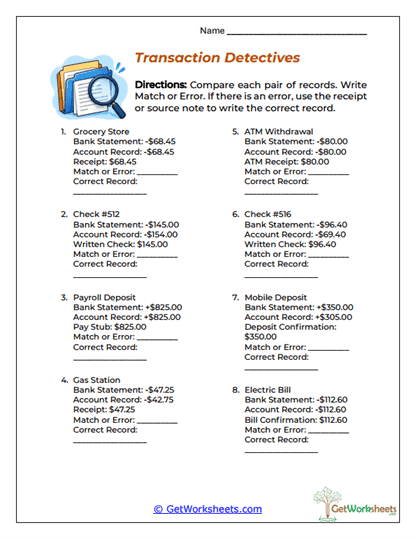
Students compare statements, account records, and supporting documents such as receipts, checks, or confirmations. They identify mismatched amounts and use the most reliable source to determine what the transaction should show. Even small differences in dollars or cents become important. This worksheet builds practical habits for checking financial records carefully.
Transaction Type Challenge
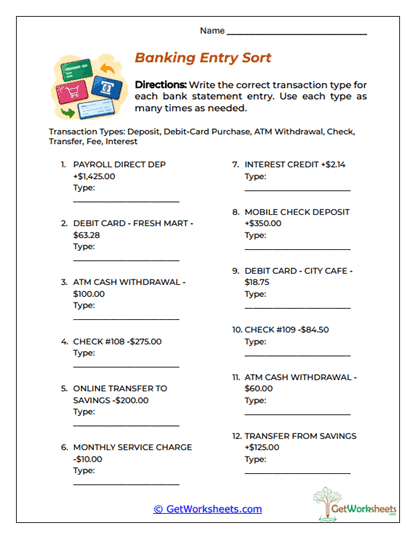
Short banking scenarios are classified as payroll deposits, debit purchases, ATM withdrawals, checks, transfers, fees, interest, mobile deposits, or other common transaction types. Students learn whether each action adds money, removes money, or moves it between accounts. Understanding this vocabulary makes later business-math problems easier to interpret. The activity strengthens financial classification and transaction awareness.
Bookmark Us Now!
New, high-quality worksheets are added every week! Do not miss out!