Break Time Check
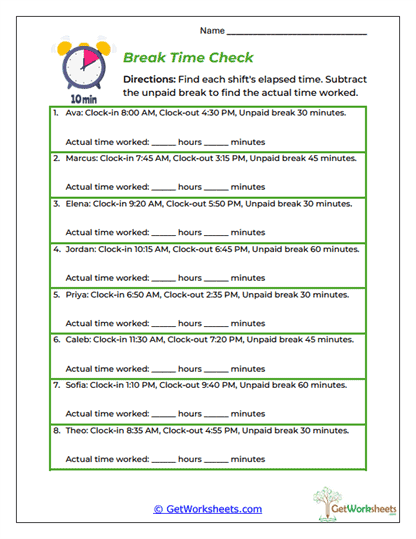
Break Time Check challenges students to calculate an employee’s actual working time after subtracting an unpaid break from the total duration of a shift. Eight employee scenarios provide specific clock-in times, clock-out times, and unpaid break lengths of 30, 45, or 60 minutes, requiring learners to complete a two-step calculation. The activity combines elapsed-time computation, time subtraction, hour-and-minute conversion, break deductions, and accurate timecard reporting within realistic business situations. Understanding the difference between total scheduled time and actual hours worked is an essential part of business math, particularly when examining employee compensation and workplace timekeeping practices.
Key Learning Objectives
-
Gross Shift Duration: Calculate the complete time interval between an employee’s starting and ending work times.
-
Unpaid Break Deductions: Subtract specified meal or rest periods to determine the amount of time that counts as actual work.
-
Minute Regrouping: Convert hours into minutes when necessary to subtract breaks accurately from a shift duration.
-
Net Hours Worked: Record the resulting paid work duration in hours and minutes without including unpaid time.
Educational Value
-
Named Employee Scenarios: Eight workplace examples connect mathematical calculations to individual employees and their daily schedules.
-
Multiple Break Lengths: The inclusion of 30-, 45-, and 60-minute deductions helps learners practice different subtraction situations.
-
Two-Step Problem Solving: Each exercise requires students to calculate total elapsed time before adjusting for an unpaid break.
-
Workplace Math Applications: The problems support instruction on employee time records, payroll preparation, and the distinction between scheduled and paid hours.
Break Time Check builds on basic time calculations by introducing an important additional factor in employee timekeeping: unpaid breaks. Rather than simply finding the difference between two clock readings, learners must use sequential reasoning, time subtraction, minute regrouping, and accurate hours-and-minutes reporting to determine the actual duration worked. This makes the activity useful for assessing whether students can apply elapsed-time skills to multistep workplace problems. Educators can also encourage learners to explain why a shift’s total length may differ from the hours recorded for compensation purposes. By reinforcing the distinction between elapsed time and net work hours, the worksheet prepares students for more advanced payroll and employment-related calculations.
Bookmark Us Now!
New, high-quality worksheets are added every week! Do not miss out!