Commissions and Sales Worksheets
About This Worksheet Collection
Commissions and sales help students understand how percentages connect directly to workplace earnings and business performance. A commission is usually calculated as a percent of sales, but real compensation plans can also include base pay, changing rates, sales targets, or tiered structures. Learning how these systems work gives students practical experience with percent calculations, decimals, money, and real-world financial reasoning.
This collection gives students several ways to practice commission math in business and career settings. Activities include calculating earnings from sales, completing commission records, matching problems with answers, solving for missing sales or rates, combining base pay with commission, checking errors, calculating real estate commissions, finding sales needed to reach an earnings goal, comparing compensation plans, working with tiered commissions, ranking employees, and solving career-based word problems. The worksheets are well suited for middle school and early high school business math, financial literacy, career readiness, tutoring, or homeschool instruction.
As students work through the collection, they strengthen percent multiplication, decimal operations, money notation, inverse reasoning, comparison, and multi-step problem solving. They also practice interpreting sales records, analyzing pay structures, checking whether answers are reasonable, comparing compensation options, and using percentages in realistic workplace situations. These activities help learners see how percent skills are used to calculate income, evaluate sales performance, and make practical business decisions.
Detailed Descriptions Of These Worksheets
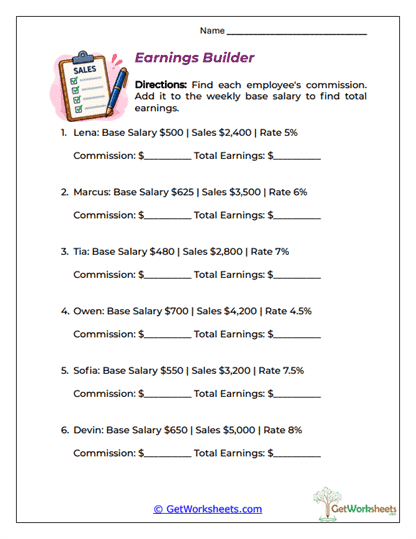
Base Pay Plus Sales
Students calculate commission earnings and then add them to a guaranteed base salary to find total pay. The multi-step structure shows how some workers receive both fixed and performance-based income. Learners compare the two parts of compensation and see how higher sales can affect the final paycheck. This activity strengthens percent calculations, money addition, and workplace income reasoning.
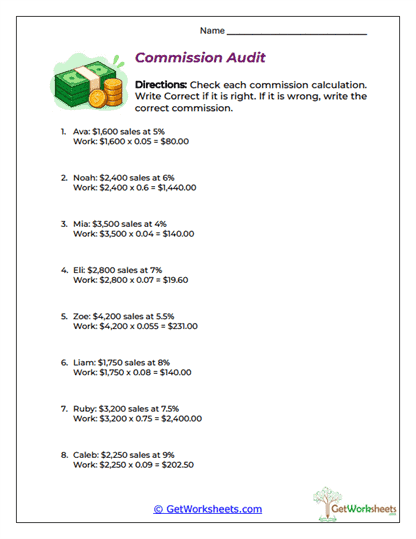
Commission Accuracy Audit
Completed commission calculations are reviewed for possible errors. Students compare sales amounts, commission rates, decimal forms, and shown earnings before deciding whether each result is correct. Incorrect examples must be recalculated and fixed. This worksheet develops percent accuracy, error analysis, and useful self-checking habits.
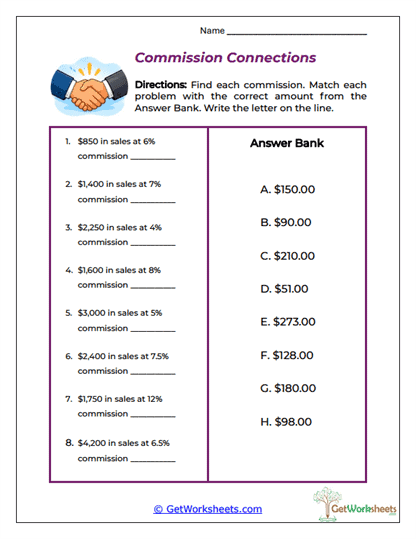
Commission Match-Up
Sales amounts and commission rates are used to calculate earnings that students then match with an answer bank. The matching format gives learners a built-in reasonableness check while still requiring them to complete the percent calculation. Different rates and sales totals provide varied practice. The activity strengthens commission fluency and error checking.
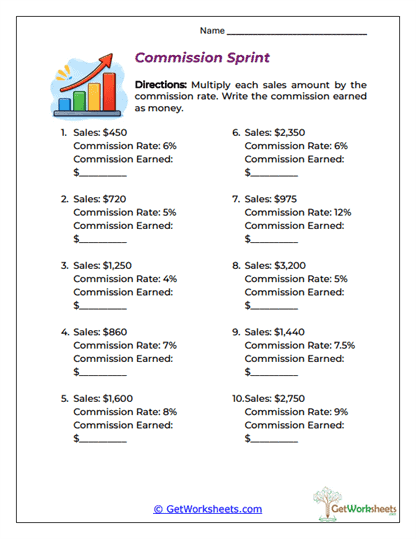
Commission Quick-Calc
Students calculate commission by finding a given percentage of each sales amount. They convert percent rates into usable decimal forms and express their results as money values. Repeated practice helps learners understand how both the sales total and the rate affect earnings. This worksheet provides a strong foundation for more advanced commission problems.
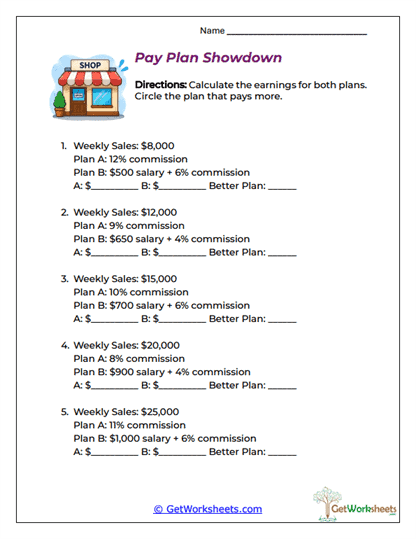
Compensation Plan Showdown
Two different pay structures are compared across several sales levels. Students calculate straight commission and compare it with base-pay-plus-commission plans to determine which option produces the higher earnings. The results show that the best compensation plan can change depending on sales performance. This activity combines percent math with real workplace decision-making.
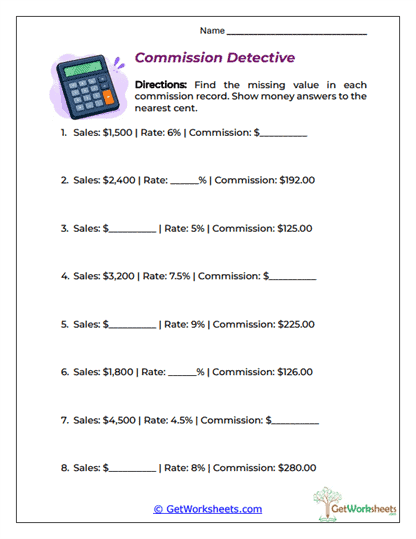
Missing Commission Solver
One part of the commission relationship is missing in each problem. Students may need to find the sales amount, commission rate, or earnings by working backward with multiplication or division. Identifying the unknown before choosing an operation encourages flexible reasoning. The worksheet builds algebra readiness through practical business situations.
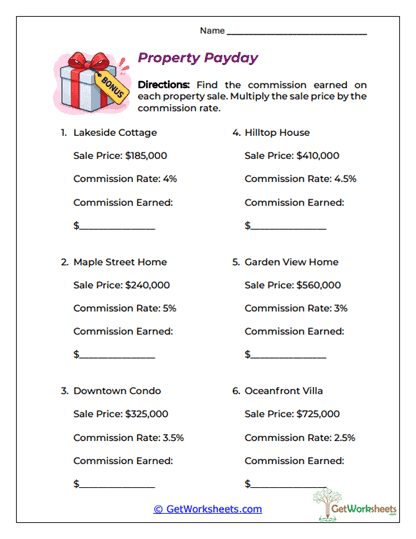
Property Sales Payday
Large property sales provide a realistic setting for commission calculations. Students apply percentages to high-value sale prices and determine the resulting earnings. The larger numbers encourage careful use of decimals, estimation, and calculator skills. This activity shows that the same commission rule works even when business amounts become much larger.
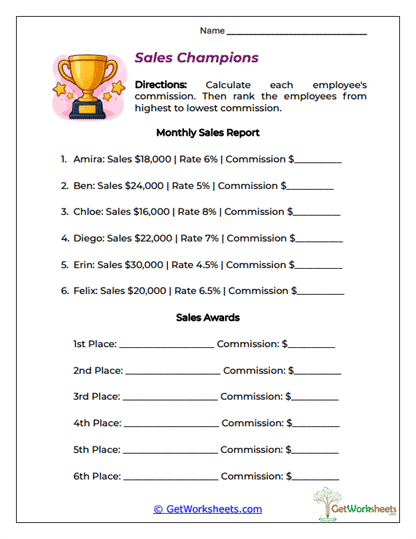
Sales Ranking Challenge
Students calculate commissions for several employees and then order the workers from highest to lowest earnings. Different combinations of sales totals and commission rates show that the person with the greatest sales does not always earn the largest commission. Learners must interpret their calculated results rather than stopping after the arithmetic. This worksheet strengthens comparison and business-data reasoning.
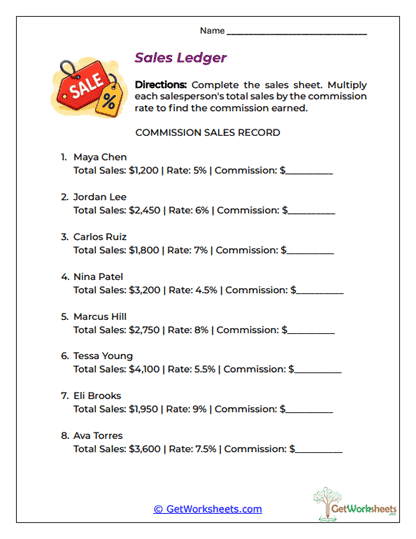
Sales Record Earnings
A business-style ledger lists salespeople, total sales, and commission rates. Students calculate each worker's earnings and complete the missing information in the record. Pulling the correct values from a structured table adds a practical data-reading component to the percent work. The activity reinforces commission calculation and organized financial recordkeeping.
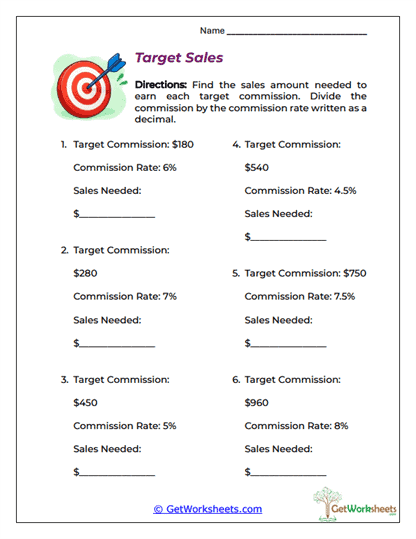
Target Earnings Planner
Students are given a desired commission amount and a commission rate and must determine the sales needed to reach that goal. Working backward requires division and strengthens understanding of the relationship among rate, sales, and earnings. Comparing different rates also shows why a lower percentage requires more sales to reach the same target. This activity develops inverse reasoning and goal-based business planning.
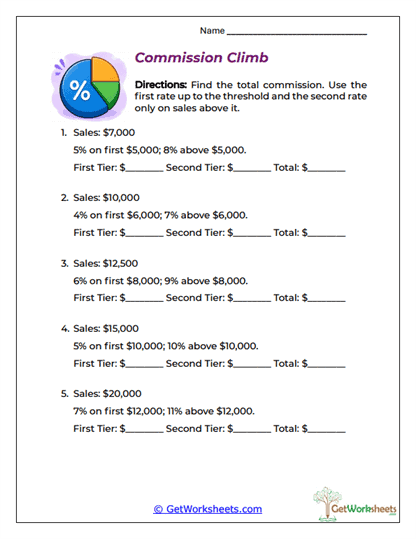
Tiered Commission Ladder
Commission earnings are calculated using multiple rates across different sales levels. Students separate the portion of sales that belongs in each tier, calculate the commission for each part, and combine the results. The layered structure introduces a more realistic compensation system than a single flat percentage. This worksheet develops multi-step percent reasoning and careful organization.
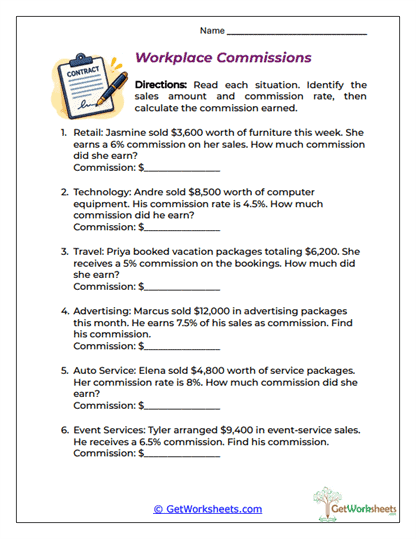
Workplace Commission Scenarios
Short career-based situations place commission math in industries such as retail, technology, travel, advertising, automotive services, and event services. Students identify the important sales amount and rate before calculating the commission earned. The word-problem format combines reading comprehension with percent skills and career awareness. This activity helps learners recognize commission math even when it appears inside a realistic workplace story.
Bookmark Us Now!
New, high-quality worksheets are added every week! Do not miss out!