Timecard Fill-In
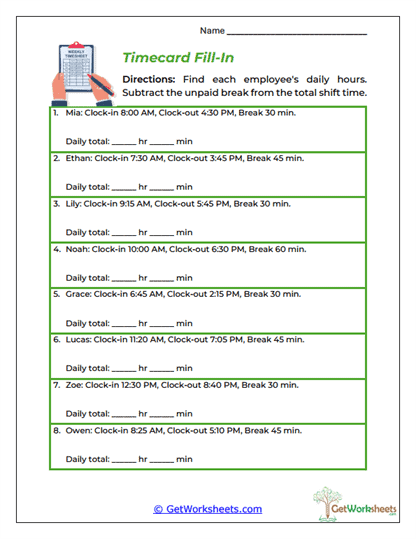
Timecard Fill-In provides a structured business math activity in which students calculate daily employee work totals from recorded clock-in times, clock-out times, and unpaid breaks. Each of the eight numbered entries presents a different employee’s work schedule, requiring learners to determine the shift’s elapsed duration and subtract the designated break period. The calculations develop proficiency with time intervals, clock arithmetic, AM and PM notation, minute regrouping, and net working-time calculations. Presented in a daily timecard format, the exercise connects these mathematical operations to employee recordkeeping, payroll preparation, and accurate business documentation.
Instructional Objectives
-
Daily Timecard Calculations: Determine the total time between an employee’s beginning and ending shift times.
-
Break Adjustment: Deduct the listed 30-, 45-, or 60-minute unpaid break to calculate the actual daily work duration.
-
Time Conversion and Subtraction: Use hours-to-minutes relationships to complete calculations involving partial hours and changing minute values.
-
Accurate Record Completion: Enter each employee’s daily total using the designated hours and minutes fields.
Classroom & Home Use
-
Eight Individual Timecards: Employee-specific scenarios provide opportunities to practice calculations across different daily schedules.
-
Consistent Answer Format: Dedicated hour and minute spaces encourage organized responses and reinforce appropriate time notation.
-
Realistic Workday Examples: The inclusion of varied starting times, ending times, and break periods reflects common employee timekeeping situations.
-
Flexible Practice Opportunities: Suitable for independent work, homework, business math assessments, and guided instruction on payroll recordkeeping.
Timecard Fill-In emphasizes both mathematical accuracy and the importance of maintaining reliable employee work records. Completing each entry requires students to interpret clock times, calculate elapsed hours, subtract unpaid minutes, regroup time units, and report daily totals correctly. The repeated timecard format encourages a consistent calculation routine, helping learners distinguish between an entire shift and the portion that qualifies as actual working time. Teachers can extend classroom discussion by examining how small mistakes in time subtraction or break deductions could affect employee records. This practical connection between arithmetic and administrative accuracy helps prepare learners for subsequent lessons involving weekly timesheets, decimal payroll hours, and employee earnings calculations.
Bookmark Us Now!
New, high-quality worksheets are added every week! Do not miss out!