Hours Over Forty
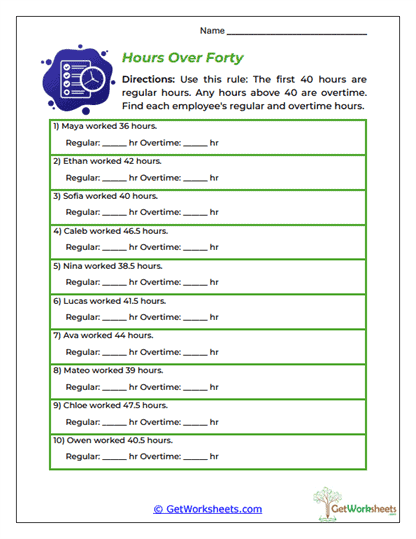
Hours Over Forty helps students understand how weekly employee work hours are divided into regular hours and overtime hours under a simplified 40-hour threshold rule. Ten employee scenarios present weekly totals ranging from fewer than 40 hours to more than 40 hours, requiring learners to identify the first 40 hours as regular time and classify any additional hours as overtime. The activity reinforces numerical comparison, subtraction, decimal-hour interpretation, threshold calculations, and employee timecard classification within a practical business math context. By examining how different weekly schedules affect the distribution of work hours, students develop foundational knowledge for payroll calculations and the mathematical treatment of overtime.
Learning Goals
-
Regular Hour Identification: Determine how many hours qualify as regular working time when an employee works fewer than, exactly, or more than 40 hours.
-
Overtime Hour Calculations: Subtract 40 from weekly totals exceeding the threshold to identify the additional hours worked.
-
Decimal Work-Hour Interpretation: Correctly handle half-hour values such as 41.5, 46.5, and 47.5 when separating regular and overtime hours.
-
Work-Hour Classification: Record regular and overtime amounts separately while verifying that their sum equals the employee’s original weekly total.
Educational Value
-
Ten Employee Scenarios: Weekly hour totals provide repeated practice with regular and overtime classification.
-
Mixed Weekly Workloads: Examples include employees working below, exactly at, and above the 40-hour threshold.
-
Fractional-Hour Practice: Half-hour values challenge learners to apply decimal subtraction accurately when calculating overtime.
-
Clear Calculation Rule: Directions explain that the first 40 hours are regular and hours beyond that amount are overtime, providing a consistent mathematical guideline.
-
Workplace Payroll Connections: The exercises introduce a key distinction used in many employee compensation calculations while keeping the focus on hours rather than pay rates.
Hours Over Forty strengthens students’ understanding of how weekly work totals can be classified for payroll purposes. By interpreting employee schedules, comparing numerical values, calculating differences, applying decimal subtraction, and verifying hour classifications, learners gain confidence with an important business math procedure. Educators can use the activity to discuss the mathematical difference between regular and overtime hours, including why an employee working exactly 40 hours has no overtime under the worksheet’s rule. The examples also prepare students to recognize fractional overtime amounts and avoid incorrectly treating every hour worked as overtime once the threshold has been exceeded. This understanding provides a foundation for more advanced lessons involving overtime pay rates, gross earnings, wage calculations, and employee payroll management, while recognizing that actual overtime eligibility depends on applicable employment rules.
Bookmark Us Now!
New, high-quality worksheets are added every week! Do not miss out!