Comparing Fractions and Decimals Worksheets
About This Worksheet Collection
Comparing fractions and decimals teaches students how to recognize the size and value of numbers even when they are written in different forms. A fraction such as 1/2 and a decimal such as 0.50 represent the same amount, so learners need to understand equivalence before they can compare or order mixed values confidently. Working with both forms helps students develop flexible number sense and prepares them for later lessons involving percents, ratios, measurement, and rational numbers.
This collection gives students several ways to explore fraction-and-decimal relationships. Activities include matching equivalent values, using comparison symbols, ordering mixed numbers, plotting values on number lines, working with visual models, analyzing mistakes, and solving practical problems involving shopping, measurements, and data tables. The pages can be used during whole-class instruction, independent practice, math centers, tutoring, intervention, homework, or homeschool lessons.
As students work through the collection, they strengthen their ability to convert common fractions and decimals, recognize equivalent quantities, compare magnitude, and use benchmarks such as 0, 1/2, and 1. They also practice interpreting number lines, reading tables, applying place-value knowledge, and explaining mathematical reasoning. These varied activities help learners move beyond memorized procedures and develop a clearer understanding of how fractions and decimals relate to one another.
Detailed Descriptions Of These Worksheets
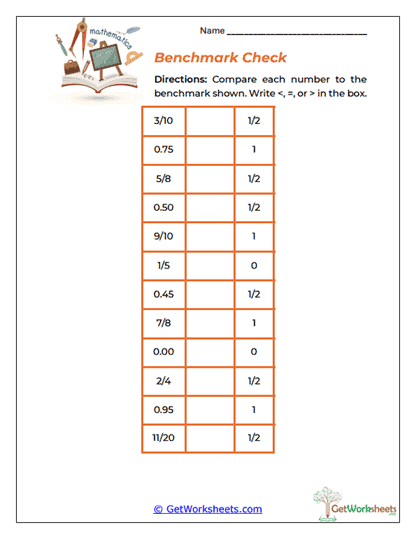
Benchmark Check
Familiar reference values provide a quick and approachable way to judge the size of fractions and decimals. Students compare mixed numbers with benchmarks such as zero, one-half, and one, then record the relationship with the correct symbol. The activity encourages mental reasoning rather than requiring a full written conversion every time. With practice, learners become faster at estimating whether a value falls below, matches, or exceeds an important benchmark.
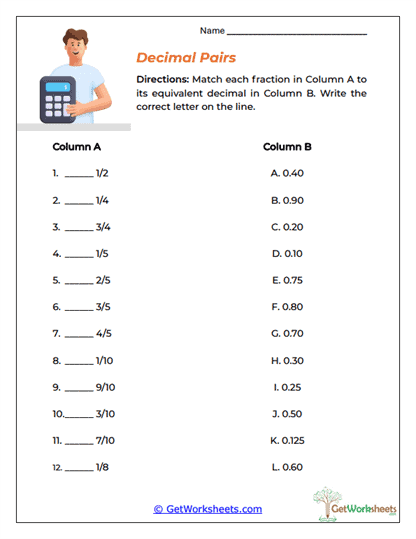
Decimal Pairs
Learners match familiar fractions with decimals that represent the same amount. The activity encourages them to connect fractional parts with tenths and hundredths while becoming more comfortable with common equivalents. Repeated practice helps values such as 1/2, 1/4, and 3/4 become easier to recognize mentally. This is a useful page for building the foundation students need before comparing mixed number forms.
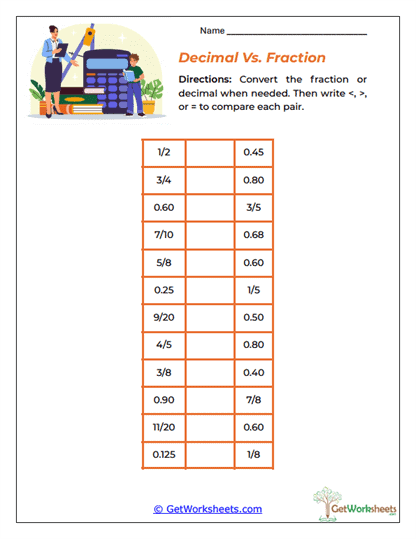
Decimal vs. Fraction
This activity asks children to compare a fraction directly with a decimal and choose the correct less than, greater than, or equal to symbol. They may convert one value into another form or rely on familiar benchmark equivalents to make each decision. Working across two forms of notation helps students focus on actual value rather than how a number looks. The practice supports stronger place-value reasoning and more flexible comparison strategies. It works especially well for learners who already understand fractions and decimals separately and are ready to connect the two.
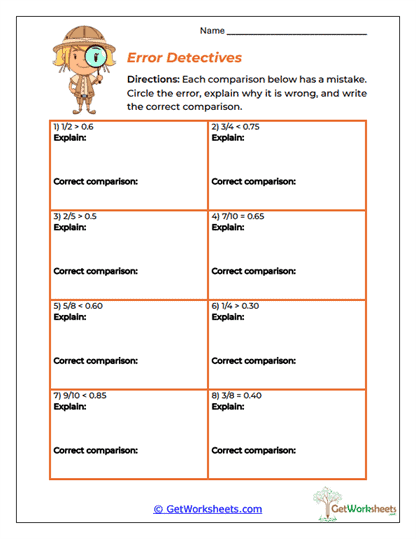
Error Detectives
Learners take on the role of math detectives as they examine fraction-and-decimal comparisons that contain errors. They decide what went wrong, explain the misunderstanding, and replace the incorrect comparison with an accurate one. Mistakes may involve conversion, decimal place value, equivalence, or misuse of comparison symbols. Analyzing incorrect reasoning helps children become more thoughtful about checking their own work. It also gives teachers and parents a useful way to identify misconceptions that may need additional review.
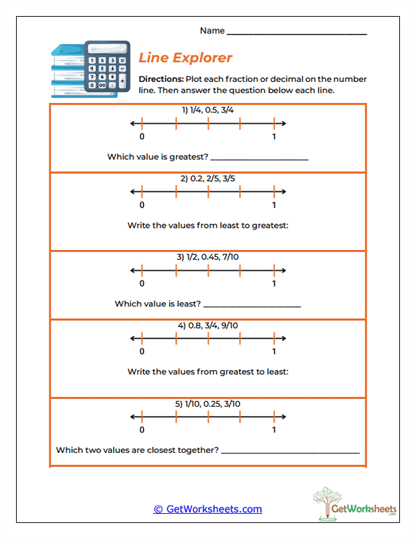
Line Explorer
Number lines give learners a visual way to see where fractions and decimals belong between zero and one. Students plot mixed values and use their positions to answer questions about order, size, and proximity. Benchmarks such as one-half provide helpful reference points when estimating where each number should go. Seeing equivalent values occupy the same location makes fraction-decimal relationships much more concrete.
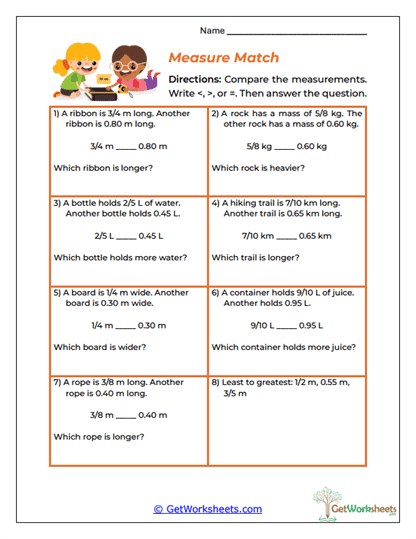
Measure Match
Measurement situations encourage children to apply fraction-and-decimal comparisons to lengths, weights, capacities, and other quantities. Students compare measurements written in two different number forms and then use the result to answer a practical question. Converting a familiar fraction to a decimal can help make close values easier to evaluate. Attention to measurement units adds another layer of useful mathematical thinking. The activity shows learners how mixed number forms can appear naturally in real-life measurements.
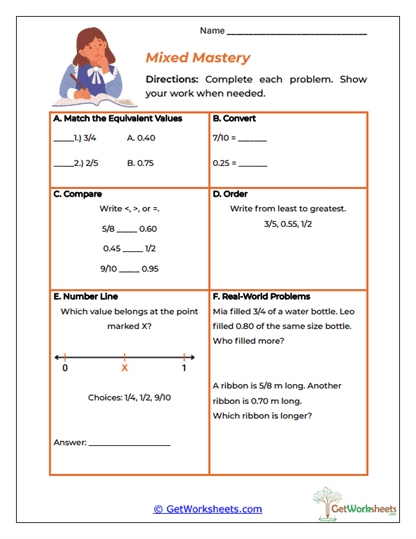
Mixed Mastery
This review page brings together many of the collection's major fraction-and-decimal skills. Students work with equivalent-value matching, conversions, comparison symbols, ordering, number lines, and short real-world applications. Moving among different question types requires learners to decide which strategy makes the most sense for each problem. The varied format can help teachers spot concepts that are secure as well as areas that may need more practice. It makes a useful final review before students begin working more extensively with percents, ratios, and other rational-number concepts.
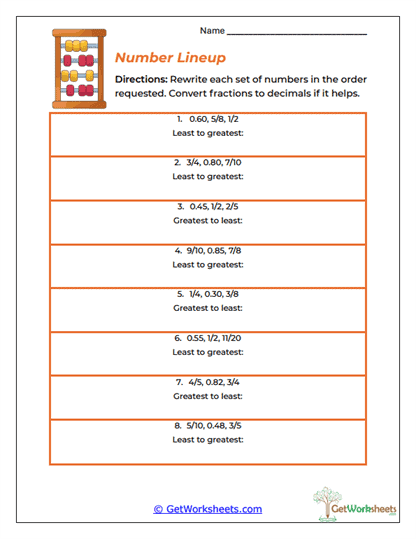
Number Lineup
Several fractions and decimals must be arranged in the requested order on each part of this page. Learners can make the task easier by rewriting fractions as decimals and then comparing all of the values in a consistent form. Because more than two numbers are involved, students must pay close attention to small differences in magnitude. The activity also reinforces the idea that differently written numbers may sometimes be equal. It provides a natural next step after students become comfortable making one-to-one comparisons.
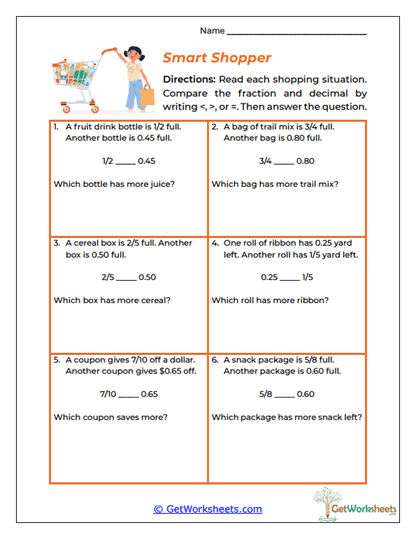
Smart Shopper
Everyday shopping situations give students a meaningful setting for comparing fractions and decimals. Learners examine amounts connected with containers, packages, coupons, or similar situations and determine which quantity is greater or whether the values are equal. They must understand both the numerical relationship and what that relationship means within the scenario. The real-world format blends computation with reading comprehension and practical decision-making.
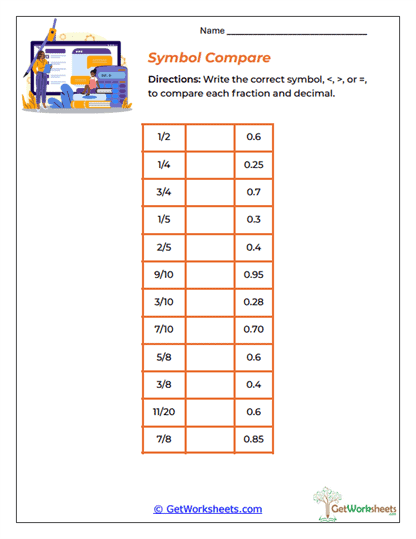
Symbol Compare
Students get focused practice comparing fractions and decimals one pair at a time. Each problem requires them to determine the relationship between the two quantities and record the appropriate comparison symbol. Familiar equivalents can be solved mentally, while less obvious examples encourage careful conversion and place-value thinking. The straightforward format is helpful for warm-ups, review, homework, or extra fluency practice.
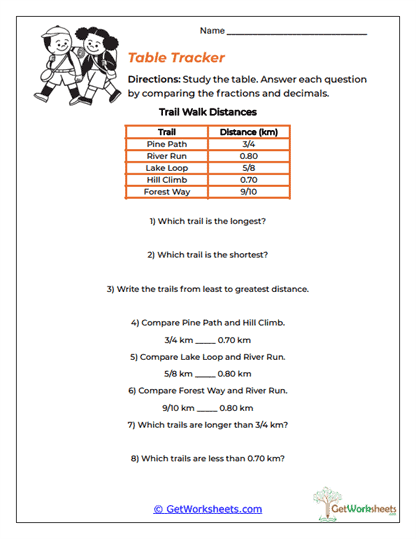
Table Tracker
A data table filled with fraction and decimal measurements gives students practice locating, interpreting, and comparing information. Learners identify larger and smaller values, put selected measurements in order, and answer questions based on the table. Converting values when needed helps them keep several different quantities organized. This page combines number sense with introductory data-literacy skills in a practical format.
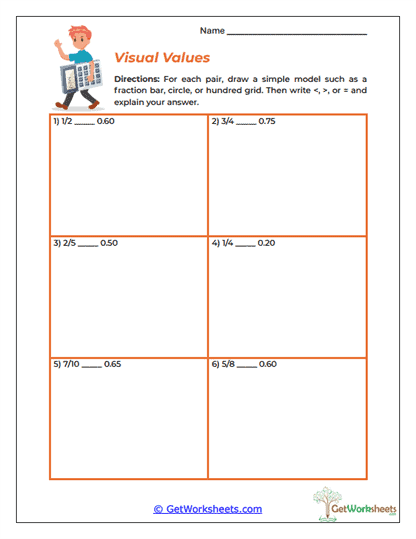
Visual Values
Instead of relying only on symbols, learners draw models to represent the fraction and decimal in each comparison. Fraction bars, circles, or hundred grids can help them see which quantity covers more, less, or the same part of a whole. After examining the models, students choose the correct comparison symbol and explain how the picture supports their answer. This approach is especially helpful for children who benefit from seeing the mathematics before working with abstract notation. It also encourages students to communicate the reasoning behind their comparisons.
Bookmark Us Now!
New, high-quality worksheets are added every week! Do not miss out!