Bank Statements Worksheets
About This Worksheet Collection
Bank statements help students understand how money moves through an account over time. By reading deposits, withdrawals, fees, transfers, interest, and balances, learners begin to see how everyday banking records are organized and how each transaction changes the amount of money available. These skills combine financial literacy with decimal computation, careful reading, and real-world problem solving.
This collection gives students several ways to practice interpreting and checking bank records. Activities include reading complete statements, identifying transaction types, maintaining running balances, checking true-or-false claims, solving for missing amounts, comparing statements with account registers, identifying cleared and pending items, totaling fees, completing reconciliations, finding errors, and analyzing paycheck spending. The worksheets are well suited for middle school business math, consumer math, financial literacy, independent practice, tutoring, or homeschool instruction.
As students work through the collection, they strengthen bank-statement reading, money addition and subtraction, transaction analysis, account reconciliation, financial vocabulary, and error-checking skills. They also practice distinguishing money coming in from money going out, identifying timing differences between records, calculating adjusted balances, and using evidence to verify financial information. These activities help learners build the practical habits needed to understand and manage everyday financial records with greater confidence.
Detailed Descriptions Of These Worksheets
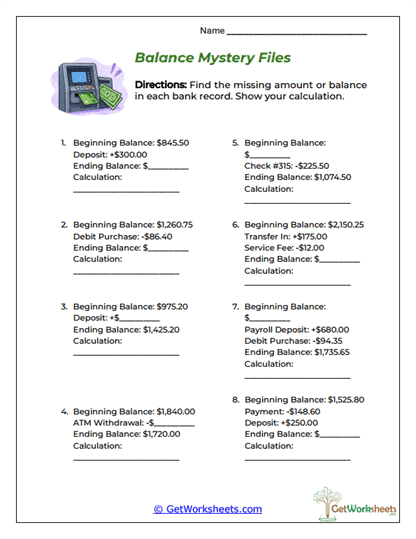
Balance Mystery Files
Students work backward through banking situations to determine missing deposits, withdrawals, payments, or beginning balances. They use known starting and ending amounts to figure out what transaction must have occurred in between. Showing the calculation encourages learners to explain the reasoning behind each answer. This activity strengthens money equations, inverse operations, and algebra readiness.
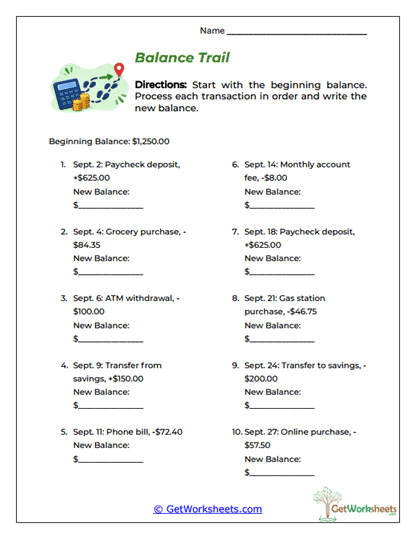
Balance Trail
A starting balance is updated one transaction at a time as students process deposits, purchases, withdrawals, transfers, and fees. Each new balance becomes the starting point for the next transaction, making careful order especially important. The worksheet reinforces decimal addition and subtraction in a realistic account-management setting. It also shows how several small transactions can affect a balance over time.
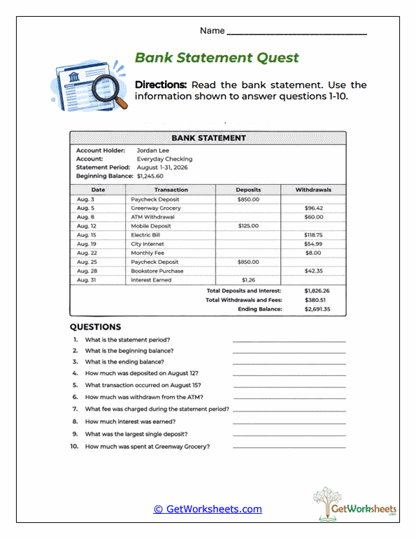
Bank Statement Quest
Students read a realistic bank statement and answer questions about the statement period, beginning balance, deposits, withdrawals, interest, and ending balance. They must locate the correct transaction information rather than rely on guesswork. The activity combines financial vocabulary with reading comprehension and money math. It provides a strong introduction to understanding actual account records.
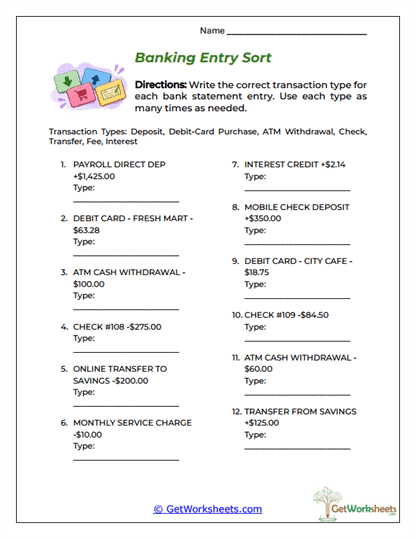
Banking Entry Sort
Common banking entries are classified by transaction type. Students identify examples involving direct deposits, debit-card purchases, ATM withdrawals, checks, transfers, fees, and interest credits. Sorting the entries helps learners recognize whether money entered, left, or moved within an account. This worksheet builds the vocabulary needed to interpret statements and banking apps more confidently.
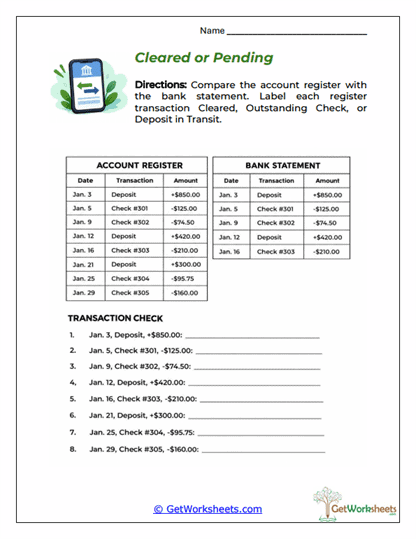
Cleared or Pending
Students compare an account register with a bank statement and determine whether transactions have cleared, remain outstanding, or represent deposits in transit. Matching dates, check numbers, descriptions, and amounts shows why two financial records may temporarily disagree. The activity introduces important reconciliation vocabulary in a practical context. It helps learners understand that timing differences do not always mean an error has occurred.
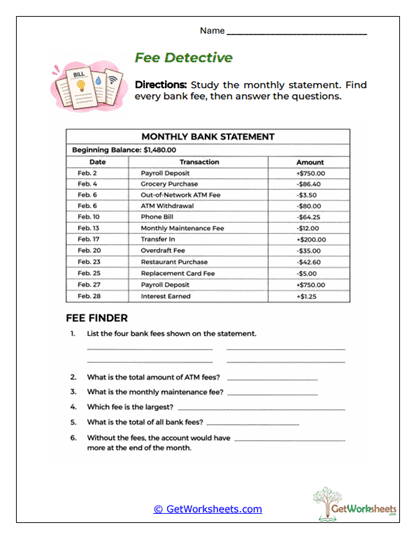
Fee Detective
A monthly bank statement is examined for ATM charges, maintenance fees, overdraft costs, replacement-card fees, and other account charges. Students locate the fees, calculate their total, and compare their impact on the balance. This activity reinforces decimal addition while showing how repeated fees can reduce available money. It also encourages thoughtful discussion about avoiding unnecessary banking costs.
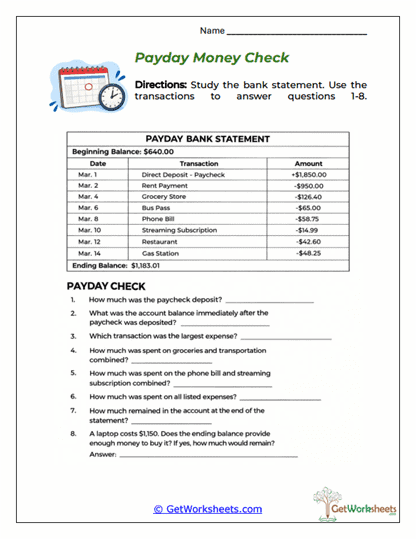
Payday Spending Review
Students follow what happens after a paycheck enters an account and several monthly expenses are paid. They identify income, compare spending categories, determine the largest expense, calculate money remaining, and consider whether additional purchases are affordable. The statement format connects banking with basic budgeting decisions. This worksheet helps learners understand that earning money and having money available to spend are not the same thing.
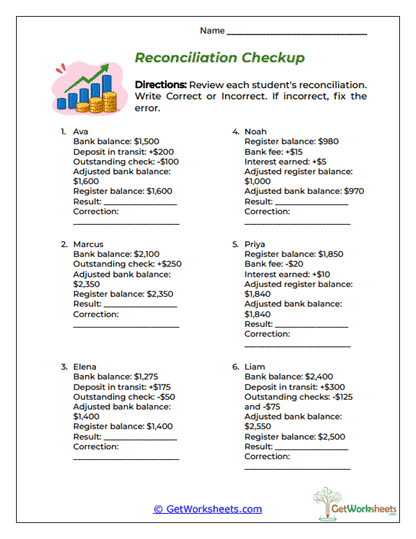
Reconciliation Checkup
Completed reconciliation examples are reviewed for mistakes involving deposits in transit, outstanding checks, fees, interest, and adjusted balances. Students decide whether each calculation is correct and repair any errors they find. Evaluating another person's work requires deeper understanding than simply following a procedure. The activity strengthens multi-step reasoning and financial error detection.
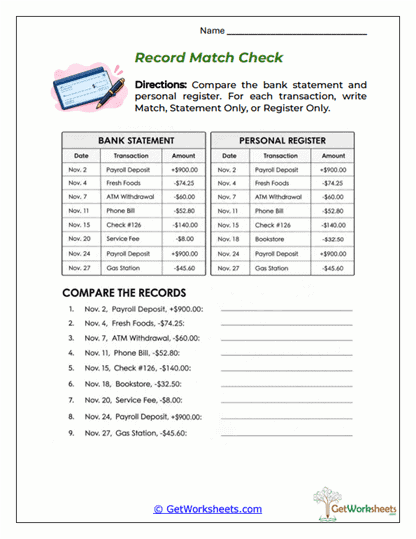
Record Match Check
Students compare a bank statement and personal account register side by side. They determine which transactions appear in both records, which appear only on one side, and whether matching amounts agree exactly. The task introduces the basic idea behind reconciling financial records. It also develops close attention to dates, descriptions, and dollar amounts.
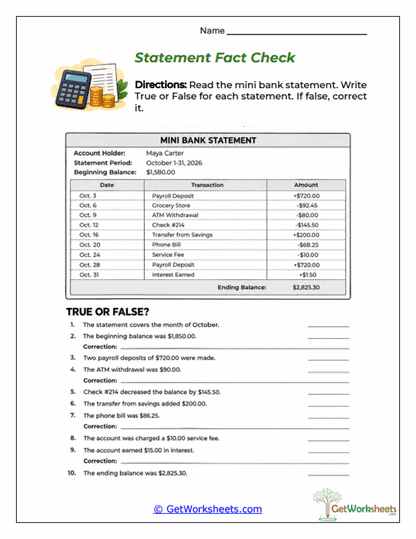
Statement Fact Check
Written claims about a mini bank statement are evaluated as true or false. Students verify each claim by returning to the statement and checking balances, deposits, withdrawals, transfers, fees, and other details. Incorrect statements must be corrected using the actual account information. This worksheet builds evidence-based reasoning and careful financial reading.
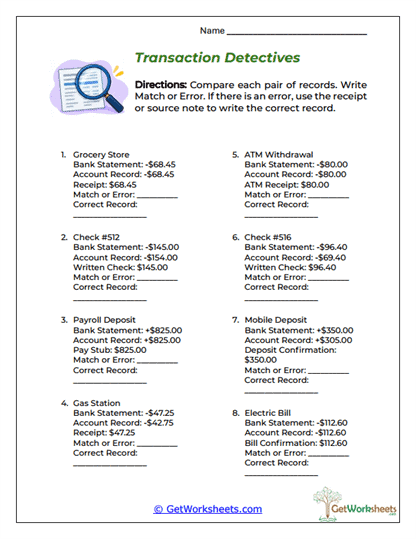
Transaction Detective
Students compare statements, account records, receipts, or written checks to determine whether financial amounts agree. When records do not match, learners identify the error and determine what the correct transaction should be. Small differences in dollars, cents, or copied digits become important clues. The activity develops practical error-checking habits that are useful in real money management.
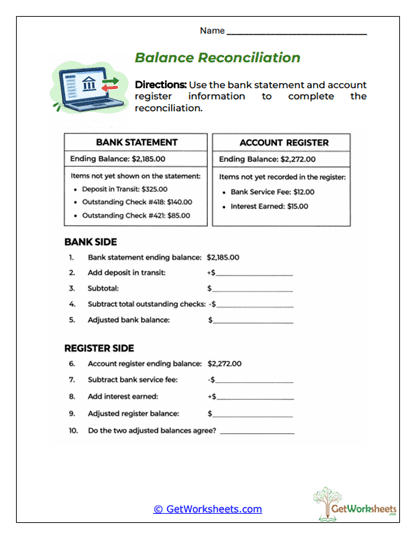
Two-Side Balance Check
Students complete a simplified bank reconciliation by adjusting both the bank balance and the account-register balance. Deposits in transit and outstanding checks are handled on the bank side, while fees and interest are considered on the register side. The goal is to calculate two adjusted balances that agree. This multi-step activity provides an authentic introduction to account reconciliation and basic accounting procedures.
Bookmark Us Now!
New, high-quality worksheets are added every week! Do not miss out!