Company Formation Worksheets
About This Worksheet Collection
Company formation helps students understand the financial and organizational decisions involved in starting a business. Learners explore how ownership structures work, how startup costs are calculated, how investors contribute capital, and how ownership percentages can be divided among founders. These topics connect business vocabulary with addition, subtraction, percentages, ratios, and real-world financial planning.
This collection gives students several ways to practice the math and decision-making involved in forming a company. Activities include identifying business structures, comparing ownership setups, totaling startup expenses, finding funding gaps, calculating investor shares, dividing profits by ownership percentage, checking startup capital, solving for missing contributions, comparing formation costs, reviewing errors, and matching equity shares. The worksheets are well suited for middle school and early high school business math, entrepreneurship, financial literacy, career readiness, tutoring, or homeschool instruction.
As students work through the collection, they strengthen startup budgeting, ownership reasoning, percent calculations, part-to-whole thinking, money operations, and business decision-making. They also practice comparing costs, checking whether funding is sufficient, calculating equity, analyzing liability and ownership needs, and reviewing financial calculations for accuracy. These activities help learners understand that forming a business involves both organizational choices and careful financial planning.
Detailed Descriptions Of These Worksheets
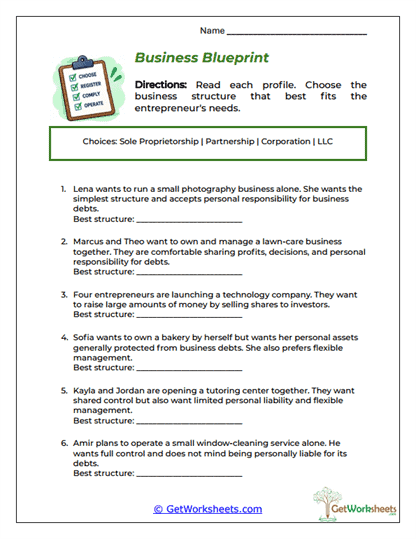
Business Structure Fit
Students read company profiles and decide whether a sole proprietorship, partnership, corporation, or LLC best matches the owners' needs. They consider factors such as number of owners, liability protection, management, funding, and control. The activity moves beyond memorizing definitions by requiring learners to apply business concepts to realistic situations. It strengthens comparison, decision-making, and entrepreneurship reasoning.
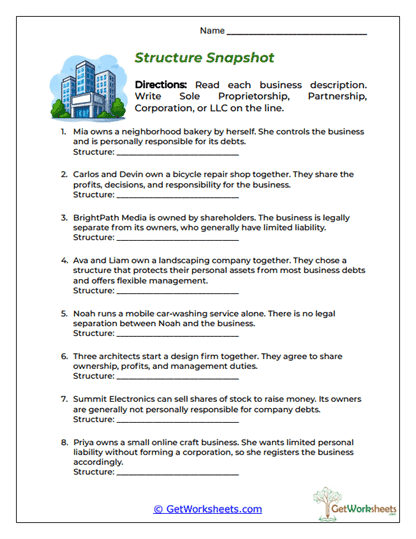
Business Structure Snapshot
Short business descriptions give students clues about ownership, liability, shared profits, and legal organization. Learners identify whether each company is a sole proprietorship, partnership, corporation, or LLC. The scenario format makes common business structures easier to understand in context. This worksheet builds vocabulary and helps students see how company organization affects responsibility and control.
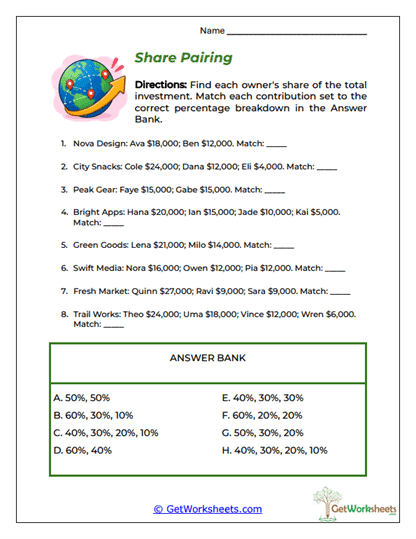
Equity Share Match
Students calculate each owner's share of a company's total investment and match the results to percentage breakdowns in an answer bank. The activity combines addition, division, ratios, and percentages in a business ownership setting. Checking that all shares total 100% provides a useful way to verify the work. This worksheet strengthens equity reasoning and part-to-whole understanding.
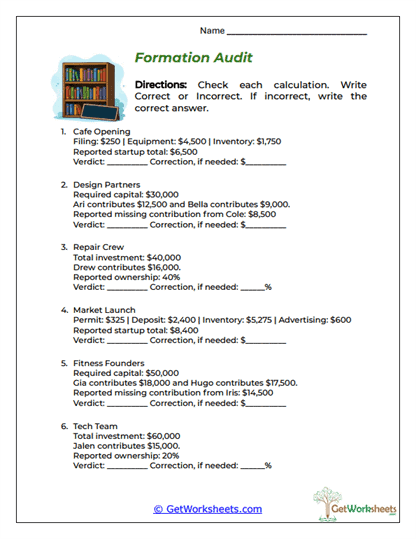
Formation Accuracy Review
Completed business-formation calculations are checked for errors involving startup costs, capital contributions, ownership percentages, and missing investments. Students decide whether each result is correct and repair any mistakes. Reviewing someone else's work requires learners to understand both the calculation and the business meaning behind it. This activity develops financial accuracy and error-analysis skills.
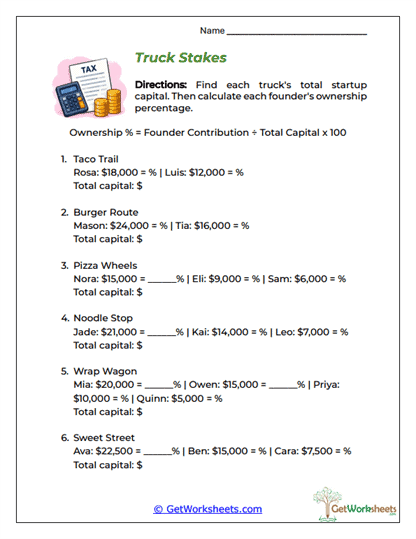
Founder Ownership Breakdown
Founder contributions are converted into ownership percentages. Students first calculate total startup capital, then determine what portion of that total came from each founder. Comparing the resulting percentages shows how different investment amounts can lead to different equity stakes. The activity provides meaningful practice with part-to-whole relationships and percent calculations.
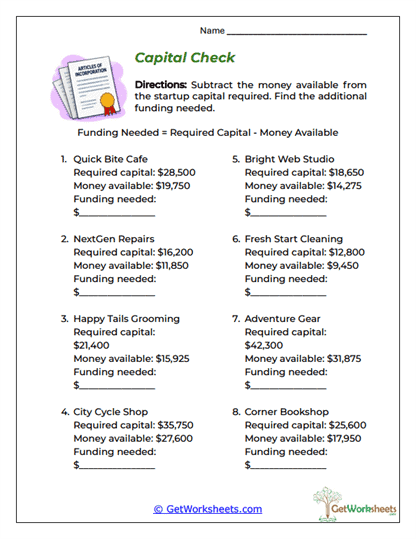
Funding Gap Finder
Students compare the amount of startup capital a business requires with the money already available. They subtract to determine how much additional funding is still needed. The straightforward setup gives subtraction a clear business-planning purpose. This worksheet also reinforces important vocabulary such as capital, available funds, and funding gap.
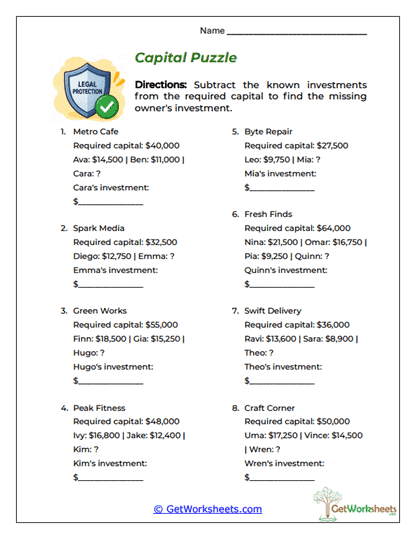
Missing Investor Amount
A required capital total and several known investments are provided, leaving one contribution unknown. Students add the known amounts and work backward to determine how much the remaining investor must provide. The practical setup introduces equation-style reasoning without making the problem overly abstract. It strengthens multi-step subtraction and business investment understanding.
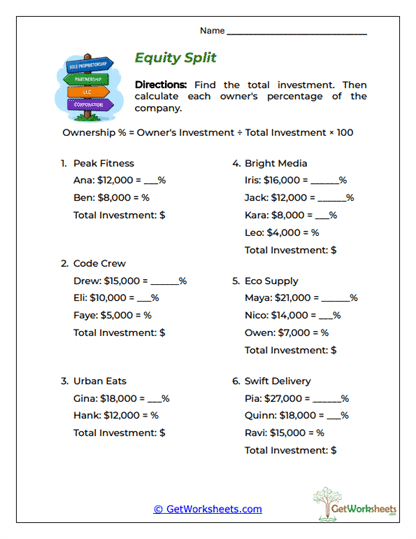
Ownership Share Calculator
Students determine how a company's total investment is divided among two or more owners. They add all contributions, divide each person's investment by the total, and convert the result into an ownership percentage. The multi-step process connects ratios and percentages with real equity decisions. Learners can check their results by confirming that all ownership shares add to 100%.
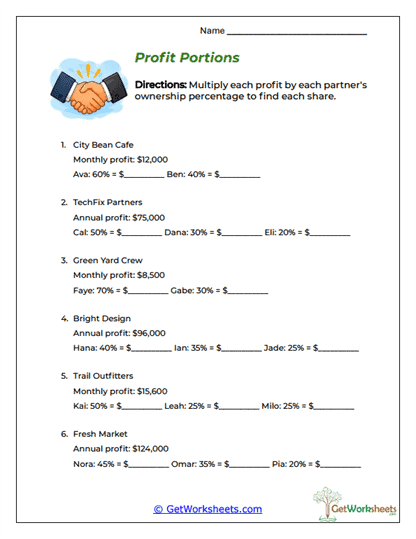
Profit Share Breakdown
Students use ownership percentages to calculate how a company's profit is divided among its owners. Each partner's share is found by multiplying the total profit by the corresponding ownership percentage. Adding all individual shares back together provides a natural accuracy check. This activity strengthens percent-of-a-number skills while showing how equity can affect business earnings.
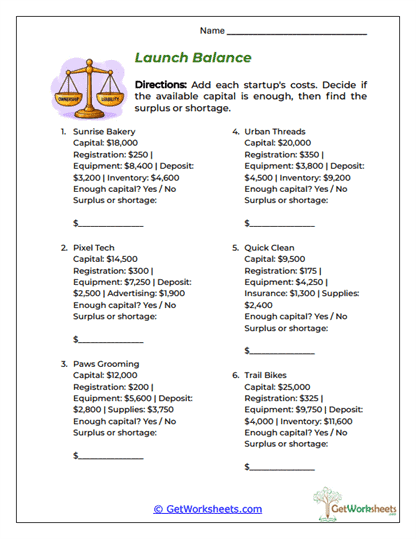
Startup Capital Check
Learners total registration fees, equipment, inventory, insurance, advertising, deposits, and other startup expenses before comparing the result with available funding. They determine whether the business has enough money to launch and calculate either a surplus or shortage. The multi-step format combines addition, comparison, and subtraction. It helps students see how a startup budget supports real business decisions.
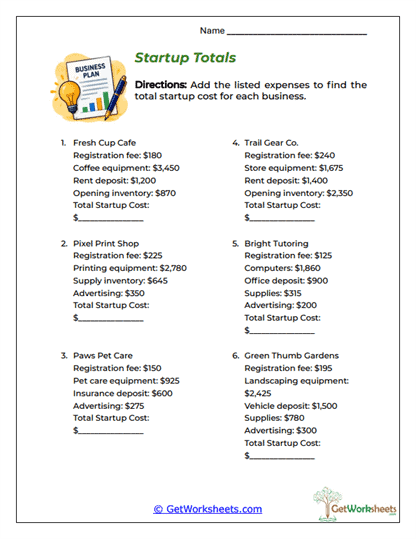
Startup Cost Builder
Students add several expenses to determine the total amount required to open different businesses. Costs may include equipment, rent deposits, supplies, vehicles, inventory, insurance, registration, and marketing. The activity emphasizes careful organization so no expense is overlooked. It provides practical practice with larger money values and startup budgeting.
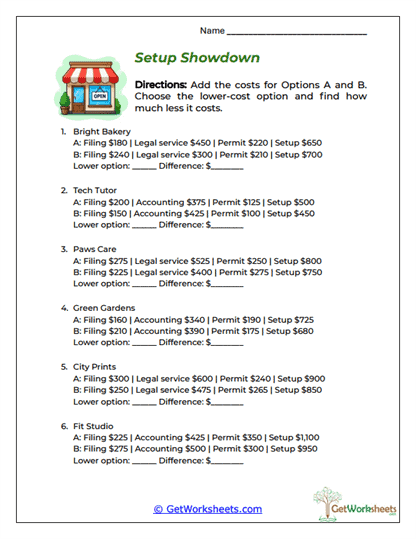
Startup Cost Comparison
Two possible startup plans are compared by totaling filing fees, permits, legal services, accounting costs, and other setup expenses. Students identify the lower-cost option and calculate the difference between the two totals. This requires learners to consider the complete cost rather than focusing on one advertised fee. The worksheet combines arithmetic with practical business decision-making.
Bookmark Us Now!
New, high-quality worksheets are added every week! Do not miss out!