Online Banking Worksheets
About This Worksheet Collection
Online banking offers a practical setting for learning how money moves, how account records are organized, and how digital transactions affect available funds. These business math worksheets introduce students to deposits, purchases, transfers, fees, scheduled payments, and account activity while building familiarity with everyday banking language.
Across the collection, students classify transactions, update balances, read account histories, investigate discrepancies, and consider digital banking alerts. Some activities focus on computation; others ask learners to compare records, apply rules, or make decisions using financial information. The worksheets can be used in business math and personal finance lessons, for independent practice, or at home.
Working through these scenarios strengthens decimal arithmetic, financial recordkeeping, data interpretation, and problem-solving. Students also learn to track how one transaction changes an account, check their calculations, and notice when information may need a closer look. Together, these skills support more thoughtful budgeting and responsible use of banking services.
Detailed Descriptions Of These Worksheets
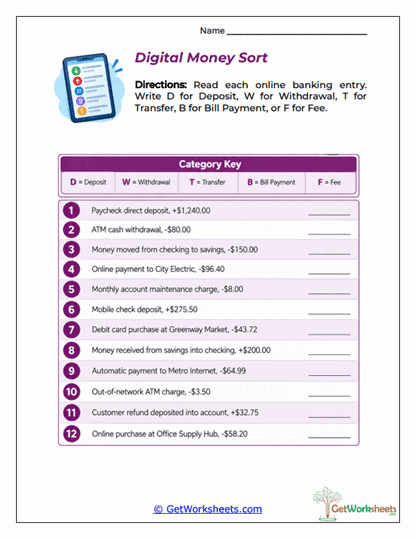
Digital Money Sort
Students sort twelve digital banking transactions into categories such as deposits, withdrawals, transfers, bill payments, and fees. Examples include paychecks, purchases, refunds, and account charges. By deciding how each transaction moves money, learners build familiarity with the records they may see in online banking.
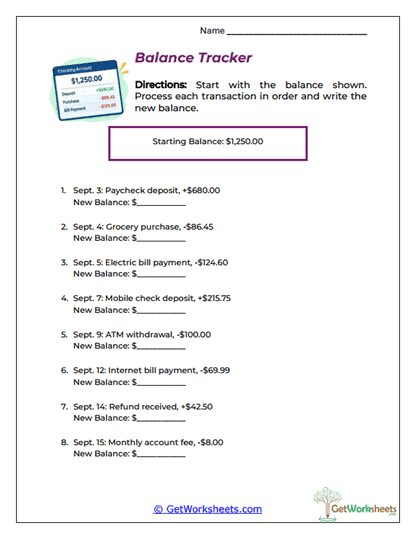
Balance Tracker
Starting with a fictional checking account balance, students process eight September transactions in date order. They add deposits and refunds, then subtract purchases, bill payments, withdrawals, and fees to update the balance each time. The running record gives students practice with decimal arithmetic and careful financial tracking.
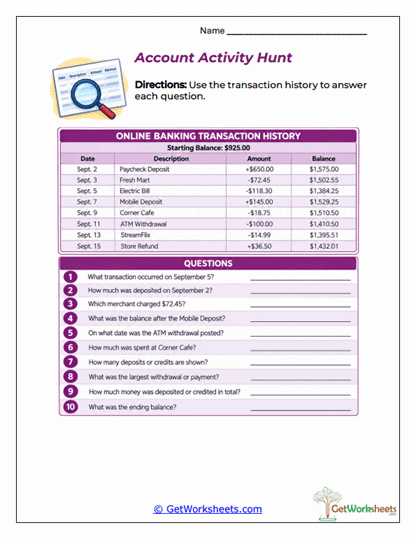
Account Activity Hunt
A fictional transaction history gives students a chance to read banking information closely. They answer ten questions about transaction dates, purchases, deposits, withdrawals, credits, and the ending balance. Some answers come directly from the table; others require calculation or comparison.
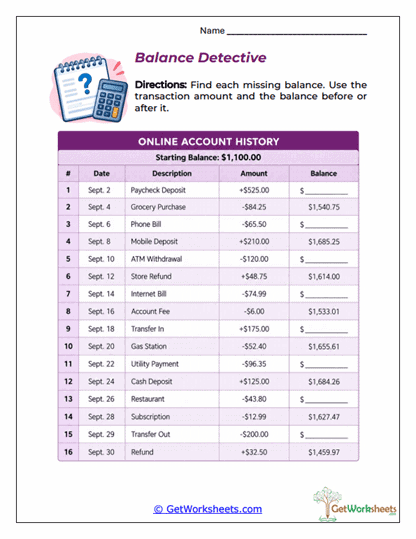
Balance Detective
Several balances are missing from a detailed, dated account history, and students use the surrounding transactions to work them out. They can reason forward or backward through deposits, payments, refunds, and fees, then check whether their answers fit the rest of the record. The investigation strengthens inverse operations and attention to financial detail.
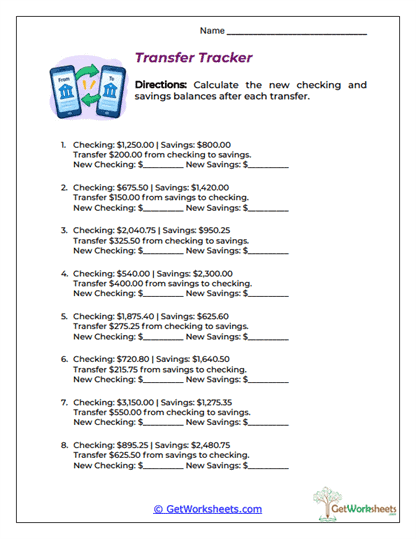
Transfer Tracker
Each scenario follows money as it moves between checking and savings. Students subtract the transfer from the account sending it and add the same amount to the receiving account. They can confirm their work by checking that the combined balance remains unchanged.
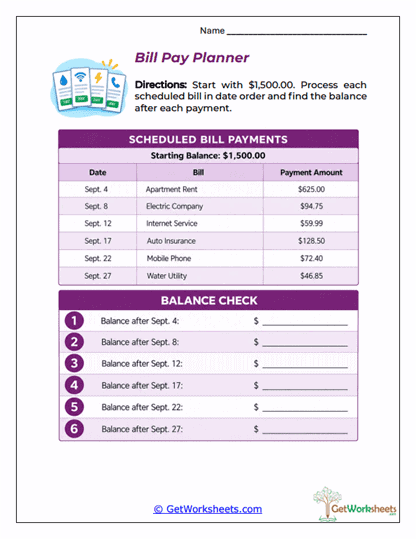
Bill Pay Planner
Six scheduled household payments are deducted in date order from a fictional checking account. Students record the balance after rent, utilities, insurance, and other bills, seeing how payment timing affects available funds. The calculations practice decimal subtraction while introducing a useful budgeting habit: planning for expenses before they come due.
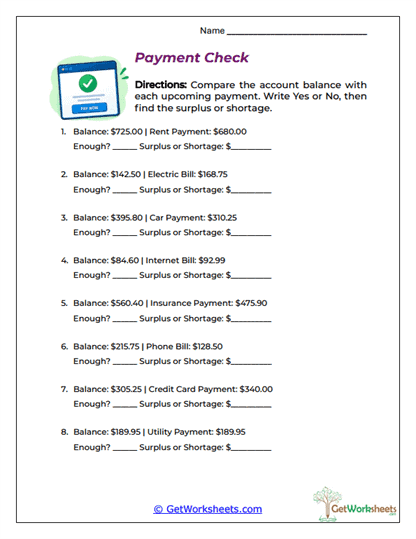
Payment Check
Can the available balance cover the bill? For each of eight scenarios, students compare the two amounts and determine whether the account would have a surplus, an exact balance, or a shortage after payment. They then calculate how much would remain or how much more money would be needed.
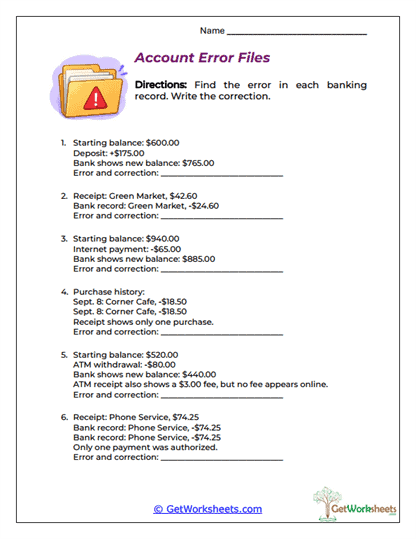
Account Error Files
Six banking scenarios contain discrepancies such as duplicate charges, missing fees, incorrect balances, or differences between a receipt and an online record. Students identify what appears wrong and calculate or explain an appropriate correction. The cases encourage careful review of financial information rather than accepting each recorded amount at face value.
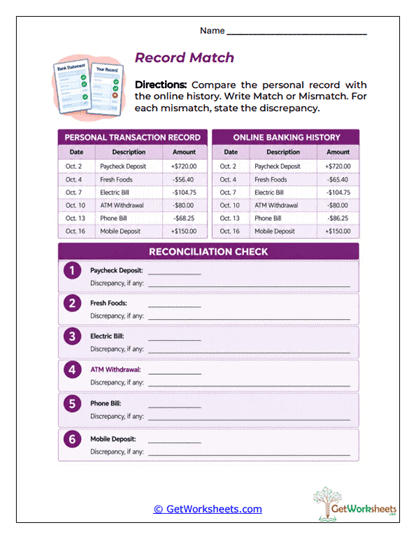
Record Match
Students compare six entries in a personal transaction record with the corresponding entries in an online banking history. They decide which details match and flag any differences in dates, descriptions, or amounts. This side-by-side review introduces the basic purpose of reconciling financial records.
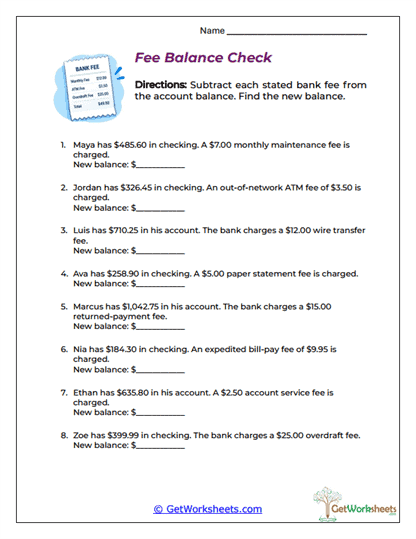
Fee Balance Check
Each of eight scenarios starts with an account balance and a banking fee. Students subtract charges for services such as ATM use, wire transfers, paper statements, or overdrafts to find the updated balance. The examples draw attention to how fees can affect the money available in an account.
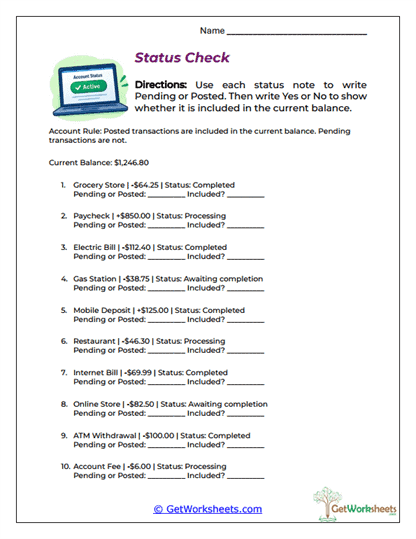
Status Check
Students classify ten online banking transactions as pending or posted according to the activity's stated rules. They also determine whether each amount has been included in the fictional account's displayed balance. The scenarios introduce processing-status language and show why transaction timing matters when reviewing account activity.
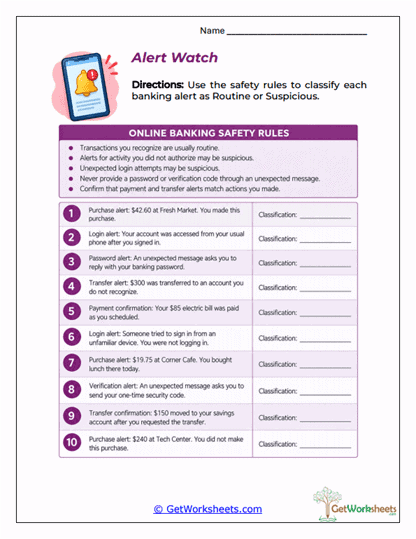
Alert Watch
Routine notifications and potentially suspicious alerts appear in ten online banking examples. Students apply a provided set of safety rules to decide which messages may need further attention. The activity builds awareness of unfamiliar purchases, unexpected login attempts, and requests for sensitive information, while prompting students to think carefully about how alerts should be verified.
Bookmark Us Now!
New, high-quality worksheets are added every week! Do not miss out!