Pricing Worksheets
About This Worksheet Collection
Pricing decisions affect how businesses cover costs, set retail prices, and communicate discounts to customers. These business math worksheets explore those decisions through familiar examples, from clothing and electronics to café menu items.
The activities move from calculating a dollar markup to finding selling prices, working backward to identify missing values, and comparing markup with gross margin. Later worksheets introduce markdowns, sale prices, price changes, and mixed word problems. The collection can support business math lessons, personal finance instruction, independent practice, or homeschool learning.
Students practice percentage conversions, multiplication, division, addition, subtraction, and inverse operations with money. They also learn to distinguish among product cost, markup, selling price, markdown, and profit measures-terms that can be easy to confuse when first studying retail pricing.
The sequence offers several ways to learn and revisit the same ideas. Students first follow clear formulas, then apply them in different product scenarios, solve for missing information, and check completed calculations for errors. By using the concepts in varied contexts, they can build accuracy and confidence and see how pricing math works in business decisions.
Detailed Descriptions Of These Worksheets
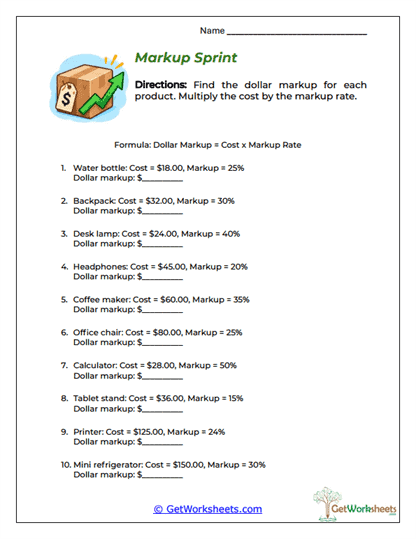
Markup Sprint
Ten product examples give students practice finding a dollar markup from an item's cost and a percentage rate. They convert each rate to a decimal and multiply, working with familiar merchandise such as backpacks, headphones, and office chairs. The activity focuses on the added amount; learners can extend it by adding that amount to the cost to find a selling price.
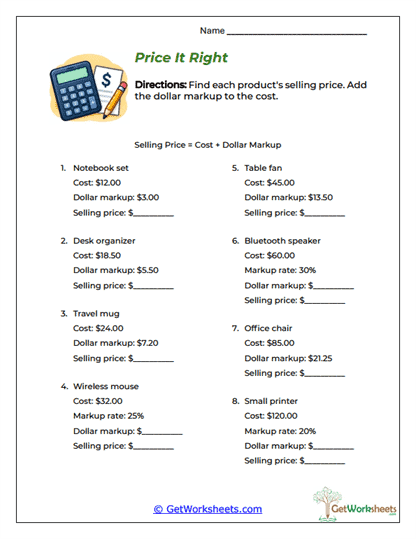
Price It Right
Some products come with a fixed dollar markup, while others provide a percentage that students must apply to the original cost. In both cases, the goal is to find the final selling price. By moving from direct addition to a two-step calculation, learners practice the relationship between cost, markup, and retail price.
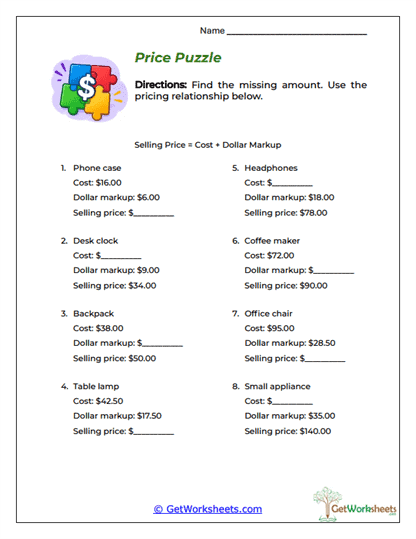
Price Puzzle
A cost, markup, or selling price is missing from each of eight product scenarios. Students decide whether addition or subtraction will reveal the unknown value, then use the relationship among the three amounts to check their work. The problems offer an accessible introduction to inverse operations and algebraic thinking.
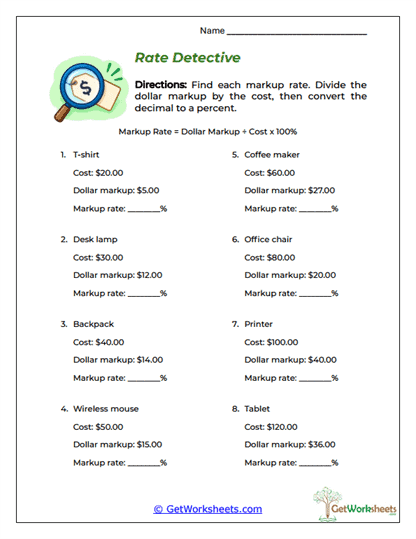
Rate Detective
Here the dollar markup and original cost are known, but the markup rate is not. Students divide the markup by the cost and express the result as a percentage. Comparing products helps show why the same dollar increase can represent different rates when the original costs differ.
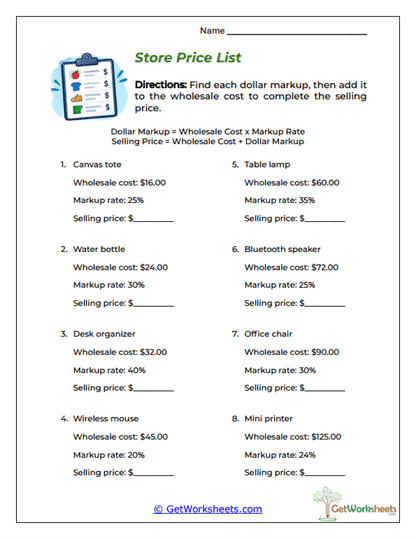
Store Price List
Each of eight products begins with a wholesale cost and a markup percentage. Students calculate the dollar markup first, then add it to the cost to create a retail price. This sequence mirrors the steps a store might use to prepare a price list and reinforces percentage multiplication alongside monetary addition.
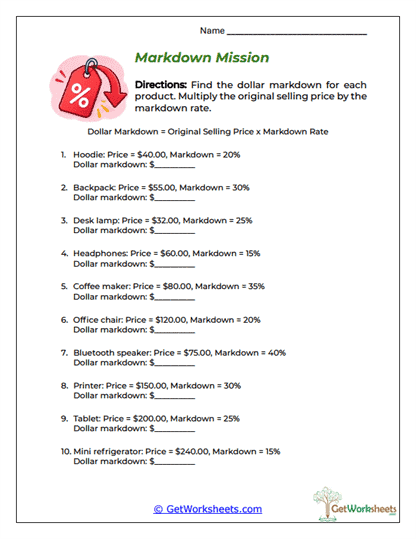
Markdown Mission
Students calculate the dollar reduction for ten products by applying a markdown percentage to each original price. The examples connect percentage multiplication with common promotions and seasonal discounts. Once they find the reduction, students can extend their work by subtracting it to determine the sale price.
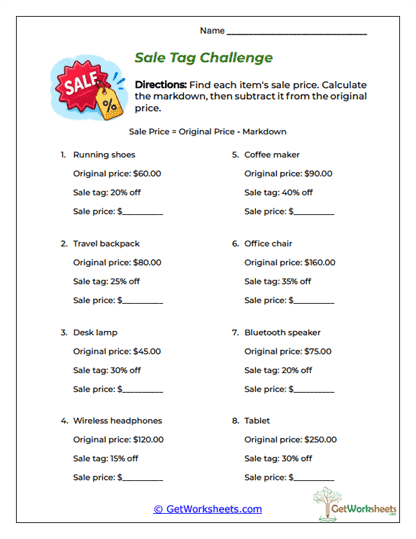
Sale Tag Challenge
Eight shopping scenarios ask students to calculate both the dollar discount and the final sale price. They apply each percentage to the original price, then subtract the savings. The two-step process helps learners distinguish the amount discounted from the amount a customer pays.
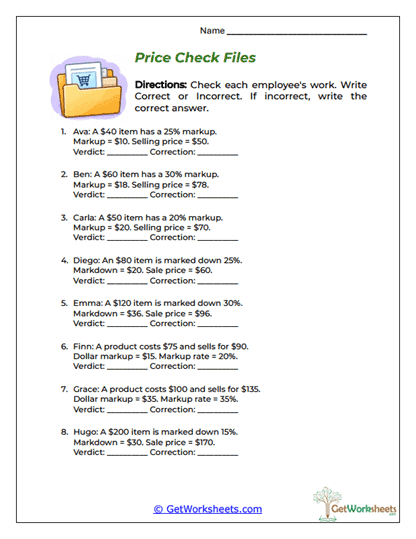
Price Check Files
Completed pricing calculations contain a mix of accurate answers and mistakes. Students inspect eight examples involving markups, selling prices, markdowns, and markup rates, then correct any errors they find. The activity encourages them to verify the operation and reasoning behind an answer, not just recalculate it.
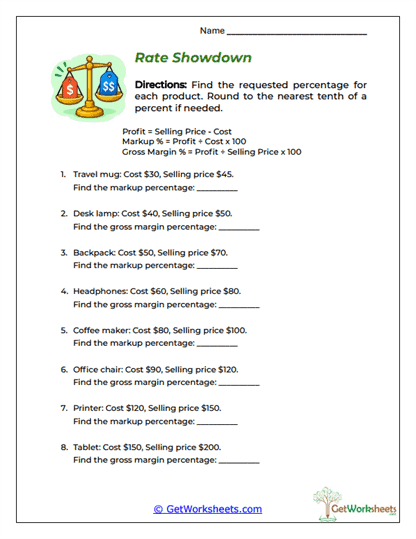
Rate Showdown
Students calculate markup or gross margin percentages using a product's cost and selling price. First, they find the dollar difference between the two amounts; then they choose the appropriate formula. The comparison highlights an important distinction: markup is measured against cost, while gross margin is measured against selling price.
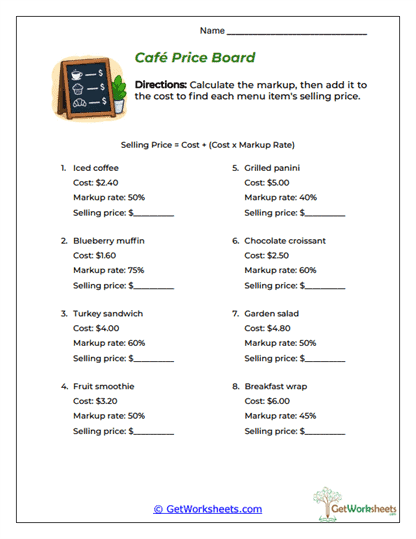
Café Price Board
A set of eight café foods and drinks provides the basis for menu pricing practice. Students apply each markup percentage to the item's preparation cost, then add the markup to find a selling price. The scenarios connect multistep calculations with decisions a café, bakery, or food truck might make.
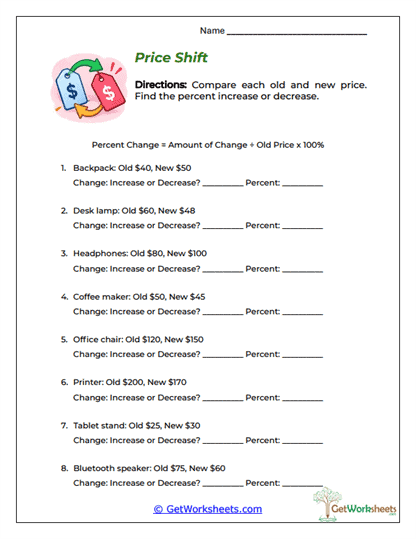
Price Shift
For each product, students compare an old price with a new one to determine whether it rose or fell. They calculate the dollar difference, then divide by the original price to find the percentage change. This gives learners a way to compare price movements even when the items started at different prices.
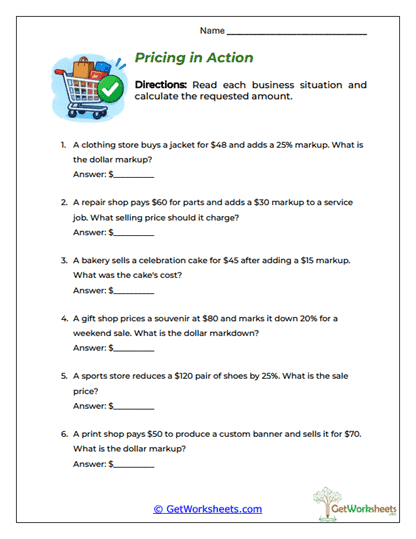
Pricing in Action
Six business word problems ask students to decide which pricing relationship applies. Depending on the scenario, they may find a markup, selling price, original cost, markdown, or sale price. Reading carefully and choosing the right operation are central to the practice, which brings together concepts from across the collection.
Bookmark Us Now!
New, high-quality worksheets are added every week! Do not miss out!