Expenses Worksheets
About This Worksheet Collection
Business expenses help students understand the different costs a company must manage in order to operate. Learners explore how expenses can be classified, totaled, compared, reduced, and analyzed over time. These topics connect everyday business decisions with addition, subtraction, multiplication, percentages, budgeting, and financial reasoning.
This collection gives students several ways to practice working with realistic business costs. Activities include sorting expenses into categories, identifying fixed and variable costs, totaling monthly expenses, solving for missing amounts, calculating supply orders, comparing budgets with actual spending, tracking cost changes, finding percent increases or decreases, comparing vendors, checking errors, calculating savings, and solving workplace expense problems. The worksheets are well suited for middle school and early high school business math, financial literacy, entrepreneurship, tutoring, or homeschool instruction.
As students work through the collection, they strengthen money operations, decimal computation, percent reasoning, cost comparison, budgeting, and business decision-making. They also practice interpreting financial information, identifying how expenses behave, checking whether calculations are accurate, and using numbers to evaluate spending choices. These activities help learners understand how businesses monitor costs and make practical decisions about where money is being spent.
Detailed Descriptions Of These Worksheets
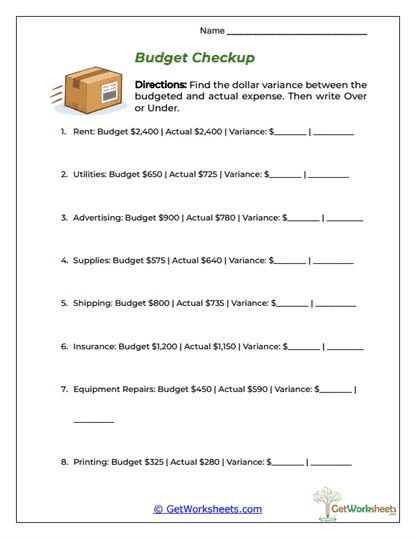
Budget Variance Check
Students compare budgeted spending with actual expenses and calculate the difference between the two amounts. They then determine whether each category finished over budget or under budget. The activity shows learners that a budget is a plan that must be compared with what actually happened. It strengthens money subtraction, comparison, and financial interpretation.
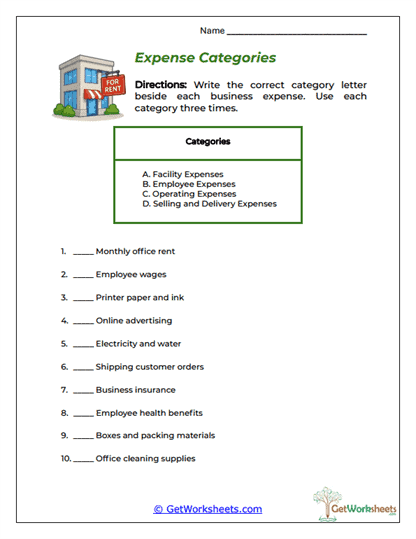
Business Expense Sort
Common company costs are grouped into categories such as facility, employee, operating, and selling or delivery expenses. Students classify items including rent, wages, utilities, supplies, advertising, shipping, and insurance. The activity helps learners understand that businesses organize spending according to purpose instead of treating every expense the same way. It also builds useful accounting and budgeting vocabulary.
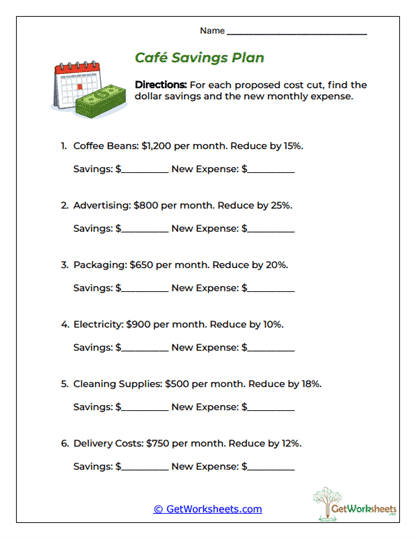
Cost-Cutting Plan
Students calculate how much money a business could save by reducing selected expenses by a given percentage. They find the dollar savings and then subtract that amount from the original cost to determine the new monthly expense. The multi-step format connects percent decrease with practical budgeting decisions. This activity helps learners see how lowering costs can improve a company's financial position.
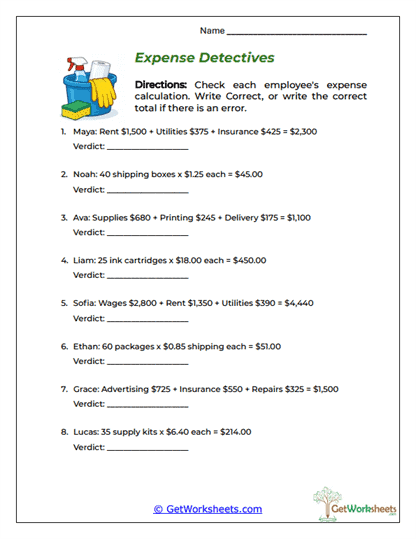
Expense Accuracy Check
Completed business-expense calculations are reviewed for possible errors. Students verify totals involving rent, supplies, wages, advertising, shipping, and other company costs, then correct any mistakes they find. The activity encourages learners to question finished work rather than assume every total is accurate. It strengthens arithmetic accuracy and financial error analysis.
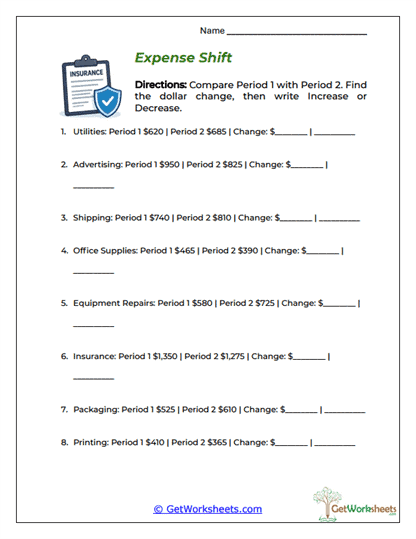
Expense Change Tracker
Students compare business expenses from two different periods and determine how much each cost increased or decreased. Categories may include utilities, advertising, shipping, repairs, packaging, and printing. The worksheet requires learners to calculate the dollar change and interpret the direction of that change. This helps students recognize cost trends over time.
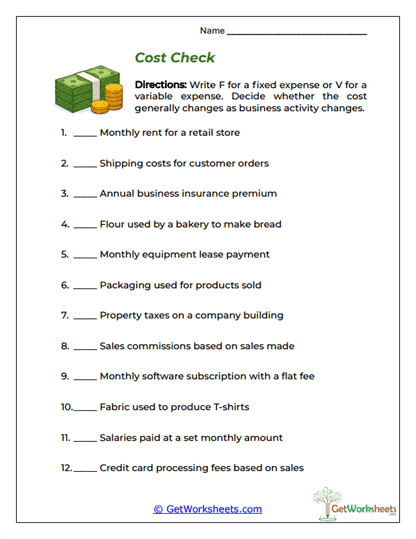
Fixed or Flexible Cost
Students classify business expenses as fixed or variable based on whether the cost tends to stay steady or change with business activity. Examples include rent, insurance, salaries, ingredients, packaging, shipping, commissions, and processing fees. The activity introduces an important budgeting concept used in pricing and profit analysis. It also encourages students to think about how different costs behave as sales or production changes.
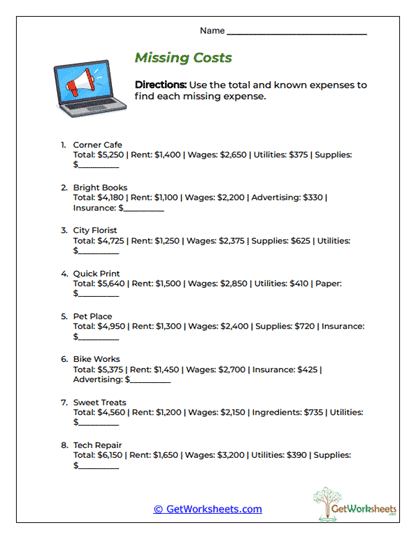
Missing Expense Finder
A total monthly expense is provided along with several known business costs, leaving one amount missing. Students add the known expenses and work backward to determine the unknown value. The practical setup turns basic subtraction into an early equation-solving task. It also helps learners understand how expense records can be checked for completeness.
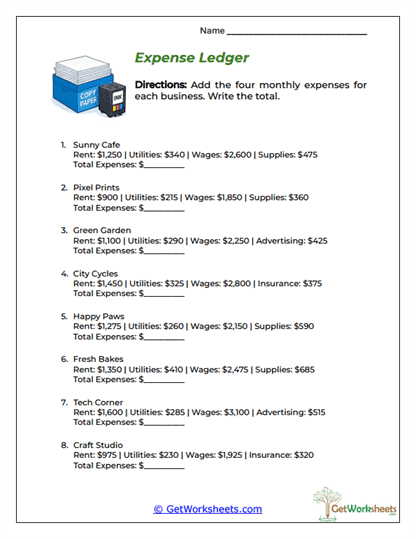
Monthly Expense Total
Students add several recurring business costs to determine the full monthly expense for each company. Items may include rent, utilities, wages, supplies, advertising, and insurance. Organizing multiple dollar amounts carefully is important so no cost is overlooked. This worksheet builds money addition and prepares students for later work with budgets and profit.
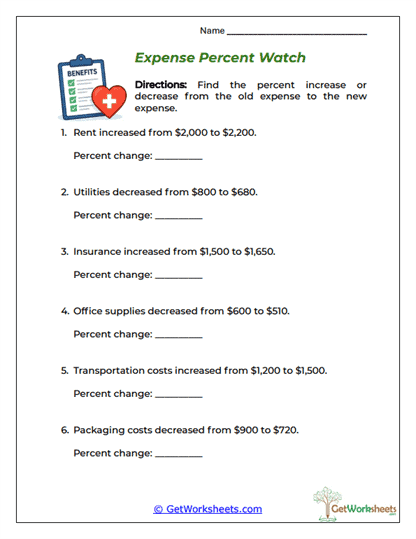
Percent Change in Costs
Students calculate the percentage increase or decrease between an old business expense and a new one. They first find the dollar change and then compare that difference with the original cost. The activity helps learners understand why the same dollar increase can have a different impact depending on the starting amount. It strengthens percent reasoning and financial analysis.
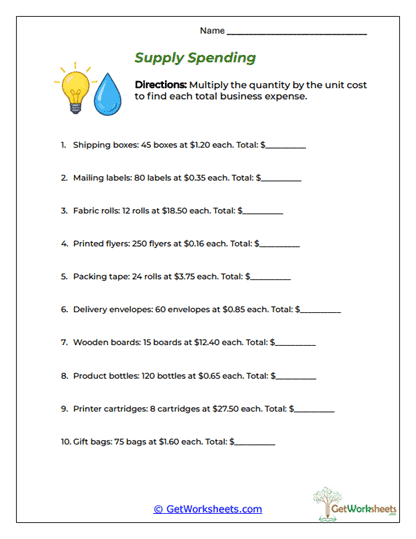
Supply Cost Calculator
Students determine the total cost of business supplies by multiplying the quantity ordered by the price per item. Examples may include boxes, labels, fabric, tape, envelopes, bottles, printer cartridges, or other materials. Working with decimal unit prices gives multiplication a realistic purchasing context. The activity strengthens unit-cost reasoning and business spending awareness.
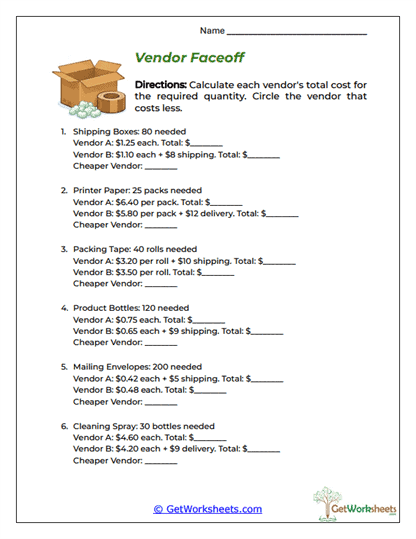
Vendor Cost Showdown
Two suppliers are compared to determine which offers the lower overall cost. Students calculate quantity-based prices, add shipping charges when needed, and compare the final totals. The activity shows why the cheapest unit price is not always the least expensive option once additional fees are included. It develops multi-step reasoning and practical purchasing skills.
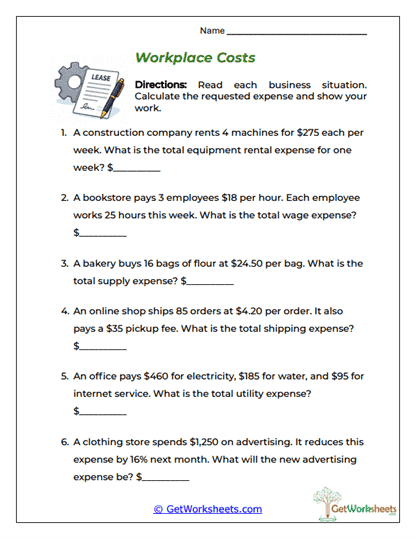
Workplace Cost Scenarios
Realistic business situations require students to decide which operations are needed before solving. Problems may involve wages, equipment rentals, utilities, supplies, shipping, advertising, or percentage reductions. The word-problem format combines reading comprehension with addition, multiplication, and percent reasoning. This activity helps learners become more confident choosing the correct math for workplace expense situations.
Bookmark Us Now!
New, high-quality worksheets are added every week! Do not miss out!