Triple Matching
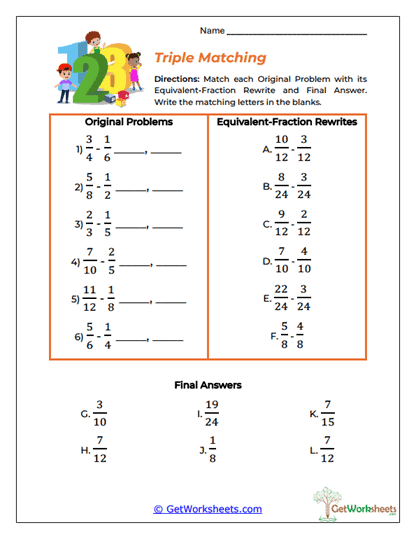
Triple Matching asks students to connect three forms of the same subtraction problem: the original unlike-denominator equation, its equivalent-fraction rewrite, and the final simplified difference. Students solve or analyze each original problem, match it with the correct renamed fractions, and then select the corresponding final answer. The worksheet strengthens equivalent fractions, common denominators, subtraction, simplification, answer matching, and multi-step reasoning. It is especially appropriate for students in grades 5-6 who are ready to see the complete subtraction process represented in several connected forms.
Academic Focus
- Analyze the original equation: Students identify the denominators and determine what common denominator is needed.
- Match the equivalent rewrite: Learners select the equation in which both fractions have been renamed correctly.
- Find the final difference: Students subtract the rewritten numerators and simplify the result.
- Connect all three forms: Children recognize that the original problem, renamed equation, and final answer belong to one mathematical chain.
Teaching Advantages
- Shows the full process: Students see how an unlike-denominator problem changes from its original form to a solvable form and then to a simplified answer.
- Provides built-in checking: An incorrect match usually signals an error in the common denominator, equivalent fractions, subtraction, or simplification.
- Encourages careful comparison: Learners must inspect several similar-looking fractions before making a choice.
- Works well for review: The page fits partner practice, math centers, homework, assessment preparation, or homeschool lessons.
- Requires no preparation: The matching activity is ready to print and use immediately.
This three-part format helps students understand that fraction subtraction is a connected process rather than a collection of unrelated rules. The original fractions must first be renamed so their pieces match, then the numerators can be subtracted, and finally the difference may need to be simplified. A parent can guide the work by asking, “Which rewrite keeps both fractions equivalent, and which answer follows from that equation?” As students make the matches, they strengthen denominator fluency, equivalent-fraction recognition, subtraction accuracy, simplification, visual comparison, and confidence. In classroom and homeschool settings, the worksheet provides a thorough review that reinforces both the procedure and the relationships among every stage of the solution.
Bookmark Us Now!
New, high-quality worksheets are added every week! Do not miss out!