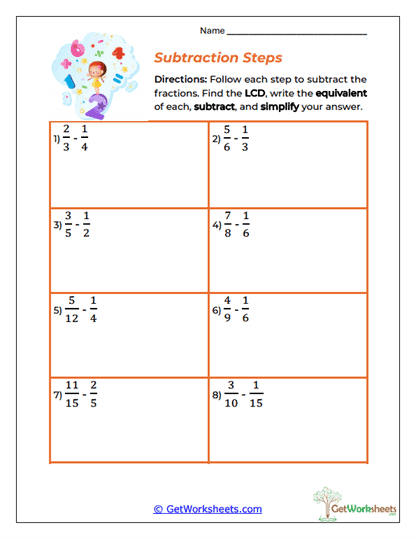
Subtraction Steps
Subtraction Steps gives students space to work through every stage of subtracting fractions with unlike denominators. Students find the least common denominator, rewrite both fractions as equivalent fractions, subtract the numerators, and simplify the final answer. The worksheet reinforces least common multiples, equivalent fractions, denominator matching, numerator subtraction, simplification, and organized problem solving. It is designed for students in grades 5-6 who are learning the complete procedure and benefit from showing each step clearly.
Academic Focus
- Find the LCD: Students identify the smallest denominator that both original denominators divide into evenly.
- Rewrite the fractions: Learners create equivalent fractions with matching denominators.
- Subtract the numerators: Students find the difference once both fractions use equal-sized parts.
- Simplify the answer: Children reduce the final fraction to its lowest terms when possible.
Teaching Advantages
- Encourages organized work: The large spaces allow students to show multiples, scale factors, rewrites, and calculations.
- Makes errors easier to locate: Teachers and parents can see whether confusion begins with the LCD, equivalent fractions, subtraction, or simplification.
- Supports gradual independence: Adults can model the first problem and then release students to complete the remaining problems.
- Useful across settings: The page fits whole-group lessons, small groups, homework, intervention, or homeschool instruction.
- Ready for immediate use: No extra preparation or supplies are necessary.
Students often make mistakes when they try to complete every part of unlike-denominator subtraction mentally. Writing each step helps them slow down and keep the fractions organized. Parents can remind children that the denominators must match before any subtraction takes place because only equal-sized pieces can be directly compared. As students complete the worksheet, they strengthen least-common-denominator knowledge, equivalent-fraction fluency, subtraction accuracy, simplification, mathematical organization, and confidence. In classroom and homeschool settings, this structured practice reinforces a reliable process that students can later apply to mixed numbers, multi-step problems, and real-world fraction situations.
Bookmark Us Now!
New, high-quality worksheets are added every week! Do not miss out!