Hidden Step
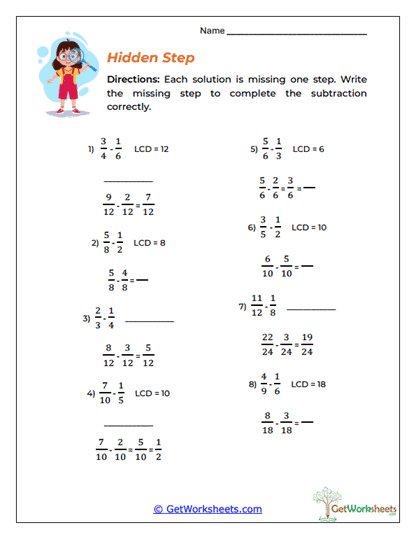
Hidden Step helps students recognize which important part is missing from an unlike-denominator subtraction solution. Students study each partially completed problem, identify whether the missing work involves finding the LCD, rewriting equivalent fractions, subtracting the numerators, or simplifying the result, and then fill in the blank correctly. This practice strengthens least common denominators, equivalent fractions, subtraction procedures, simplification, equation structure, and logical reasoning. It is especially helpful for students in grades 5-6 who know the main rules but need practice understanding how the steps connect.
Learning Goals
- Recognize the missing process: Students determine which step is absent from each worked solution.
- Complete equivalent fractions: Learners correctly rename fractions using the stated common denominator.
- Finish the subtraction: Students subtract the rewritten numerators while keeping the common denominator.
- Check the full solution: Children review the entire problem to make sure every step leads to the final answer.
How This Helps
- Builds procedural understanding: Students learn why each step is necessary instead of memorizing a disconnected routine.
- Encourages close reading: Learners must inspect the work carefully before deciding what belongs in the blank.
- Supports error prevention: The format helps children notice which steps they often forget in their own work.
- Works in many settings: Use it for classroom review, small groups, homework, tutoring, intervention, or homeschool practice.
- No-prep resource: The worksheet can be printed and used immediately.
A child may know how to subtract unlike fractions but still skip an important step when working too quickly. This worksheet slows the process down and asks students to study the relationship between the LCD, the equivalent fractions, the subtraction, and the simplified difference. Parents can guide the work by asking, “What has already been done, and what still needs to happen?” As students complete the missing work, they strengthen fraction fluency, mathematical sequencing, denominator reasoning, subtraction accuracy, self-checking, and confidence. In classroom and homeschool settings, this practice reinforces the full structure of a correct solution and helps learners become more organized and independent.
Bookmark Us Now!
New, high-quality worksheets are added every week! Do not miss out!