Ratio Tables Worksheets
About This Worksheet Collection
Ratio tables give students a structured way to see how two quantities change together while preserving the same proportional relationship. Instead of treating each ratio as a separate problem, students can compare columns, identify scale factors, simplify or enlarge values, and notice how one constant pattern controls the entire table. This collection uses that visual structure to strengthen equivalent-ratio reasoning, unit-rate thinking, and early algebra connections.
The worksheets ask students to complete missing values, identify scale factors between columns, create equivalent ratios, simplify ratio pairs, find unit rates, work with multiple blanks, match tables that represent the same relationship, locate specific target values, and translate real-world situations into tables. Recipe and shopping contexts make the relationships easier to interpret, while activities involving k and y = kx begin connecting ratio tables to proportional equations. Because the formats vary, learners must do more than follow one repeated pattern.
Across the collection, students become more comfortable using multiplication and division in both directions, choosing useful anchor pairs, identifying the amount for one unit, and checking whether corresponding values remain consistent. They also learn to treat ratio tables as connected systems rather than isolated columns. These ideas prepare students for proportions, unit rates, constant of proportionality, graphs, equations, scale factors, and other middle-school topics built around proportional relationships.
Detailed Descriptions Of These Worksheets
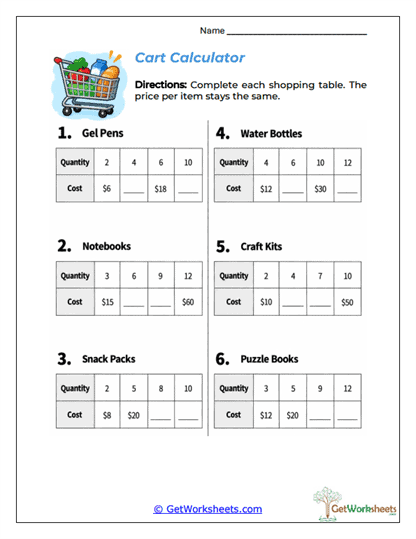
Cart Calculator
Shopping situations turn ratio tables into cost-and-quantity models. Students fill missing prices while keeping the unit price constant for products such as pens, notebooks, snacks, and craft items. Finding the cost of one item can simplify the entire table, although scale factors may also provide an efficient route. The activity connects proportional reasoning with practical money math and unit pricing.
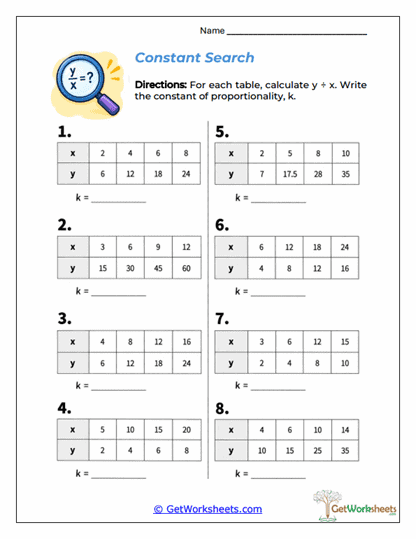
Constant Search
Students calculate y ÷ x to identify the constant of proportionality in each table. Once k is found, they verify that the same multiplier connects the two rows across the remaining columns. This makes the relationship behind y = kx visible through numerical data rather than abstract notation alone. The worksheet creates a direct bridge from ratio tables into pre-algebra.
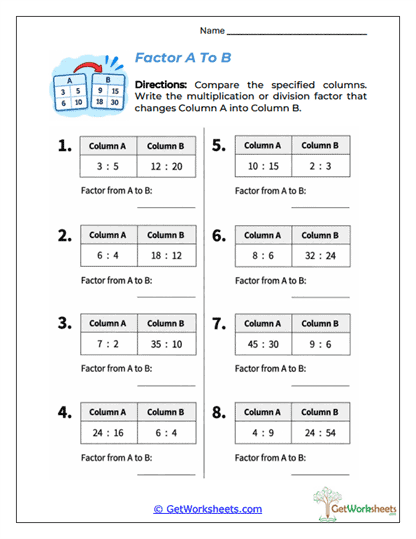
Factor A To B
Two ratio columns are compared to determine the multiplication or division factor that changes Column A into Column B. Students test whether the same factor works on both quantities, which provides a built-in check for equivalence. Some relationships scale upward while others reduce to smaller values. The activity isolates scale-factor reasoning and strengthens multiplicative thinking.
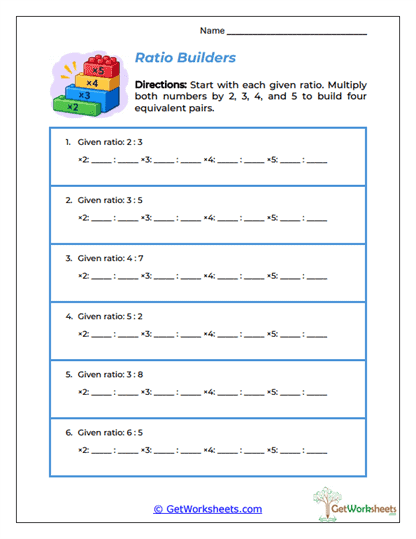
Ratio Builders
Students actively generate families of equivalent ratios by multiplying both terms of a starting ratio by several given factors. Rather than only recognizing equivalence after the fact, learners see exactly how larger versions of a ratio are produced. Repeated multiplication makes the role of the scale factor especially clear. This foundational activity also prepares students for completing ratio tables later.
Ratio Gaps
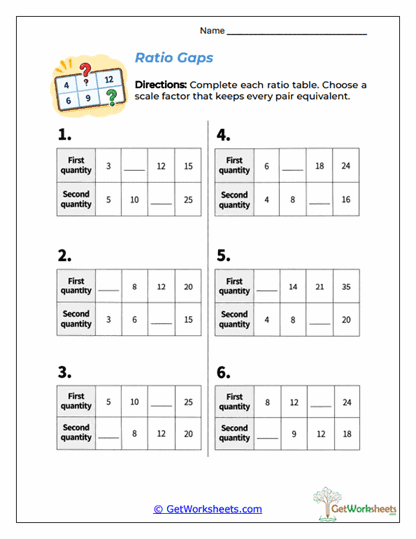
Several blanks appear within the same ratio table, so students must choose a useful complete pair as an anchor before filling the missing values. Some targets require scaling up, while others are easier to reach by dividing. The format encourages learners to work strategically instead of assuming they must proceed from left to right. It also reinforces the idea that every column belongs to one connected proportional system.
Ratio Partners
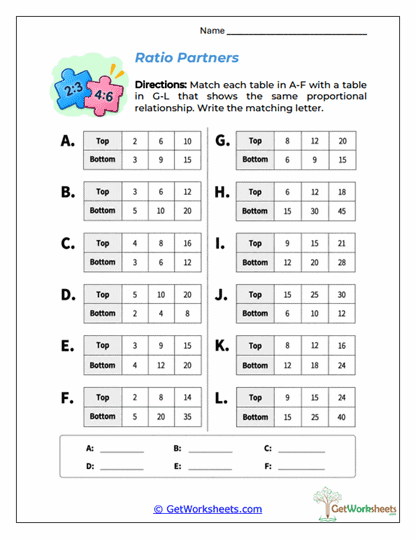
Students compare entire ratio tables and match those that express the same underlying relationship. Simplifying complete pairs, finding unit rates, or comparing scale factors can all reveal the correct partners. Because the tables may contain very different numerical values, learners must focus on the relationship rather than surface appearance. This creates a deeper equivalence task than ordinary pair matching.
Ratio Stepdown
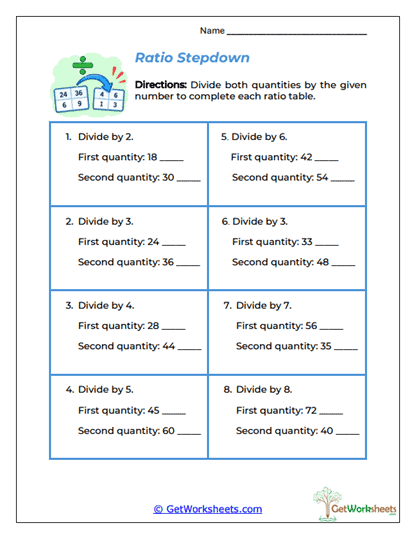
Given ratio pairs are reduced by dividing both quantities by the same stated factor. Students practice creating smaller equivalent ratios while strengthening division fluency and common-factor awareness. The directions make the scaling process explicit, allowing learners to concentrate on consistency across both terms. This activity builds a strong foundation for simplifying ratios independently.
Ratio Table Rally
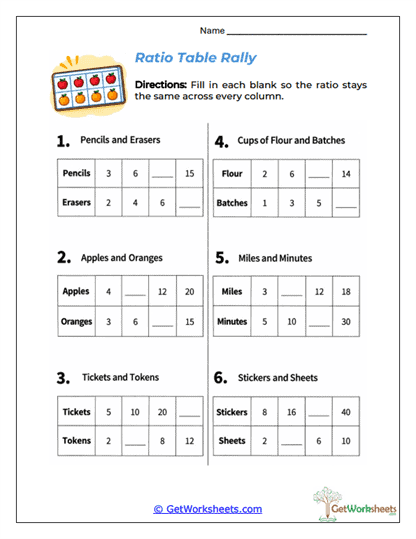
Missing values are completed across tables that represent familiar paired quantities such as supplies, foods, distances, and quantities. Students identify how one known pair changes and apply the same factor to the corresponding value in the other row. The organized table layout makes equivalent ratios easier to compare than isolated expressions. This worksheet provides broad foundational practice with ratio-table structure.
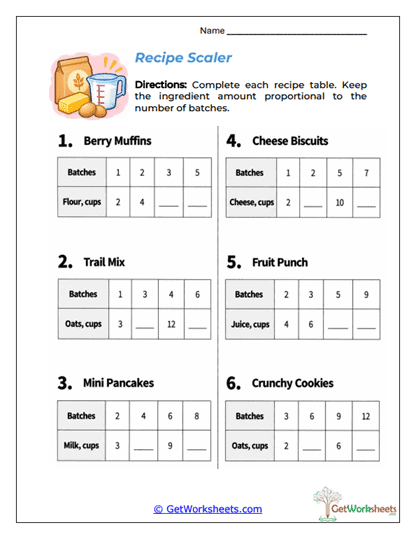
Recipe Scaler
Batch sizes and ingredient amounts are organized into ratio tables that students complete without changing the recipe relationship. Learners may find the amount needed for one batch first or scale directly from another known column. The cooking context makes it clear why ingredient quantities must grow or shrink consistently with the number of batches. This activity combines ratio tables, unit rates, and practical proportional reasoning.
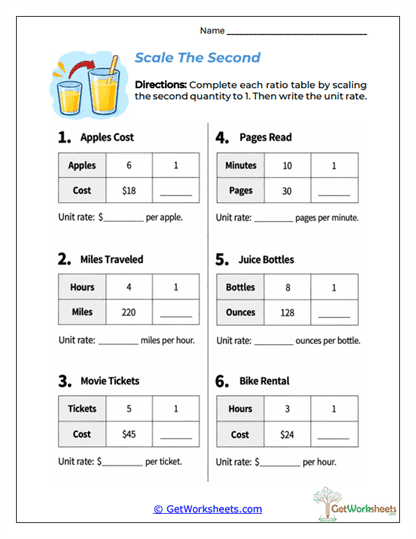
Scale The Second
Each relationship is simplified until one quantity equals 1, revealing the unit rate. Students work with costs, distances, reading rates, rentals, and other real-world examples where "per one" information is useful. Dividing both quantities by the same factor preserves the ratio while making the relationship easier to interpret. The worksheet also lays groundwork for constant of proportionality and better-buy problems.
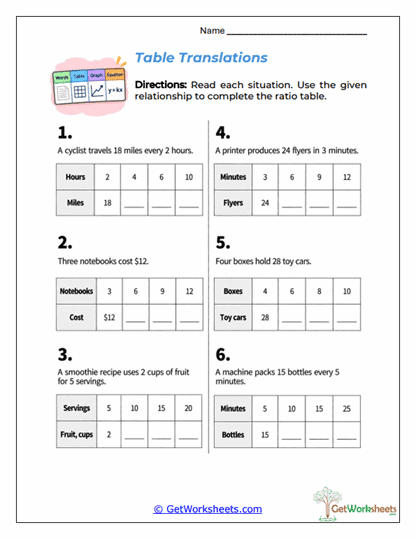
Table Translations
Short real-world stories are converted into organized ratio tables. Students identify the two connected quantities, place the initial relationship correctly, and then extend that relationship across missing entries. Cycling, prices, recipes, printing, packaging, and production provide varied contexts for the same proportional idea. This worksheet develops the important skill of moving from words to a numerical model.
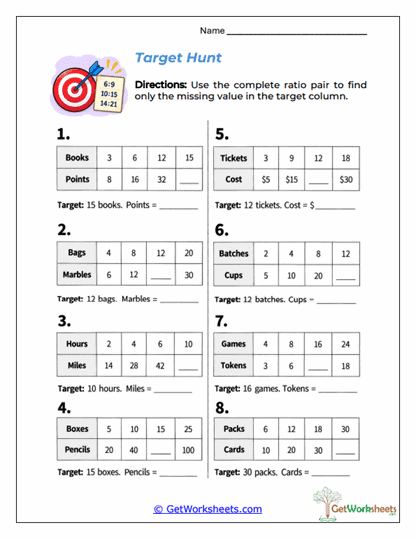
Target Hunt
Instead of completing an entire table, students use the available ratio information to find one requested value. The most efficient strategy is often to select the known pair that connects most directly to the target and apply an appropriate scale factor. This encourages selective use of information rather than unnecessary computation. The activity helps students see ratio tables as problem-solving tools rather than grids that must always be fully completed.
Bookmark Us Now!
New, high-quality worksheets are added every week! Do not miss out!