Cross Multiplication Method Worksheets
About This Worksheet Collection
Cross multiplication gives students a dependable way to work with proportions by connecting two equivalent ratios through their diagonal products. The method is useful because it transforms a fraction-based relationship into a multiplication equation that is often much easier to solve. These worksheets build the idea gradually, beginning with identifying diagonal pairs and writing cross-product equations before moving into variables, decimals, fractions, geometry, scale problems, and real-world applications.
The collection uses several formats to develop both accuracy and flexibility. Students write cross-product equations, test whether ratios are proportional, solve for missing values, match proportions with equations or answers, work with variables in different positions, and apply the method to map scales and similar figures. More advanced activities introduce decimal and fractional values, while word problems require learners to organize quantities into consistent ratios before any cross multiplication can begin.
As students move through the collection, the goal shifts from simply remembering an "X" pattern to understanding why the method works and when it is appropriate to use. Learners become more careful about corresponding quantities, unit consistency, variable placement, equivalent ratios, and checking whether a completed proportion makes sense. Those habits support later work with rates, scale factors, percentages, similar figures, algebraic equations, measurement, and other proportional relationships.
Detailed Descriptions Of These Worksheets
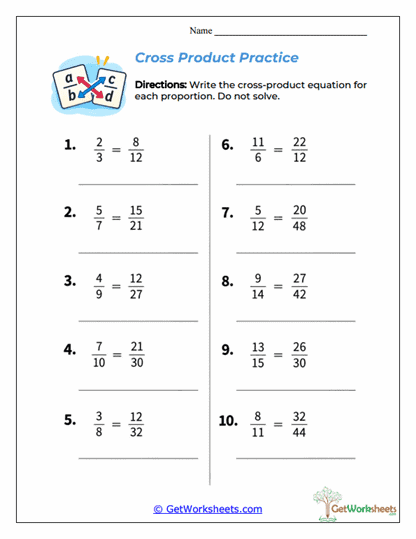
Cross Product Practice
Students begin by translating proportions into cross-product equations without solving them. This isolates the structure of the method so they can concentrate on identifying the two diagonal pairs correctly. Equivalent ratios such as 2/3 = 8/12 show why the resulting products should be equal. The focused setup practice creates a strong foundation before variables and algebraic solving are introduced.
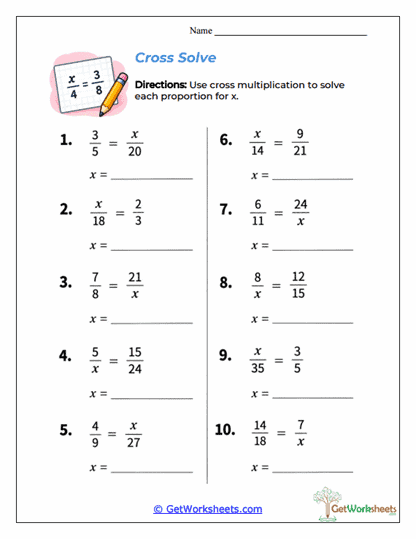
Cross Solve
Variables are added to proportions so students can use the complete cross-multiplication process. They form the cross-product equation, simplify it, and divide to isolate the unknown value. Because the variable appears in different positions, learners must rely on the proportion structure rather than one memorized arrangement. This activity connects ratio reasoning directly with one-step equation solving.
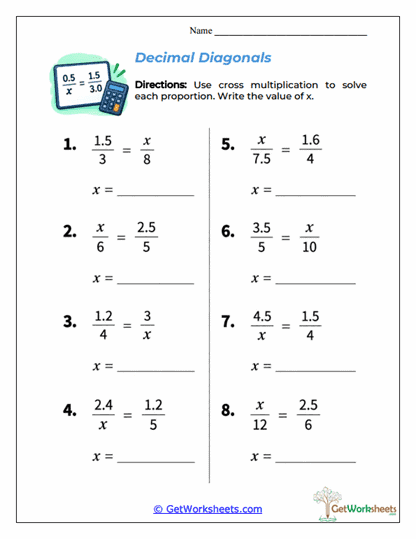
Decimal Diagonals
Decimal values make familiar proportion problems slightly more demanding without changing the underlying method. Students cross multiply, complete the decimal arithmetic accurately, and solve the resulting equation for the unknown. The worksheet demonstrates that cross multiplication works just as consistently with non-whole-number quantities. It also gives meaningful practice with decimal multiplication and division in proportional settings.
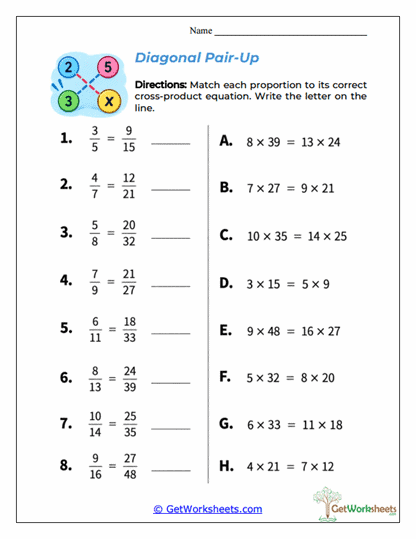
Diagonal Pair-Up
Rather than calculating a missing value, students match each proportion with the cross-product equation that represents it correctly. The task draws attention to which numbers sit across from one another diagonally and should therefore be multiplied together. This makes setup errors easier to recognize before students move into more complicated solving. The matching format also gives structural practice a puzzle-like feel.
Fraction Cross Quest
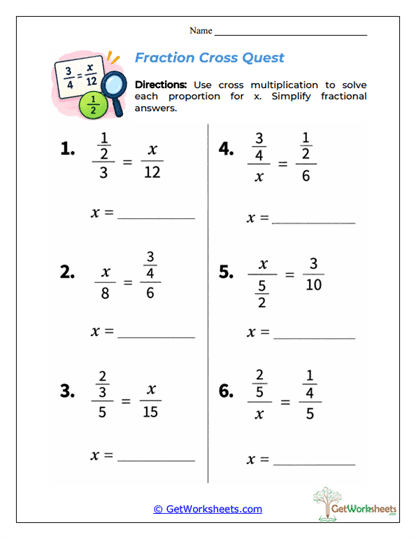
Proportions containing fractional quantities extend the method into more advanced arithmetic. Learners still use the same diagonal relationship, but the cross products may now involve multiplying fractions and simplifying fractional results. This requires closer attention to numerators, denominators, and reduction. The activity helps students see that increasingly complex numbers do not require a completely different proportional strategy.
Number Hunt
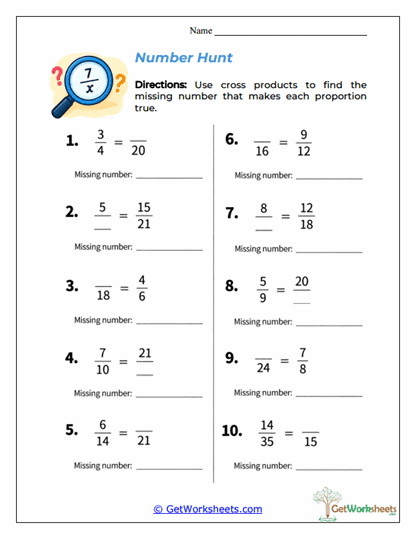
Blank spaces replace variables as students determine which missing number makes each pair of ratios equivalent. Cross multiplication reveals the unknown regardless of whether it appears in a numerator or denominator. The blank format can make the algebraic idea feel more approachable while preserving the same reasoning used when solving for x. Students can also verify each answer by checking that the completed cross products agree.
Proportion in Action
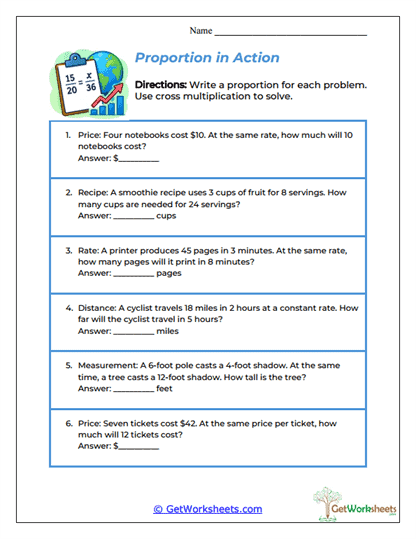
Real-world situations require students to create the proportion themselves before using cross multiplication. Problems involving prices, recipes, rates, travel, measurements, and other practical quantities challenge learners to decide which information corresponds. Keeping units in the same order becomes especially important because an incorrect setup will produce a misleading equation. This worksheet serves as a strong application of the method beyond prewritten fraction equations.
Ratio Truth Check
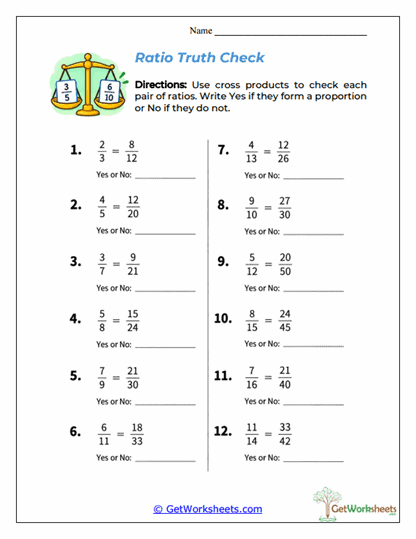
Students use cross products as a test for proportionality rather than as a way to solve for an unknown. Each pair of ratios is examined to determine whether the two diagonal products are equal, followed by a Yes or No conclusion. This emphasizes that cross multiplication can provide evidence that two ratios represent the same relationship. The activity strengthens both multiplication accuracy and the conceptual meaning of equivalent ratios.
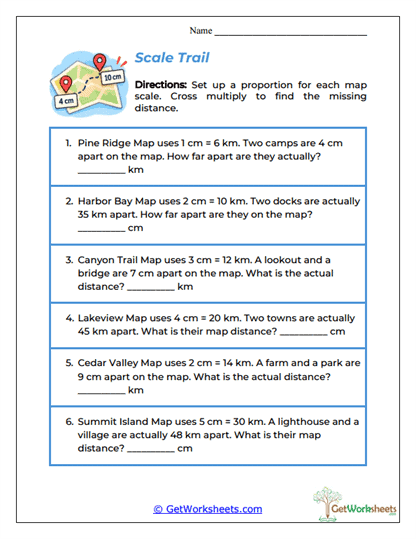
Scale Trail
Map scales give proportional relationships a practical measurement context. Students translate relationships such as centimeters on a map and kilometers in reality into proportions, then cross multiply to find an unknown distance. Some problems reverse the direction by asking for the map measurement rather than the actual distance. Careful unit alignment becomes a central part of successful setup.
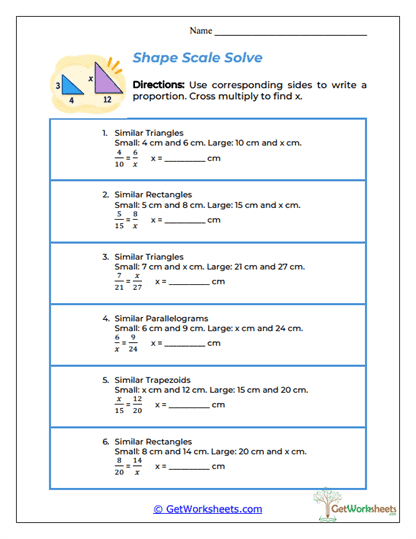
Shape Scale Solve
Similar figures provide a geometric application of cross multiplication. Students identify corresponding sides, build a proportion from those side lengths, and solve for the missing measurement. Because the arithmetic only works when the correct sides are paired, the worksheet combines geometry reasoning with proportion solving. The activity also introduces ideas that support later work with scale factors, enlargements, reductions, and similarity.
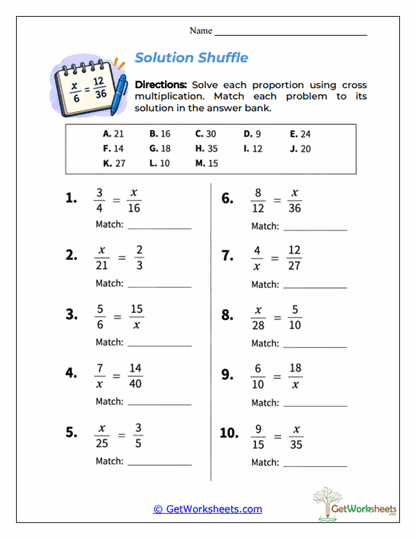
Solution Shuffle
Each proportion is solved and then matched with the correct value in an answer bank. The bank provides immediate feedback because an incorrect cross product or division step may produce a result that is not available. Variables appear in different positions, so students still need to apply the method flexibly. The matching element turns repeated solving into a self-checking activity.
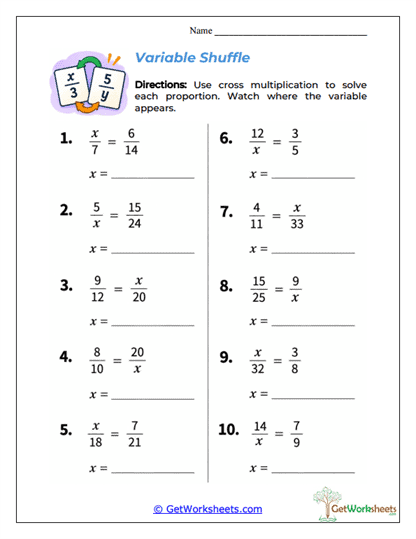
Variable Shuffle
The position of x changes from problem to problem, appearing in different numerators and denominators. Students learn that this visual rearrangement does not alter the fundamental cross-product relationship. They multiply across the diagonals, write the resulting equation, and isolate the variable in the same way each time. The worksheet is especially useful for breaking dependence on one memorized proportion layout.
Bookmark Us Now!
New, high-quality worksheets are added every week! Do not miss out!