Equivalent Ratios Worksheets
About This Worksheet Collection
Equivalent ratios help students understand that the same relationship can be represented with many different pairs of numbers. A ratio such as 2:3 does not stop being meaningful when both terms are doubled, tripled, or simplified; the quantities change, but the comparison between them remains constant. This collection develops that idea through scale factors, tables, number lines, visual models, missing values, sorting, mixtures, recipes, and other contexts that make proportional relationships easier to recognize.
Rather than relying on one repeated format, the worksheets ask students to approach ratio equivalence from several directions. Learners match related ratios, identify scale factors, complete ratio tables and chains, determine whether pairs are equivalent, fill missing values, sort ratios into families, and find the ratio that breaks a proportional pattern. Double number lines and block models provide visual support, while recipe and drink-mixture problems show why preserving the same relationship matters in practical situations.
Across the collection, students become more comfortable scaling ratios up and down, simplifying larger ratios, and checking that both terms have changed by the same factor. They also begin to recognize equivalent ratios as a foundation for proportions, unit rates, scale drawings, similar figures, percent relationships, and algebraic reasoning. The emphasis throughout is on understanding the multiplicative relationship connecting the numbers rather than simply memorizing a procedure.
Detailed Descriptions Of These Worksheets
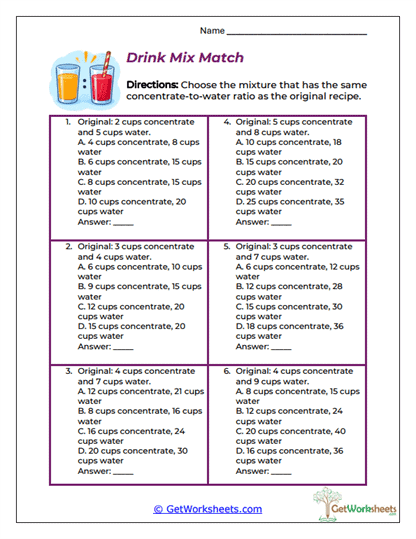
Drink Mix Match
Students compare concentrate-to-water mixtures to determine which option preserves the original ratio. Because changing only one ingredient alters the strength of the drink, the context makes equivalent ratios easy to interpret as maintaining the same balance. Learners can scale both quantities or simplify the choices to test each mixture. The activity gives proportional reasoning a practical meaning beyond symbolic ratio pairs.
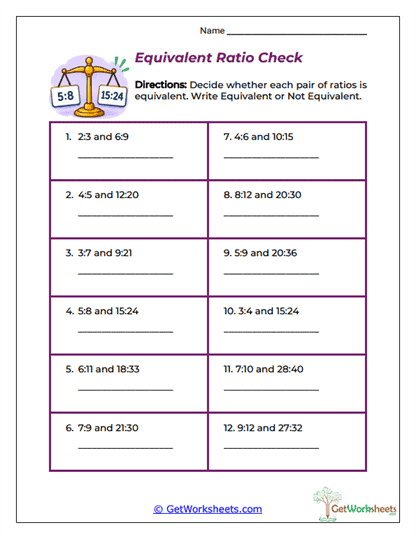
Equivalent Ratio Check
Pairs of ratios are classified as equivalent or not equivalent. Students look for a common multiplier or divisor that transforms both terms consistently, rather than judging the ratios by appearance alone. Larger ratios may also be simplified to reveal whether they share the same basic relationship. This format develops mathematical judgment and reinforces the idea that both parts must change together.
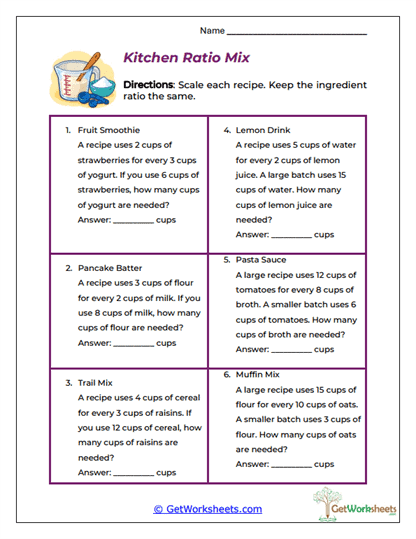
Kitchen Ratio Mix
Recipe situations ask students to increase or decrease ingredient amounts without changing the original mixture. Learners determine how much the batch has been scaled and then apply that same factor to the second ingredient. The familiar cooking context makes it clear why changing quantities inconsistently would alter the recipe. This worksheet strengthens scale-factor reasoning through an everyday application.
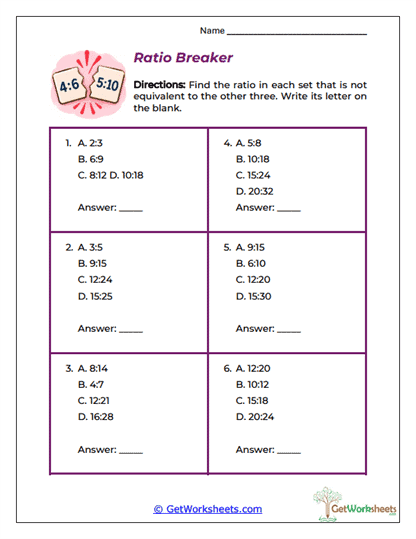
Ratio Breaker
Each group contains several ratios that share one proportional relationship and a single ratio that does not belong. Students simplify or compare scale factors to identify the odd one out. Because multiple choices must be examined together, the task goes beyond a basic pairwise equivalence check. The puzzle-like structure builds error detection and flexible ratio comparison.
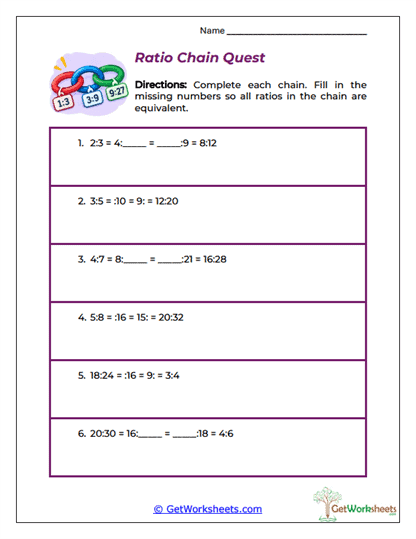
Ratio Chain Quest
Students maintain the same relationship across a sequence of several equivalent ratios. Missing values may appear at different points in the chain, requiring learners to work forward, backward, or from a complete ratio in the middle. This format makes scale changes visible across multiple representations of the same relationship. It also develops multi-step proportional reasoning that transfers well to ratio tables.
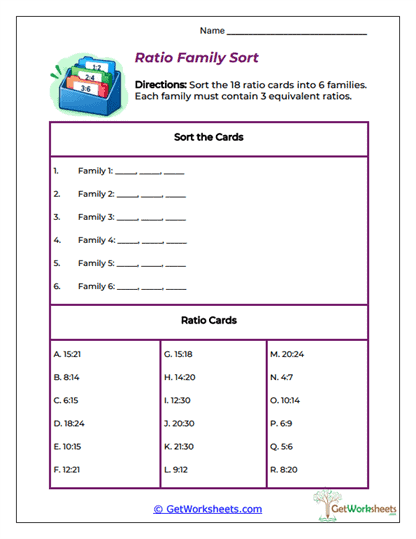
Ratio Family Sort
A larger set of ratio cards must be organized into groups whose members are all equivalent. Simplifying each ratio to a common form provides one reliable strategy, while scale-factor reasoning offers another. The sorting task requires students to compare many ratios and keep track of which relationships have already been identified. This makes the activity a deeper review of equivalence than simple one-to-one matching.
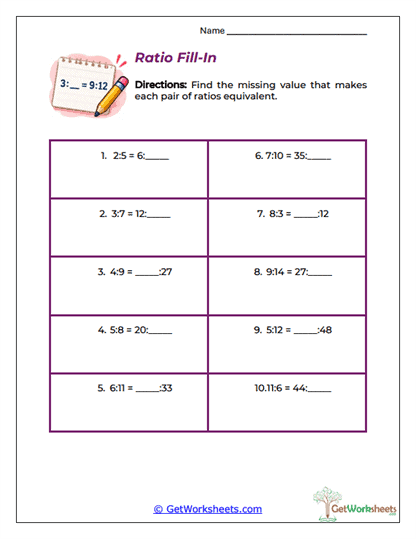
Ratio Fill-In
Missing terms are completed so that two ratios continue to describe the same relationship. Students identify how a known term was multiplied or divided and apply that factor to the corresponding missing value. Because blanks can occur in either part of the ratio, learners must focus on correspondence rather than one fixed pattern. The activity forms a natural bridge from equivalent ratios to solving proportions with unknowns.
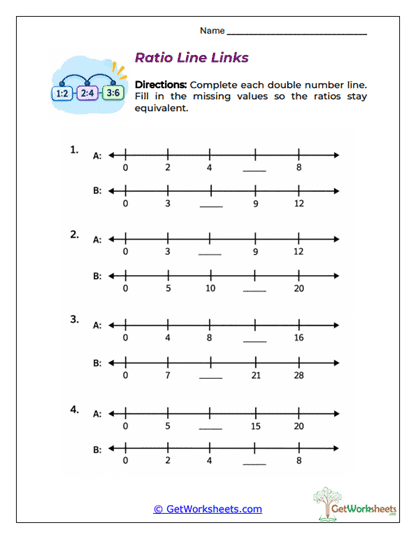
Ratio Line Links
Double number lines show two related quantities increasing together at a constant rate. Students complete missing values by examining corresponding positions and preserving the same ratio from one point to the next. The visual structure makes proportional growth easier to see than isolated symbolic ratios alone. This worksheet also prepares students for later work with rates and unit-rate models.
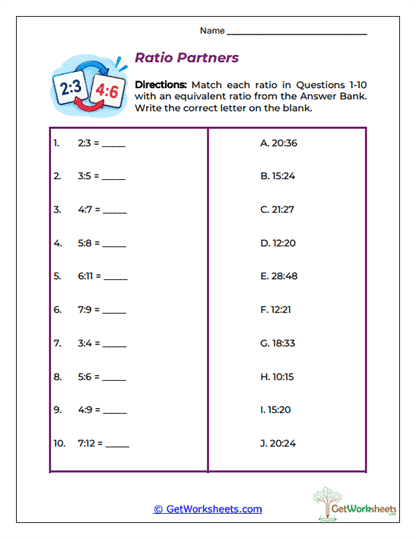
Ratio Partners
Written ratios are matched with scaled versions that represent the same relationship. Students may multiply both terms by a common factor or simplify a larger ratio to find its partner. The matching structure encourages quick recognition of proportional patterns while still requiring accurate multiplicative reasoning. This activity provides straightforward practice with one of the central ideas behind equivalent ratios.
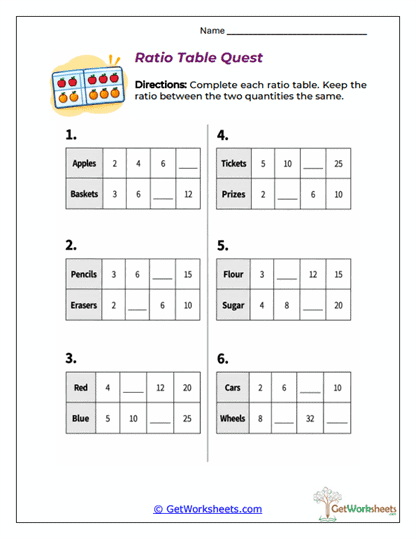
Ratio Table Quest
Students complete missing values in tables containing pairs of related quantities. Each column represents an equivalent version of the same ratio, so the relationship must remain constant as values increase or decrease. Contexts involving objects, ingredients, and other quantities make the paired values easier to interpret. The table format helps students see proportional relationships as repeating numerical patterns.
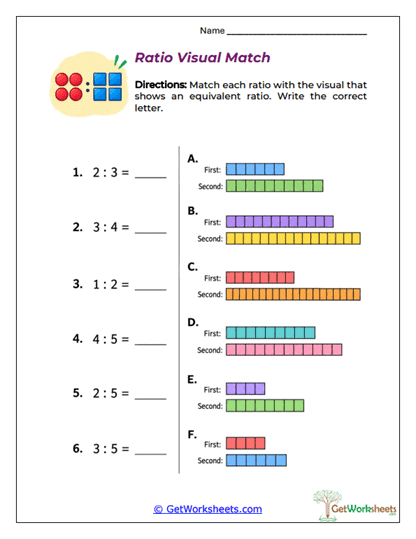
Ratio Visual Match
Block models represent larger or smaller versions of written ratios. Students count the two groups in each visual, write or interpret the resulting ratio, and simplify when necessary to determine the correct match. The pictures make equivalent ratios concrete by showing the same proportional relationship at different sizes. This is especially useful for connecting visual understanding with symbolic ratio notation.
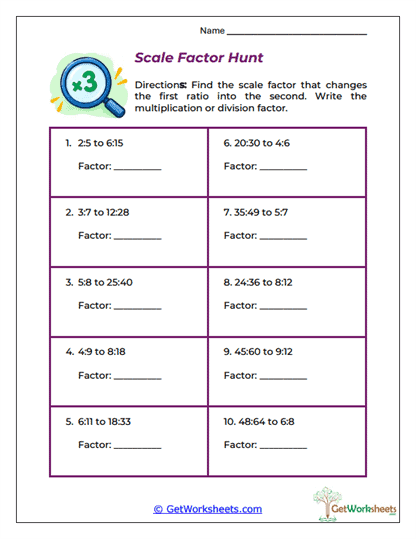
Scale Factor Hunt
Students determine the exact multiplier or divisor that changes one ratio into another equivalent ratio. Both enlargements and reductions appear, so learners practice scaling upward as well as simplifying downward. The same factor must work on both terms, providing a direct check for accuracy. This activity develops the scale-factor thinking needed later in proportions, similar figures, and scale drawings.
Bookmark Us Now!
New, high-quality worksheets are added every week! Do not miss out!