Ratios vs Proportions Worksheets
About This Worksheet Collection
Ratios and proportions are closely connected, but they describe different mathematical ideas. A ratio compares two quantities, while a proportion states that two ratios represent the same relationship. Understanding that distinction helps students know whether they are simply describing a comparison, checking equivalence, or solving a relationship involving two equal ratios. This collection builds that vocabulary and structure before moving students into more advanced proportion work.
The worksheets approach the topic through classification, matching, equivalent-ratio practice, ratio tables, visual models, written descriptions, missing values, and real-world recipe comparisons. Students distinguish ratios from proportions, identify expressions that belong to neither category, create true proportions, verify whether proportional statements are correct, and match ratios with equivalent proportion equations. Several activities also require learners to move between colon notation, fraction notation, words, tables, and pictures.
As students work through these activities, they become more precise about how ratios and proportions are written, interpreted, and connected. They learn that equivalent ratios form the basis of every true proportion and that multiplication, division, simplification, and scale factors can all be used to verify those relationships. These skills prepare learners for cross multiplication, proportional equations, unit rates, scale drawings, similar figures, percentages, and other middle-school topics built on proportional reasoning.
Detailed Descriptions Of These Worksheets
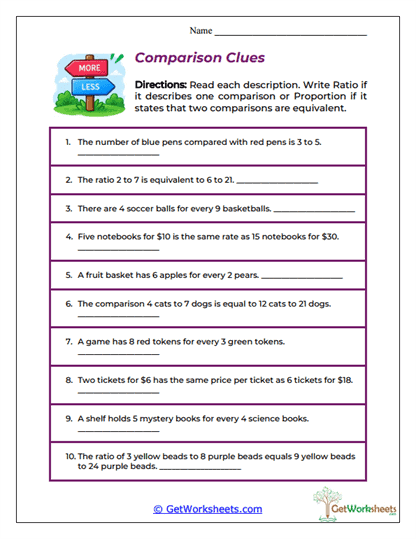
Comparison Clues
Short written situations ask students to decide whether the language describes a ratio or a proportion. Statements expressing one comparison are distinguished from those saying that two rates or relationships are equivalent. Phrases such as "for every," "same rate," and "equivalent" provide useful contextual clues. This activity strengthens mathematical vocabulary while preparing students to recognize proportional relationships inside word problems.
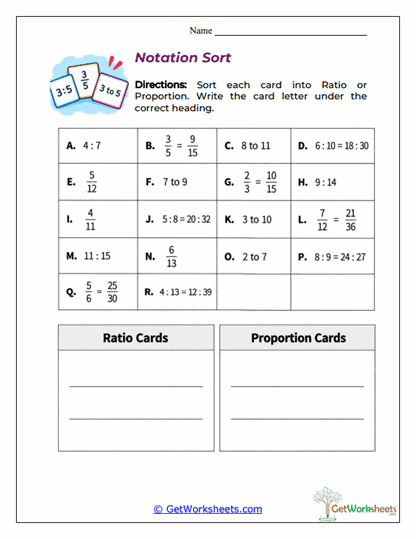
Notation Sort
Ratio and proportion cards are classified according to their mathematical structure. Students encounter colon notation, fractions, "to" language, and equality statements, so they must look beyond one familiar format. A single comparison belongs with ratios, while two equivalent comparisons joined by an equals sign form a proportion. The sorting format builds fast recognition of the notation students will encounter in later proportion work.
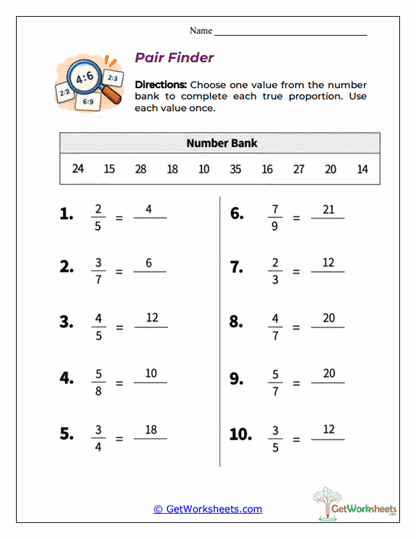
Pair Finder
Missing values are selected from a number bank to complete true proportions. Students can use an obvious scale factor when one is available or turn to cross multiplication when the relationship is less direct. Because each answer-bank value is used strategically, the format offers a natural self-checking feature. The activity combines equivalent-ratio reasoning with early unknown-value problem solving.
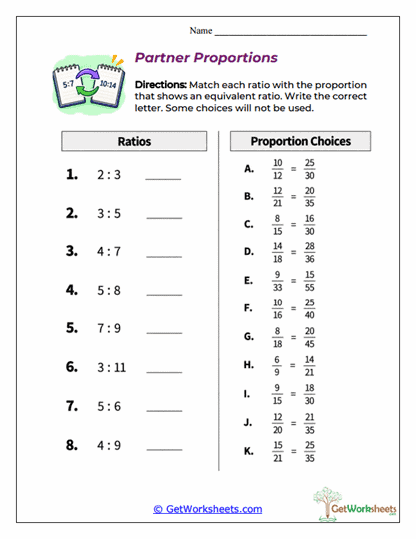
Partner Proportions
Individual ratios are matched with proportion statements that express the same relationship. Students simplify ratios within each proportion or examine scale factors to determine which equation corresponds to the target. Extra answer choices require genuine verification rather than superficial matching. This worksheet makes the connection between a single ratio and a full proportion especially clear.
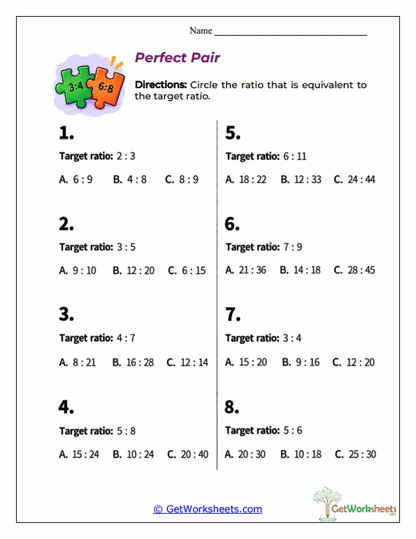
Perfect Pair
Each target ratio is followed by several possible equivalent forms, and students select the correct match. Recognizing a shared scale factor or simplifying the choices provides evidence for the decision. The multiple-choice structure keeps the focus on equivalence while reinforcing multiplication and division. This activity provides a useful bridge from basic ratios to true proportion statements.
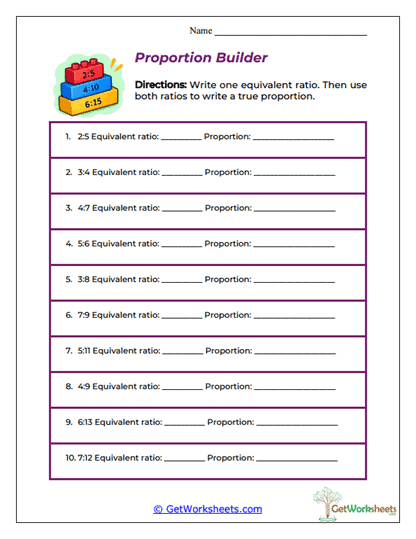
Proportion Builder
Students create their own true proportions by generating an equivalent ratio from a given starting ratio. A chosen scale factor is applied to both terms before the original and new ratios are written as an equality. Because several different scale factors could produce correct answers, learners see that one ratio can belong to an entire family of equivalent forms. The task shows exactly how proportions are constructed.
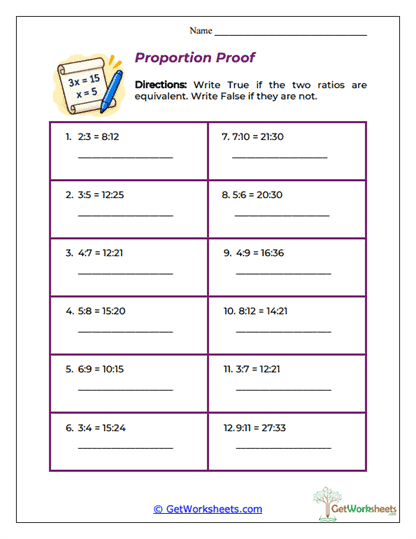
Proportion Proof
True-or-false decisions require students to verify whether two ratios actually form a proportion. Scale factors, simplification, or cross products can all serve as checking strategies depending on the numbers involved. Rather than accepting an equality at face value, learners must produce mathematical evidence that the two relationships match. This strengthens both proportional reasoning and error detection.
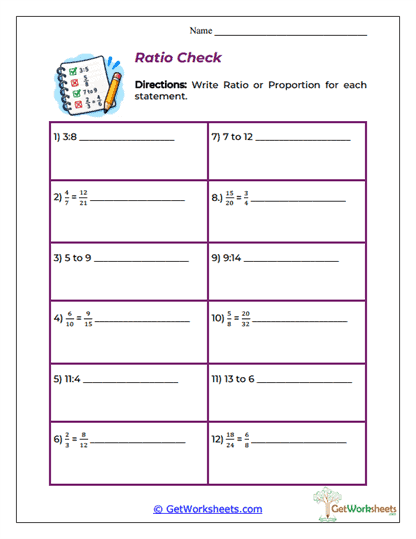
Ratio Check
Students classify each item as either a ratio or a proportion. Single comparisons appear in forms such as colon notation, fraction notation, and "to" language, while proportions contain two equal ratios. The activity emphasizes the structural difference between the two concepts before students are asked to perform any solving. It provides a clear introductory foundation for the rest of the collection.
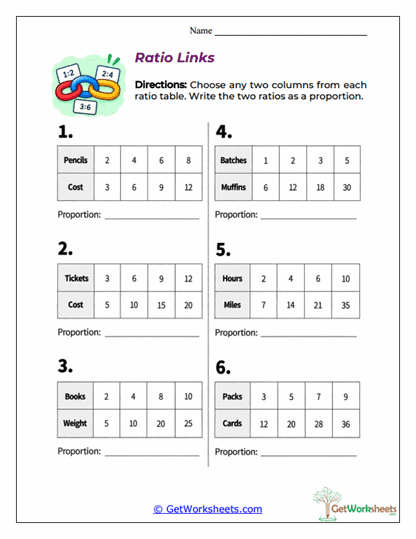
Ratio Links
Completed ratio tables are converted into proportion equations. Students select two columns, preserve the order of the paired quantities, and set the resulting equivalent ratios equal to one another. Because several column combinations may be valid, the activity highlights that every column in a proportional table represents the same underlying relationship. This worksheet connects visual table models with symbolic proportion notation.
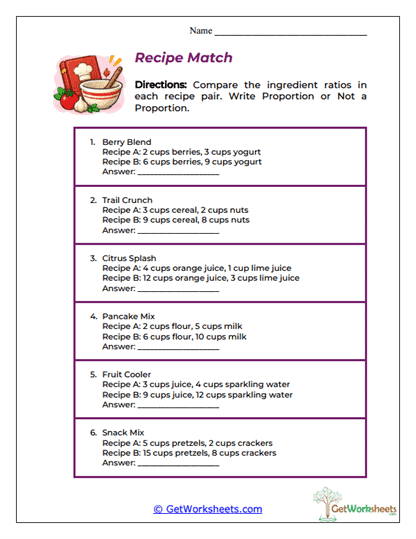
Recipe Match
Pairs of recipes are compared to determine whether their ingredient ratios are proportional. Students examine whether both ingredients changed by the same scale factor or simplify each pair to a common form. The cooking context makes equivalence meaningful because an inconsistent ratio would change the mixture itself. This activity gives proportions a practical interpretation based on maintaining balance.
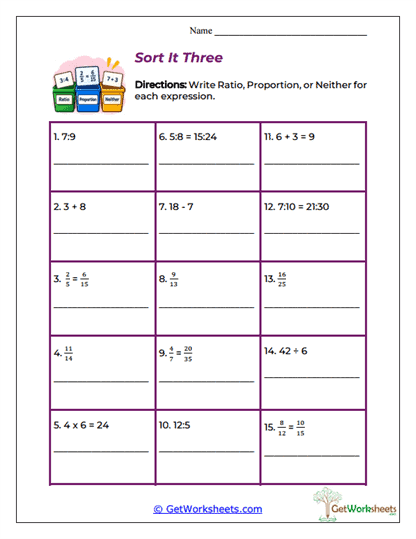
Sort It Three
Expressions are separated into Ratio, Proportion, or Neither categories. Alongside valid ratio and proportion examples, students encounter ordinary arithmetic expressions that do not belong to either group. This forces learners to identify mathematical structure before applying a label. The three-way classification is especially useful for correcting the misconception that any expression containing two numbers must be a ratio.
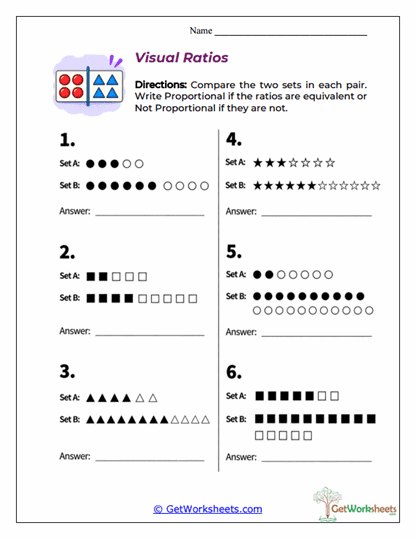
Visual Ratios
Picture sets made from filled and unfilled shapes are translated into numerical ratios and compared for equivalence. Students count each group, write the relationship, and simplify or scale as necessary to determine whether the two visuals form a proportion. The concrete models help learners see proportionality before relying entirely on symbolic notation. This worksheet is particularly effective for connecting visual reasoning with abstract ratio concepts.
Bookmark Us Now!
New, high-quality worksheets are added every week! Do not miss out!