Ratio and Proportion Word Problems Worksheets
About This Worksheet Collection
Ratio and proportion word problems challenge students to move beyond numerical patterns and recognize how two quantities are connected inside a real situation. Whether the context involves prices, recipes, travel, maps, speed, or similar figures, the essential task is the same: identify the relationship that stays constant and use it to determine an unknown value. This collection develops that skill through a wide range of practical settings that make proportional reasoning feel useful rather than abstract.
The worksheets ask students to solve missing-quantity problems, enlarge and reduce ratios, find unit rates, write proportions from stories, choose efficient strategies, resize recipes, compare unit prices, use map scales, work with similar figures, and solve speed problems. Some activities emphasize setup without solving, while others require students to carry the entire process through to a labeled final answer. The mix of scale factors, unit rates, ratio tables, and proportion equations encourages learners to choose methods based on the structure of the problem instead of relying on one procedure every time.
Across the collection, students strengthen reading comprehension, unit awareness, multiplication, division, and strategic decision-making alongside ratio skills. They learn to distinguish parts from totals, keep corresponding quantities aligned, work forward or backward through constant relationships, and judge whether an answer makes sense in context. These habits prepare students for more advanced work with rates, percentages, scale drawings, similar figures, linear relationships, algebraic modeling, and real-world quantitative reasoning.
Detailed Descriptions Of These Worksheets
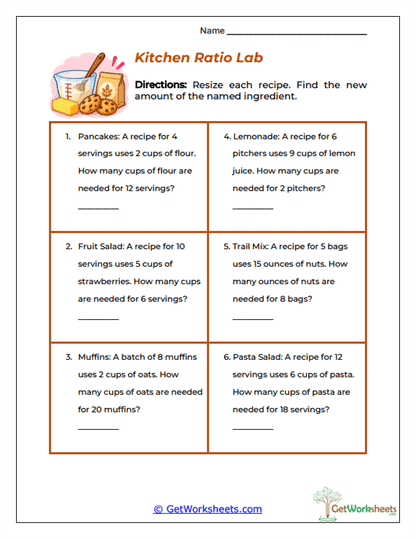
Kitchen Ratio Lab
Recipe problems ask students to resize ingredient amounts while preserving the original relationship between servings and quantities. Learners compare the old and new batch sizes, identify the scale factor, and multiply or divide the ingredient amount accordingly. The familiar cooking context makes proportional change easy to visualize. This activity strengthens equivalent-ratio reasoning while connecting math with everyday food preparation.
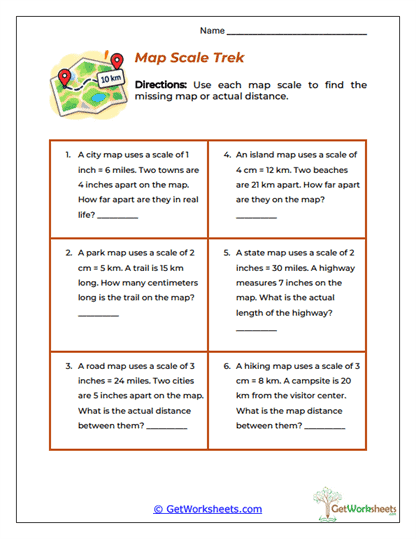
Map Scale Trek
Map scales are used to connect small measurements on a drawing with larger real-world distances. Students may work from the map to the actual distance or reverse the process to determine the required map measurement. Careful attention to units is essential because inches, centimeters, miles, and kilometers must remain properly matched. The worksheet builds scaling skills while showing how proportions support navigation and geographic measurement.
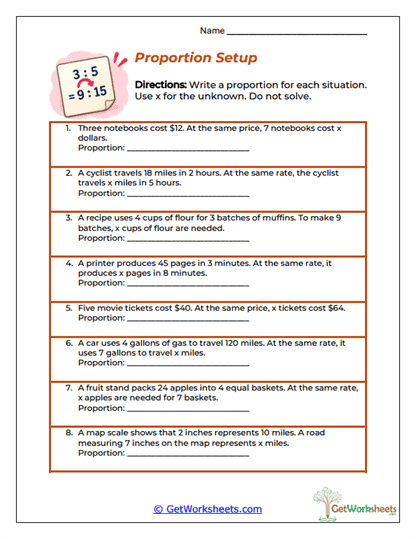
Proportion Setup
Students focus entirely on translating written situations into correctly structured proportions. Prices, travel, recipes, fuel use, printing rates, packing, and map scales all require learners to identify corresponding quantities and place them in a consistent order. Because the directions stop before solving, students can concentrate on setup rather than arithmetic. This isolates one of the most common trouble spots in proportion word problems.
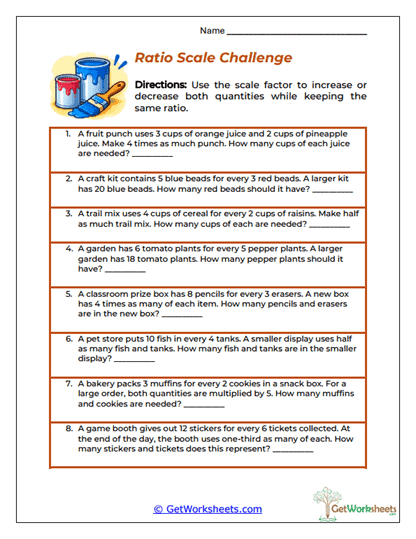
Ratio Scale Challenge
Real-world situations require students to enlarge or reduce both parts of a ratio using the same scale factor. Juice mixtures, bead kits, gardens, classroom supplies, and other contexts make the idea of proportional resizing concrete. Learners practice both multiplication and division depending on whether the situation grows or shrinks. The activity reinforces that the internal balance of a ratio must remain unchanged.
Ratio Story Quest
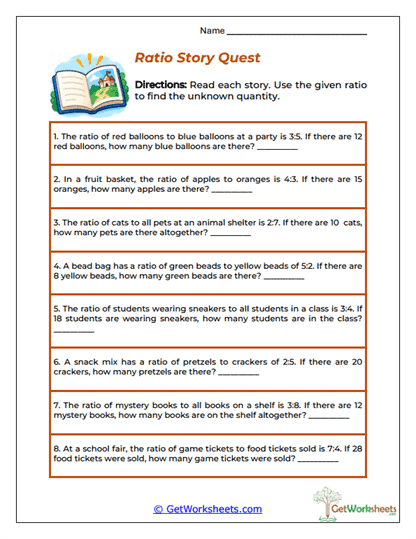
Short stories provide a ratio, one known quantity, and a missing amount to determine. Students identify which part of the relationship corresponds to the known value, find the scale factor, and use it on the matching quantity. Some questions ask for one part, while others require the combined total. The worksheet develops both proportional reasoning and careful reading of what the question is actually asking.
Similar Size Search
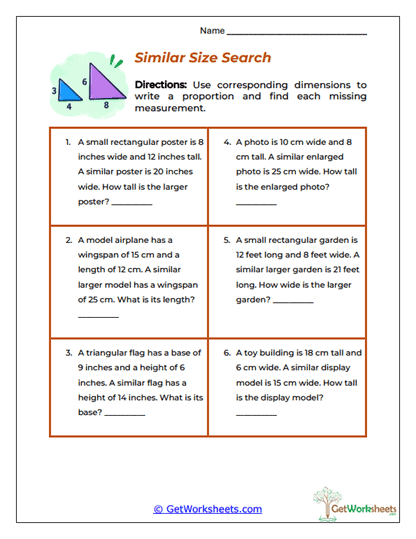
Students use proportions to find missing dimensions in similar figures and scaled objects. Posters, airplane wings, triangles, photographs, gardens, and models require learners to identify corresponding measurements before solving. A correct pairing of dimensions matters just as much as the arithmetic itself. This activity connects ratio reasoning with geometry, scale factors, and measurement.
Speed Route Quest
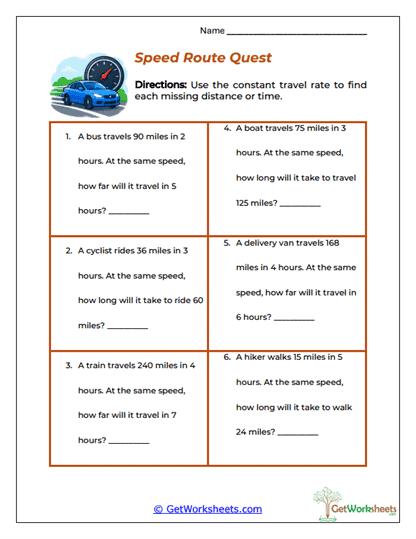
Constant-speed situations ask students to find missing distances or travel times. Learners may determine a unit rate first or use a proportion directly, depending on which approach makes the numbers easier to work with. Problems involving buses, cyclists, trains, boats, delivery vehicles, and hikers make the relationship between distance and time concrete. The worksheet provides a strong foundation for later rate problems in algebra and science.
Strategy Selector
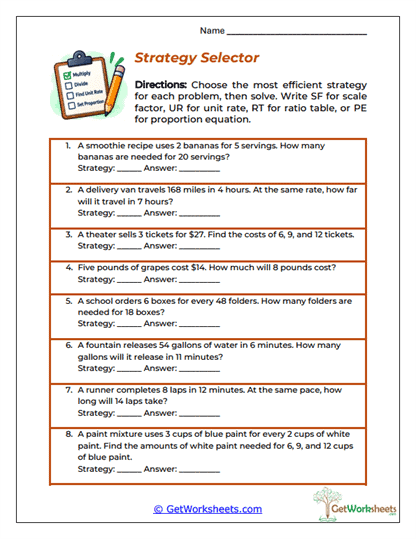
Students decide which proportional method is most efficient before solving each problem. Scale factor, unit rate, ratio table, and proportion equation are all available choices, forcing learners to consider the structure of the numbers instead of applying one method mechanically. The real-world contexts include recipes, travel, groceries, school supplies, water flow, and mixtures. This worksheet develops mathematical independence and strategic flexibility.
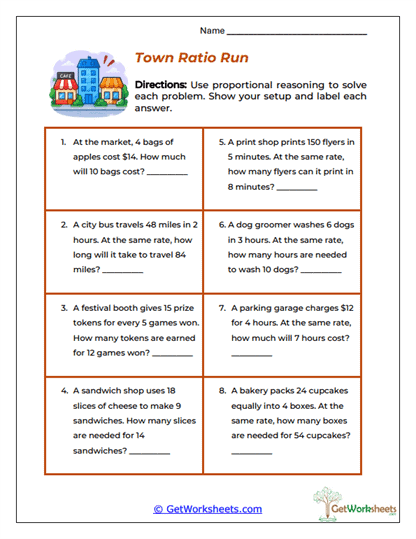
Town Ratio Run
A broad mix of real-world problems serves as cumulative practice with proportional reasoning. Shopping, travel, printing, food preparation, parking, services, and other contexts require students to identify the relationship that remains constant and choose an appropriate strategy. Because the problem type changes repeatedly, learners cannot stay on autopilot. The activity is well suited for review and assessment of flexible problem-solving skills.
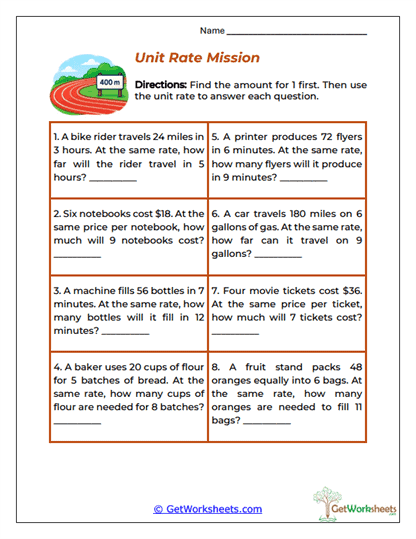
Unit Rate Mission
Students solve proportion problems by first finding the amount for one unit. Travel, cost, production, and other situations require division to determine the unit rate and multiplication to scale that rate to a new quantity. The two-step structure makes many problems easier to organize. This worksheet reinforces the idea that "per one" information can simplify a wide range of proportional situations.
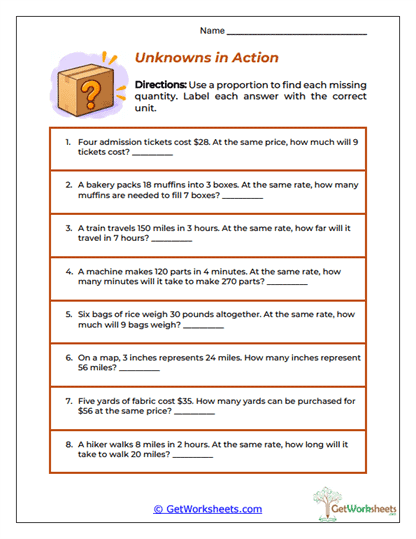
Unknowns in Action
Students complete the full proportion-solving process in practical contexts involving prices, travel, production, weight, maps, fabric, and time. They identify the relationship, write a proportion, solve for the unknown, and label the result with the correct unit. Alternative methods such as unit rates may also work when appropriate. This activity brings reading, setup, calculation, and interpretation together in one task.
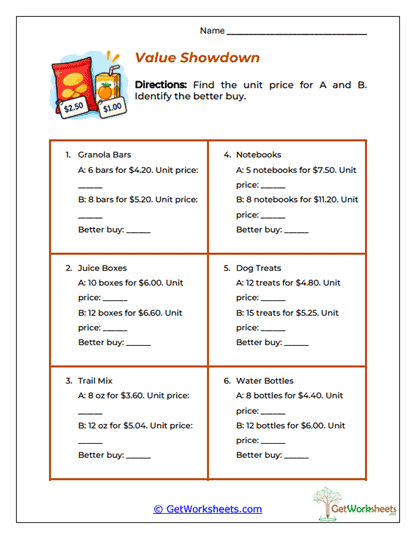
Value Showdown
Students compare purchase options by calculating the unit price for each one. Package sizes and total costs vary, so dividing to find the cost per item or ounce creates a fair basis for comparison. Decimal money calculations make the activity especially practical. The worksheet strengthens unit-rate reasoning while teaching a useful financial-literacy skill.
Bookmark Us Now!
New, high-quality worksheets are added every week! Do not miss out!