Converting Fractions and Percentages Worksheets
About This Worksheet Collection
Fractions and percentages are two different ways to describe the same part of a whole, and learning to move between them gives students a much more flexible understanding of proportion. Instead of treating 3/4 and 75% as unrelated values, learners begin to see both as equivalent representations of the same quantity. That connection strengthens fraction sense, percent understanding, equivalence, simplification, and proportional reasoning.
The worksheets in this collection approach fraction-percent conversion through direct practice, matching, sorting, tables, multiple-choice questions, number lines, error analysis, and real-world applications. Students convert fractions to percents, rewrite percents as simplified fractions, complete missing pairs, evaluate completed conversions, plot equivalent values, and apply the skill to situations involving recipes, sports, scores, surveys, sales, and other everyday contexts. The range of formats helps grades 5-6 students build fluency without reducing the topic to one repeated procedure.
As students work through the collection, common benchmark relationships such as 1/2 = 50%, 1/4 = 25%, and 3/4 = 75% become useful reference points for less familiar values. Learners also practice simplifying fractions, interpreting percentages greater than 100%, and judging whether an answer is reasonable before accepting it. These habits create a strong foundation for later work with ratios, probability, discounts, data, percent change, and proportional relationships.
Detailed Descriptions Of These Worksheets
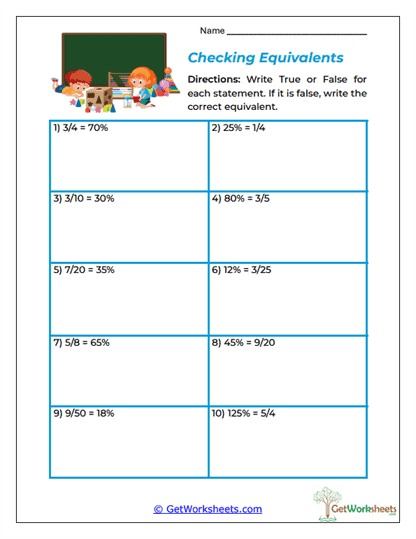
Checking Equivalents
Students inspect completed fraction-percent statements and decide whether each relationship is true or false. Incorrect matches must be repaired, which makes familiar benchmarks especially useful for checking whether a value is reasonable. Rather than simply producing conversions, learners analyze the relationship between two forms and determine whether they genuinely represent the same amount. This builds stronger self-checking habits and reveals whether students understand equivalence beyond memorized pairs.
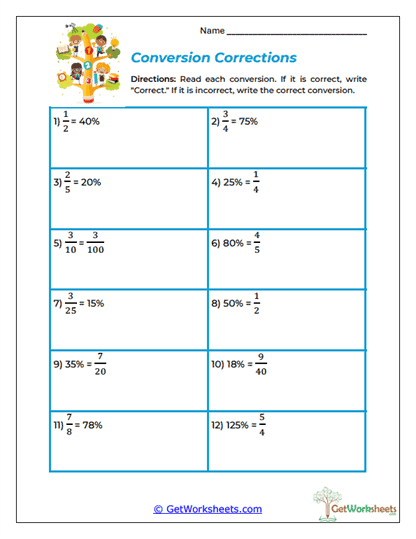
Conversion Corrections
Fraction-percent mistakes become clues for students to investigate. Learners examine each statement, identify where the conversion went wrong, and replace the incorrect value with an accurate equivalent. Benchmark relationships such as one-half, one-quarter, and one whole provide efficient ways to test suspicious answers. The error-analysis format encourages students to explain why a conversion fails instead of treating correction as a simple answer replacement.
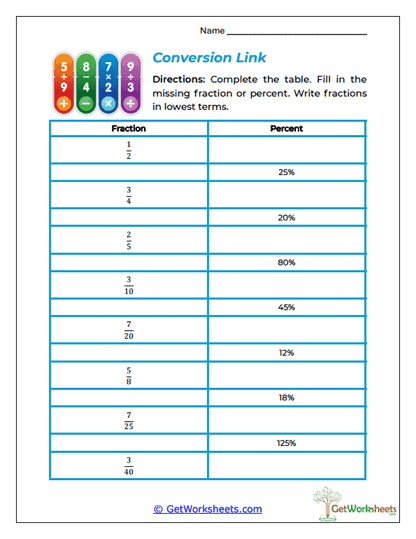
Conversion Link
A table mixes fraction-to-percent and percent-to-fraction conversions so students must first determine which direction each row requires. Some problems call for finding an equivalent percentage, while others require writing a percent as a simplified fraction. Seeing both forms side by side reinforces that the amount itself does not change. The changing direction makes this an effective test of flexible conversion rather than one-rule repetition.
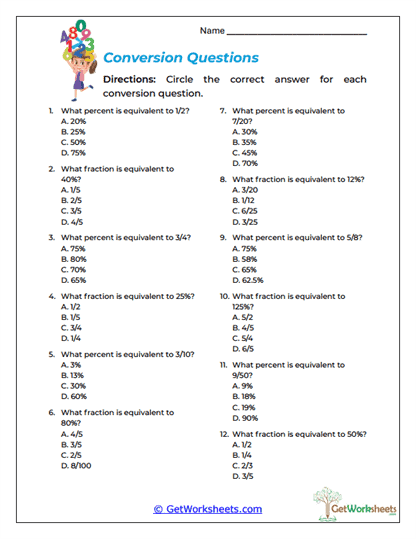
Conversion Questions
Multiple-choice problems ask students to identify the fraction or percent equivalent to a given value. Closely related answer choices require careful reasoning, especially when fractions must be simplified or benchmark knowledge can eliminate an option quickly. Both conversion directions appear throughout the activity. The format supports fluency while also encouraging students to judge whether an answer is sensible before selecting it.
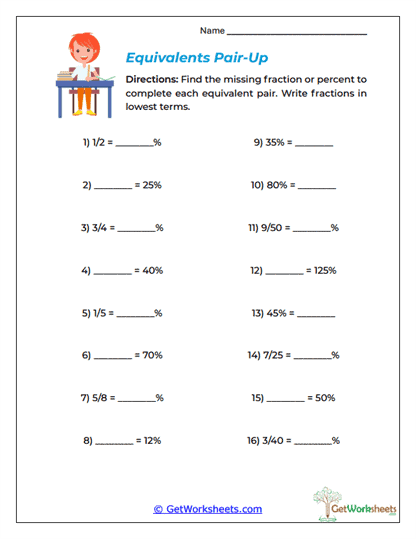
Equivalents Pair-Up
Students complete missing fraction-percent pairs, switching continually between the two representations. Some values begin as fractions, while others begin as percentages that must be written in lowest terms. Common conversions become easier to recognize through repetition, while less familiar values demand deliberate calculation. The worksheet develops the ability to move comfortably in either direction without depending on one fixed routine.
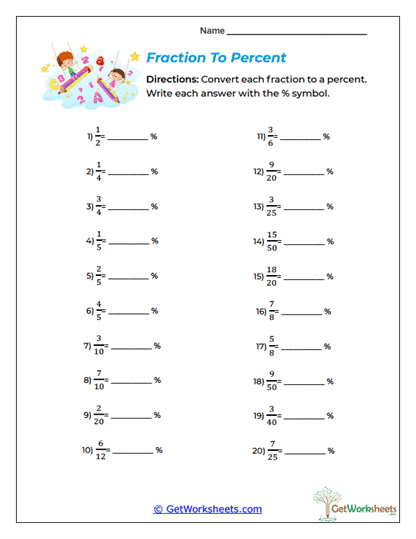
Fraction To Percent
This worksheet concentrates on rewriting fractions as percentages. Familiar benchmarks appear alongside fractions with denominators such as 6, 8, 25, 40, and 50, encouraging students to use equivalent fractions, division, or other efficient strategies. The progression shows that a denominator does not need to be 100 for a percentage to be found. Students gain a clearer understanding of percent as another way to describe a part-whole relationship.
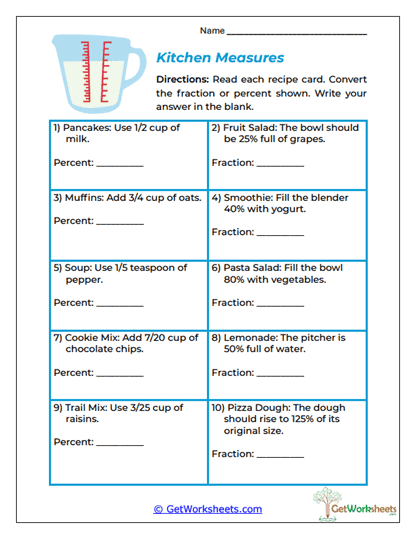
Kitchen Measures
Recipe quantities and container measurements make fraction-percent equivalence more concrete. Students translate fractional portions into percentages and convert percentage amounts back into simplified fractions. Measuring cups, bowls, and ingredient quantities help learners picture the values instead of seeing them only as notation. The activity also includes percentages above 100%, reinforcing that a percent can describe more than one whole.
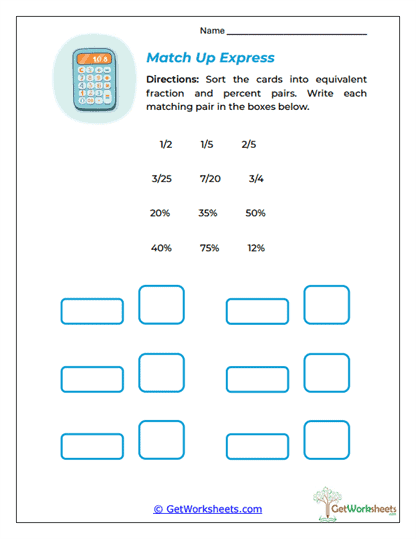
Match Up Express
Fractions and percentages are mixed together and must be reorganized into equivalent pairs. Because the correct partners are not already aligned, students must search for relationships and use benchmark knowledge, division, or equivalent fractions strategically. The sorting structure encourages comparison across several values at once. It is particularly useful for developing fast recognition of commonly used fraction-percent combinations.
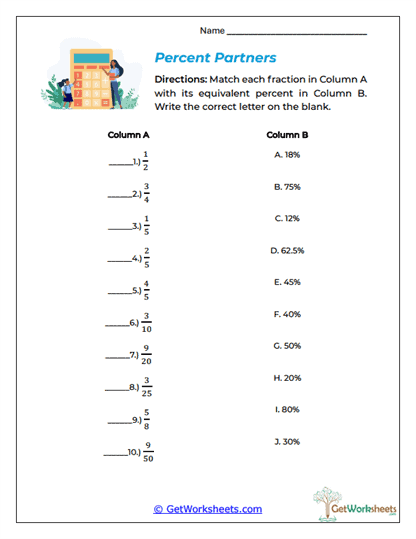
Percent Partners
Students match fractions in one column with their equivalent percentages in another. Values range from familiar benchmarks to less immediate examples such as twentieths, twenty-fifths, and eighths. The answer bank creates opportunities for elimination and self-correction as matches are completed. Repeated pairing helps important equivalences become easier to recognize without recalculating every example from scratch.
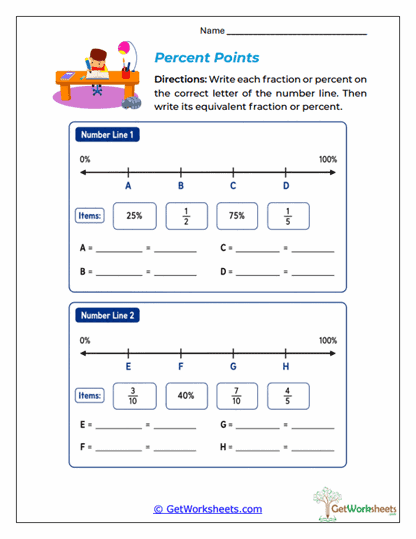
Percent Points
A number line from 0% to 100% provides a visual setting for fraction-percent equivalence. Students plot fractions and percentages, compare their positions, and write the alternate representation for each value. Seeing 1/2 and 50% occupy the same point makes equivalence physically visible rather than purely symbolic. The activity also reinforces ordering, magnitude, and benchmark relationships across a shared scale.
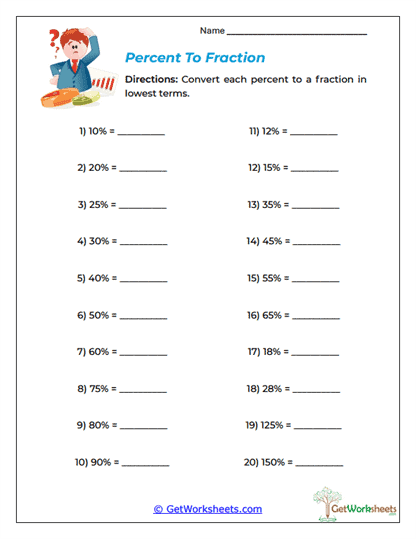
Percent To Fraction
Students begin with percentages, write them as fractions over 100, and reduce the results to lowest terms. The problems include common percents, less familiar values, and percentages greater than 100%, which may produce fractions larger than one whole. Simplification becomes an essential part of the conversion rather than a separate skill. This gives students meaningful practice with factors and equivalent fractions while deepening their understanding of what percent notation means.
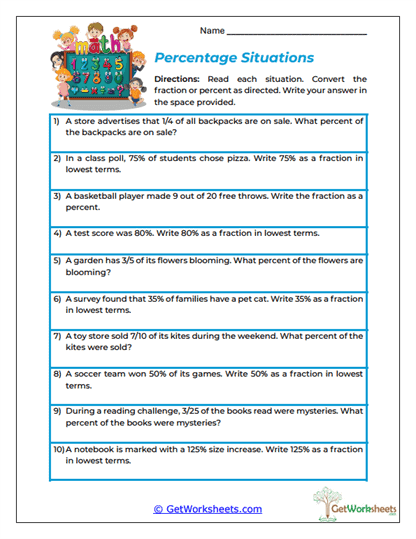
Percentage Situations
Short real-world problems place fraction-percent conversion inside meaningful contexts. Students interpret situations involving sales, sports, scores, surveys, growth, and other part-whole relationships before deciding how to rewrite the quantity. The reading component requires them to understand what the fraction or percent represents instead of simply manipulating symbols. This helps students see why the ability to convert between the two forms matters in practical mathematics.
Bookmark Us Now!
New, high-quality worksheets are added every week! Do not miss out!