Finding the Whole Given a Part and Percent Worksheets
About This Worksheet Collection
Finding the whole from a known part and percentage requires students to reverse the percent relationship rather than calculate forward from a total. That shift makes the topic especially valuable because learners must think carefully about which quantity is missing, how the percent relates to the known amount, and why dividing by the percent written as a decimal reconstructs the original whole. The work strengthens percent sense, inverse operations, proportional reasoning, equations, and number magnitude.
The worksheets in this collection present missing-whole problems through tables, matching, multiple-choice questions, bar models, error analysis, surveys, discounts, progress goals, classroom data, and mixed equation formats. Some activities make the part-percent-whole structure explicit, while others hide the relationship inside real-world situations that students must interpret before solving. The variety helps grades 5-6 learners recognize the same mathematical relationship even when the surface form changes.
As students progress, they become more comfortable checking whether a result is reasonable before accepting it. They learn that a percent below 100% usually means the whole should be larger than the known part, while a percent above 100% can produce a whole that is smaller. These habits build stronger proportional thinking and prepare students for later work with original prices, rates, data, goals, markups, discounts, and more advanced percent equations.
Detailed Descriptions Of These Worksheets
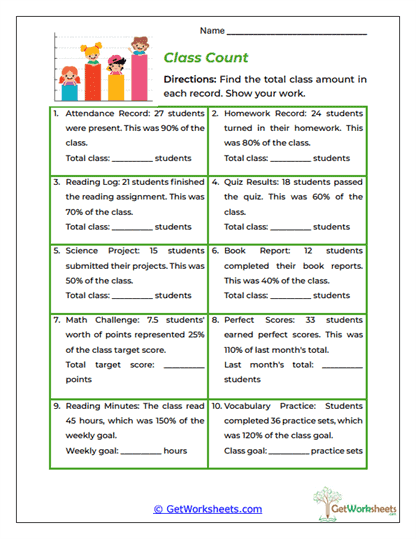
Class Count
School-based situations ask students to recover a missing total from a completed amount and a percentage. Depending on the problem, the whole may represent a class size, target score, weekly goal, or earlier amount. Students must first interpret what the total means in context before applying the calculation. This makes the worksheet especially useful for strengthening word-problem reasoning alongside percent fluency.
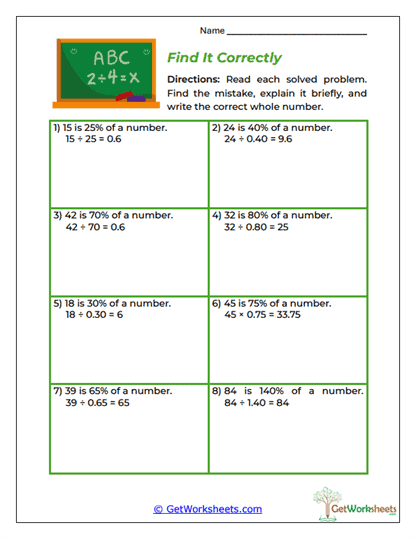
Find It Correctly
Students examine completed missing-whole problems that contain an error somewhere in the process. They determine whether the mistake came from converting the percent, choosing the wrong operation, or calculating the final whole incorrectly. Each problem then requires a corrected solution and explanation. The error-analysis format helps students understand why the method works instead of treating it as a formula to memorize.
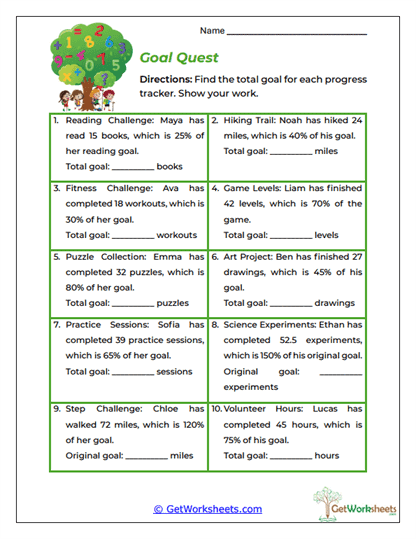
Goal Quest
Progress toward reading, exercise, projects, games, and other goals becomes the basis for reverse percent reasoning. Students know how much has been completed and what percentage of the goal that amount represents, then work backward to find the full target. The setting makes the missing whole easy to interpret as the complete goal rather than an abstract unknown. It also reinforces the practical use of percentages for tracking progress.
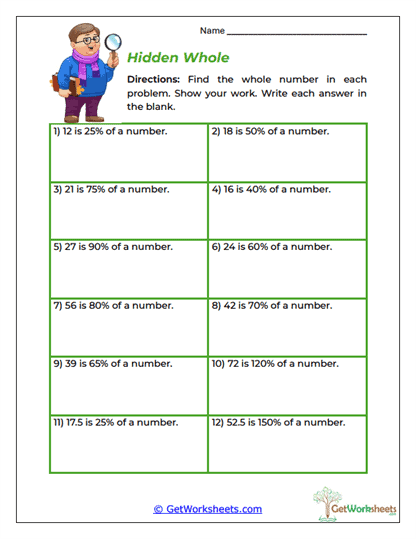
Hidden Whole
This worksheet provides direct practice with statements in which the part and percent are known but the total is missing. Students convert the percent to decimal form and divide the known amount by that value to recover the whole. Familiar percentages allow some problems to be solved mentally, while values above 100% broaden students' understanding of how percent relationships behave. The activity establishes the core procedure in a clear, focused format.
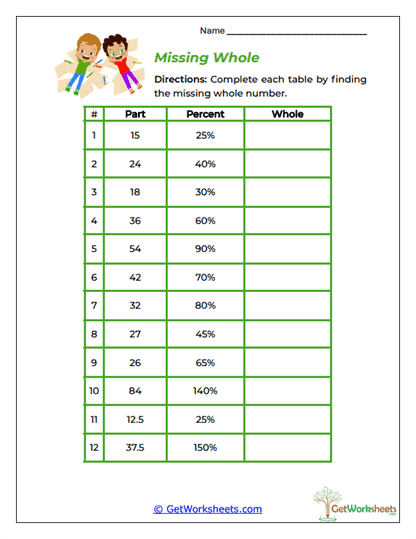
Missing Whole
A three-column table organizes the known part, known percent, and unknown whole. Students complete each row using the same inverse percent relationship while working with a range of percentages, including values greater than 100%. The structure makes the roles of the quantities easy to distinguish. This format is particularly helpful for building fluency and revealing whether students confuse the part with the total.
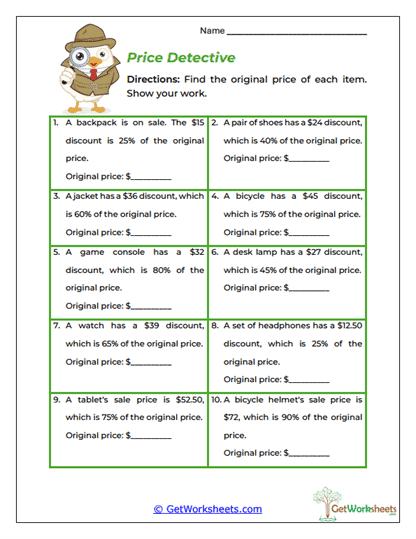
Price Detective
Original prices are reconstructed from known discount amounts and discount percentages. Students treat the discount as the part and the original price as the missing whole, then use division to uncover the starting value. The shopping context gives the calculation an immediate financial meaning. It also lays useful groundwork for later work with sale price, tax, markup, and other consumer-math applications.
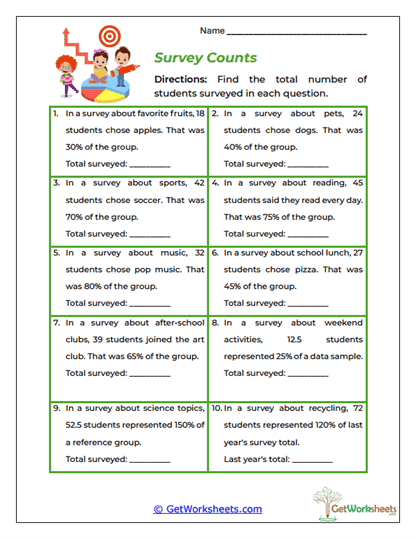
Survey Counts
Students use partial survey data to determine how many people participated altogether. A category count acts as the known part, while the stated percentage describes how large that group is relative to the entire survey. Working backward turns percent into a tool for reconstructing population size. The activity connects naturally with later work involving polls, graphs, statistics, and data summaries.
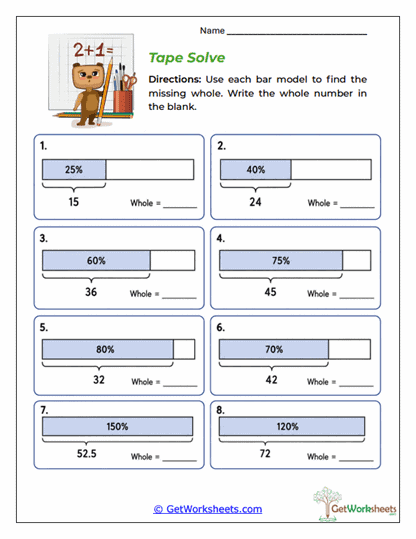
Tape Solve
Bar models make the missing-whole relationship visible before students rely on symbolic calculation. The known part is shown as a shaded section of a full tape, allowing learners to reason from familiar percentages such as 25%, 50%, 75%, or 80% toward the complete amount. Students can solve by equal groups, fractions, proportions, or division. This visual approach is especially useful for learners who benefit from seeing how the part fits inside the whole.
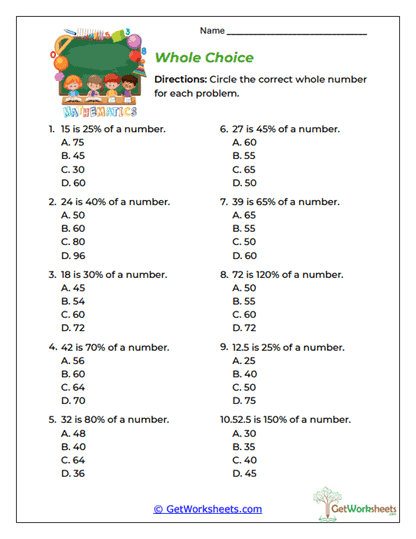
Whole Choice
Multiple-choice problems ask students to identify which total makes each part-and-percent statement true. The answer choices encourage estimation and reasonableness before exact calculation, especially when the percent is clearly below or above 100%. Familiar percent-fraction relationships can often provide an efficient route to the solution. The format helps students combine computational skill with judgment.
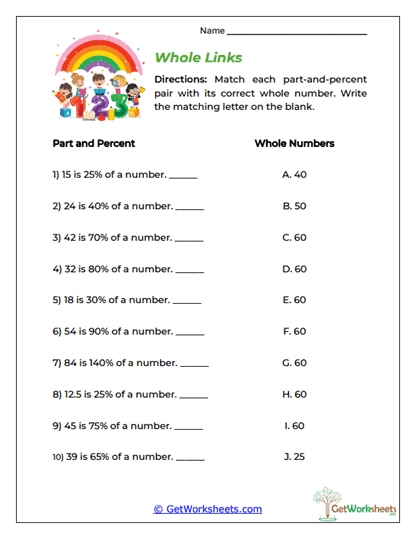
Whole Links
Part-and-percent statements are matched with the whole numbers that complete them correctly. Students solve each relationship and then locate the corresponding result in an answer bank. The matching structure provides natural feedback because an unavailable answer signals that the calculation may need to be revisited. This activity develops fluency while keeping repeated missing-whole practice from feeling mechanical.
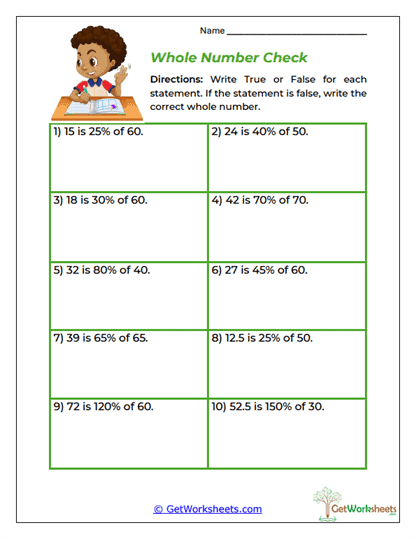
Whole Number Check
Students decide whether completed part-percent-whole statements are true or false and correct any that fail. One useful checking strategy is to multiply the proposed whole by the stated percent and see whether the original part is recovered. That reverse verification reinforces the relationship from both directions. The worksheet helps students develop independence by teaching them how to test a result instead of stopping as soon as a number is found.
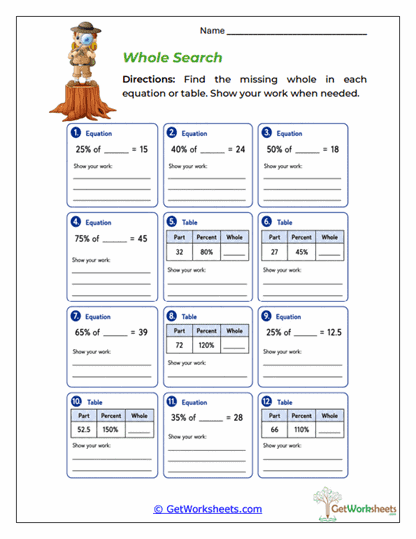
Whole Search
Equations and small tables are mixed together so students must recognize the missing-whole relationship in more than one representation. A problem may appear as "25% of ___ = 15" in one section and as a part-percent table in another. The mathematical structure remains the same even though the layout changes. This variety builds flexible reasoning and prepares students for word problems that may not present percent information in a familiar format.
Bookmark Us Now!
New, high-quality worksheets are added every week! Do not miss out!