Converting Decimals and Percentages Worksheets
About This Worksheet Collection
Converting between decimals and percentages helps students recognize that two different forms can describe exactly the same quantity. Rather than treating decimal notation and percent notation as separate topics, these worksheets emphasize the relationship between place value and "per hundred" thinking. As students move between forms, they build a stronger understanding of magnitude, equivalence, and why values such as 0.4 and 40% represent the same amount.
The collection gives students several ways to develop that relationship. Some activities focus directly on converting one form into the other, while others use tables, matching, sorting, multiple-choice questions, number lines, error analysis, and real-world contexts. Learners also encounter values below 1%, familiar percentages such as 50% and 75%, and percentages greater than 100%, ensuring that conversion practice extends beyond only the simplest examples.
As students work through these worksheets, they begin to rely less on a memorized decimal-point rule and more on numerical understanding. They learn to use 100% = 1 as a reference point, judge whether a converted value has a reasonable size, recognize equivalent forms quickly, and interpret decimals and percents in shopping, probability, scores, progress, and other everyday situations. Those habits create a strong foundation for later work with discounts, taxes, interest, percent change, data, probability, and financial mathematics.
Detailed Descriptions Of These Worksheets
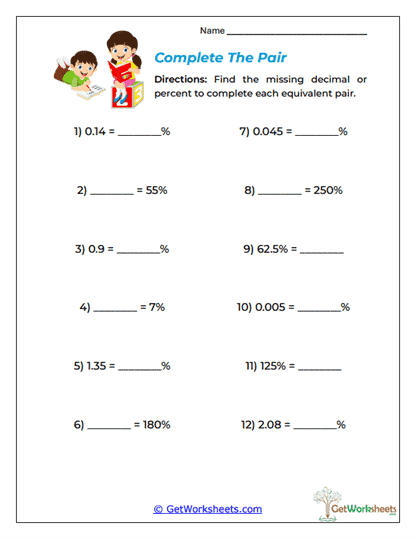
Complete The Pair
Students complete decimal-percent pairs when one representation is missing. Because some problems begin with a decimal and others begin with a percent, learners must first determine which direction the conversion should go. Values range from very small percentages to quantities above 100%, preventing the activity from becoming a one-pattern exercise. The changing direction develops flexibility and reinforces the idea that both forms describe the same underlying amount.
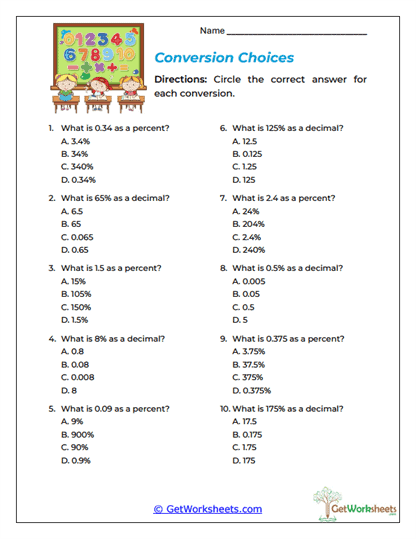
Conversion Choices
Multiple-choice problems challenge students to select the decimal or percent that correctly matches a given value. Similar-looking distractors make place-value accuracy especially important, since an extra zero or misplaced decimal can change the quantity dramatically. Students alternate between both conversion directions and encounter familiar as well as less common values. The format encourages learners to check magnitude before trusting an answer that merely looks plausible.
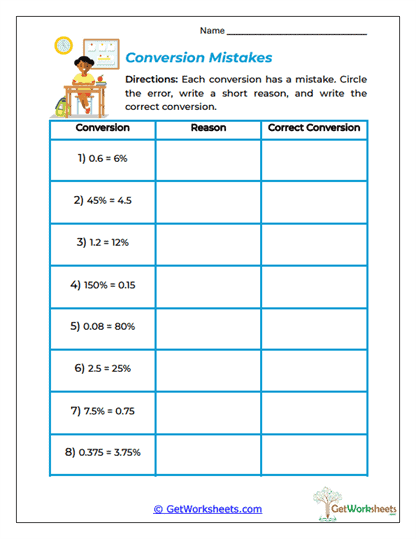
Conversion Mistakes
Incorrect decimal-percent statements become problems to diagnose rather than examples to ignore. Students determine what went wrong, explain the error, and then supply the correct equivalent value. Examples such as a percent above 100% being written as a decimal below 1 help expose misconceptions about place value and magnitude. The activity develops strong self-checking habits by requiring students to understand the relationship well enough to repair faulty reasoning.
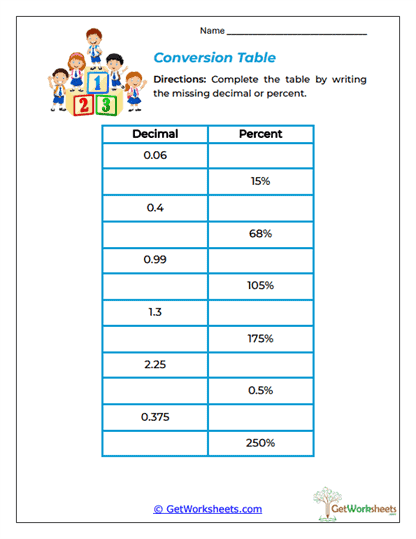
Conversion Table
A two-column table places equivalent decimals and percents directly beside one another. Students fill whichever representation is missing, switching repeatedly between multiplying and dividing by 100. Seeing pairs together makes patterns such as 1.3 = 130% or 0.06 = 6% easier to notice. The organized format is particularly useful for mixed review and for revealing whether a student is comfortable converting in both directions.
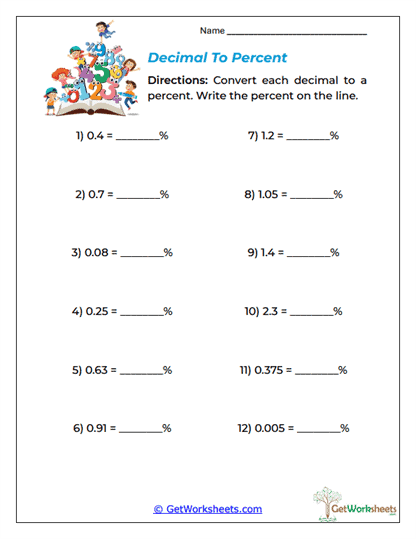
Decimal To Percent
Students concentrate specifically on rewriting decimals as percentages. The problems move beyond simple tenths and hundredths to include thousandths, decimals greater than 1, and values that produce percentages below 1%. This range helps learners see that multiplying by 100 changes the notation without changing the underlying quantity. The worksheet provides focused practice for building fluency before more mixed conversion tasks are introduced.
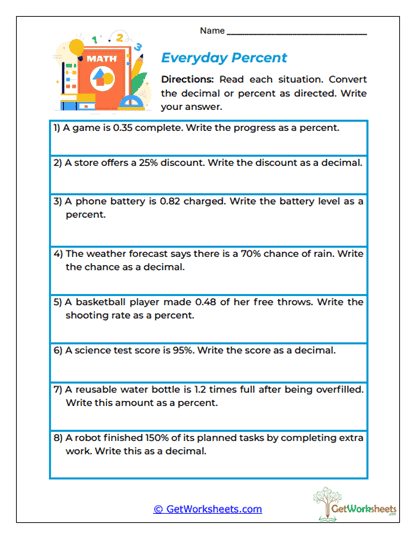
Everyday Percent
Real-world situations give decimal-percent conversions an immediate purpose. Battery levels, test scores, weather chances, store discounts, game progress, and sports statistics require students to translate values from one form to another while considering what the number represents. Context becomes part of the mathematics because learners must decide whether a converted value makes sense in the situation. This helps connect conversion skills with the kinds of percentages students regularly encounter outside school.
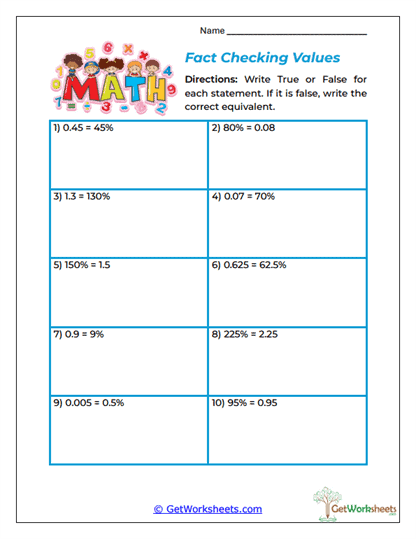
Fact Checking Values
Students judge whether completed decimal-percent equivalences are true or false. A statement must first pass a magnitude check and then, when necessary, be corrected. This creates an opportunity to use familiar anchors such as 50% = 0.5 and 100% = 1 when evaluating less familiar examples. The fact-checking format encourages students to question numerical relationships rather than automatically accepting written work.
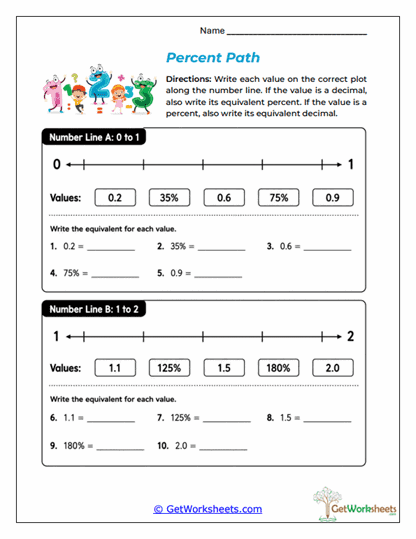
Percent Path
Number lines make decimal and percent equivalence visible as position. Students place values between 0 and 1 and then continue beyond 1 so they can see exactly where percentages such as 125% or 180% belong. Converting each value while locating it reinforces both notation and magnitude. The visual structure is especially helpful for correcting the misconception that percentages must stop at 100%.
Percent To Decimal
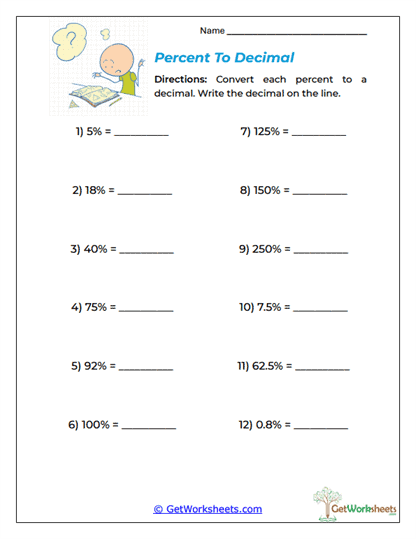
This activity reverses the most familiar conversion direction by having students rewrite percentages as decimals. Learners work with ordinary whole-number percents, decimal percents, values below 1%, and percentages well above 100%. The variety requires careful placement of zeros and a strong sense of whether the resulting decimal should be less than, equal to, or greater than 1. The worksheet builds the fluency needed for later calculations involving rates, discounts, tax, and interest.
Store Tags
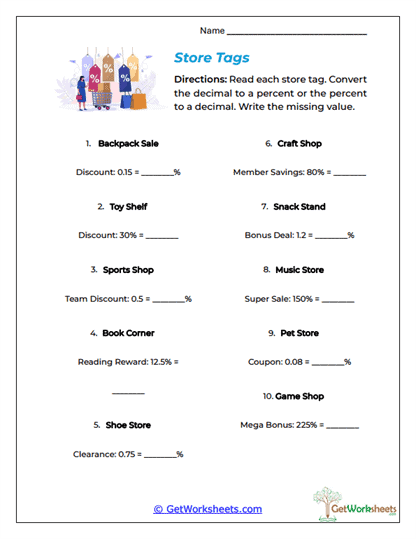
Shopping language provides a natural setting for switching between decimal and percent forms. Discounts, rewards, clearance offers, savings, and bonus deals ask students to interpret a value before converting it. Familiar financial vocabulary helps make abstract notation more meaningful and shows why fluency between the two forms matters. The activity also prepares students for later work in consumer math involving discounts, markups, tax, and percent change.
Value Links
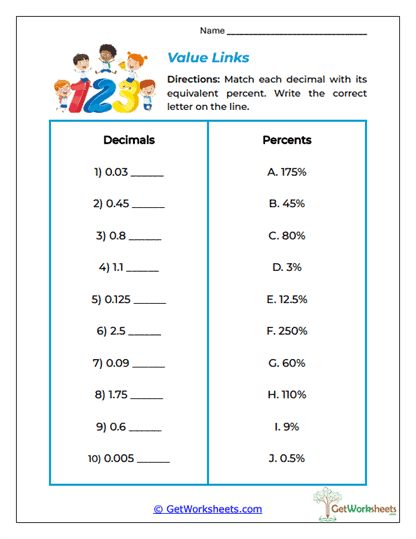
Students match decimals with equivalent percentages from a separate answer bank. The search for a correct partner turns conversion into a comparison task, while elimination provides a useful form of built-in feedback. Tiny decimals, common fractional values, and numbers greater than 1 all appear, broadening students' understanding of possible percent sizes. The activity is well suited for developing faster recognition of equivalent forms.
Value Sort
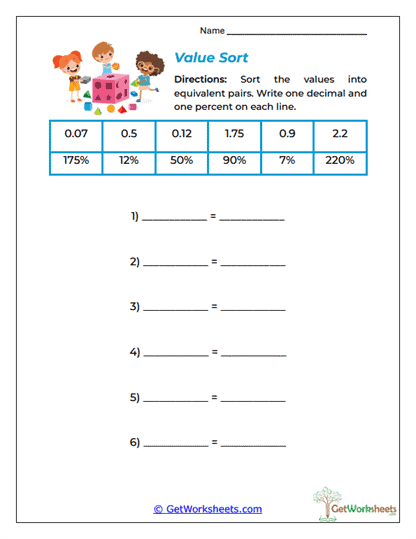
Decimals and percentages are mixed together and must be organized into equivalent pairs. Instead of solving a sequence of isolated conversions, students examine the entire set and look for relationships among the values. Familiar pairs can be identified quickly, while less obvious ones require deliberate place-value reasoning. The sorting structure promotes pattern recognition and helps students see conversion as a relationship between representations rather than as two unrelated procedures.
Bookmark Us Now!
New, high-quality worksheets are added every week! Do not miss out!