Exponent Operations Worksheets
About This Worksheet Collection
Exponent operations help students understand how powers behave when they are multiplied, divided, raised to another power, or used within grouped expressions. Instead of treating exponent rules as isolated shortcuts, learners benefit from seeing how repeated multiplication, matching bases, products, quotients, and parentheses explain why each rule works. Building this understanding gives students a stronger foundation for algebraic simplification and more advanced work with expressions.
This collection gives students several ways to practice exponent operations and properties. Activities include identifying rules, matching expressions with answers and properties, solving for missing powers, correcting mistakes, sorting expressions by property, simplifying mixed and multi-step expressions, explaining mathematical reasoning, cracking codes, and applying powers to real-world situations. The worksheets can be used for classroom instruction, independent practice, homework, intervention, tutoring, enrichment, or homeschool lessons.
As learners complete the collection, they strengthen rule recognition, repeated-multiplication reasoning, algebraic thinking, expression simplification, and mathematical communication. They also practice choosing the correct property, working backward from equivalent expressions, organizing multi-step solutions, analyzing errors, and explaining why a rule applies. These varied activities help students move from memorizing exponent rules to understanding how and when to use them.
Detailed Descriptions Of These Worksheets
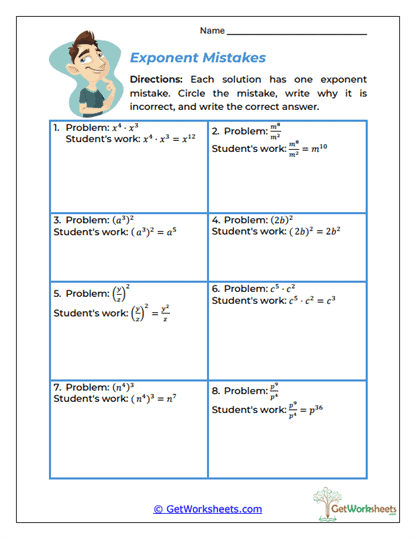
Exponent Mistakes
Incorrect exponent solutions give students an opportunity to study what went wrong instead of simply solving another routine problem. Learners inspect the bases, powers, operations, and grouping symbols before identifying the rule that was misapplied. They then correct the expression and explain the error. This process strengthens self-checking habits and helps students recognize common misconceptions before those mistakes become patterns.
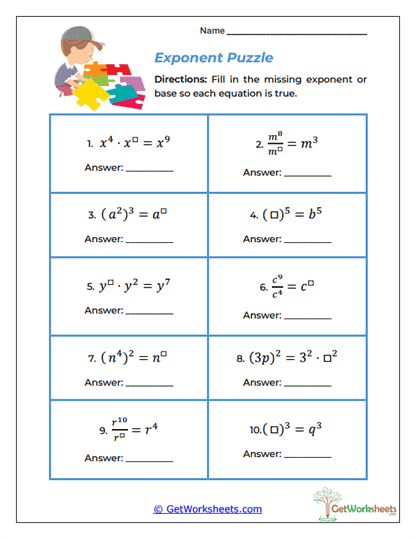
Missing Powers Puzzle
Students work backward through exponent equations to determine missing powers, bases, or other unknown values. The problems involve multiplication, division, powers of powers, and grouped expressions, so learners must decide which relationship connects the two sides. Rather than relying on a repeated procedure, students use equality and exponent properties as clues. This puzzle-style practice builds flexible reasoning and provides a useful bridge toward algebra.
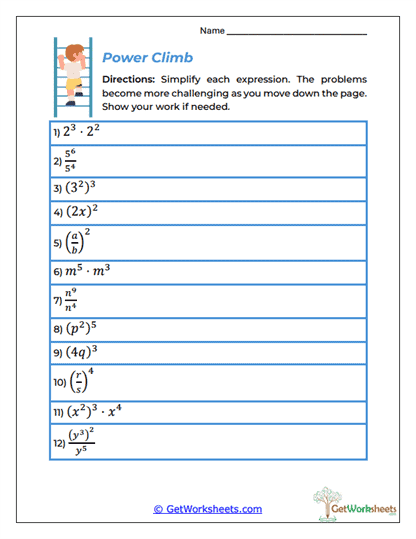
Power Climb
A mixed set of exponent problems gives students practice switching among several power properties on the same page. Learners simplify products, quotients, powers of powers, powers of products, and powers of quotients while deciding which rule fits each expression. The variety encourages students to examine structure instead of assuming the same method will work every time. This makes the worksheet a strong choice for cumulative review before quizzes or tests.
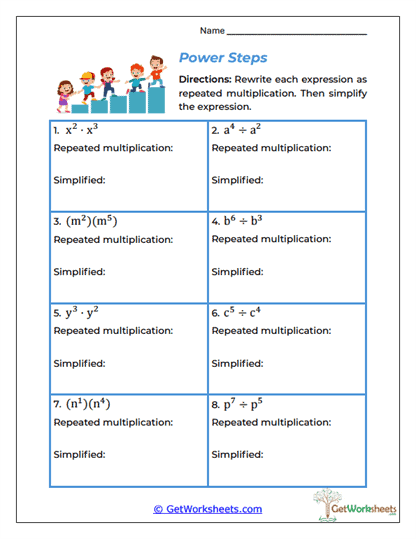
Power Steps
Repeated multiplication helps students see what exponent notation actually represents before they simplify. Learners identify the base, expand powers into factors, and examine how multiplication or division changes the resulting exponent. Slowing the process down makes the reasoning behind the rules more visible. This activity is especially helpful for students who need a concrete connection between basic multiplication and algebraic power notation.
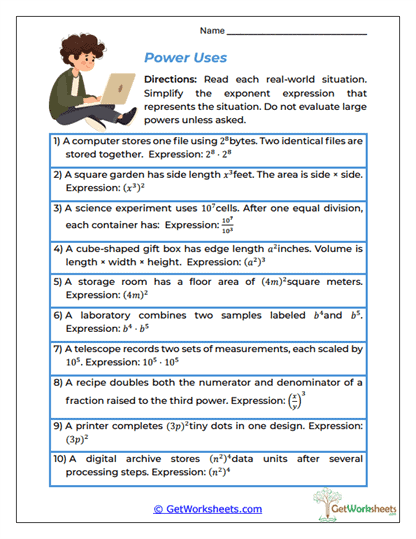
Power Uses
Real-world and scientific situations show learners how powers can represent repeated quantities, area, volume, measurement, data, and scaling. Students interpret each scenario and simplify the exponent expression connected with it. The context encourages them to think about what the notation means rather than treating it as a collection of symbols. This worksheet also supports connections with geometry, science, and technology. It is useful for showing students why powers are an efficient way to represent repeated factors.
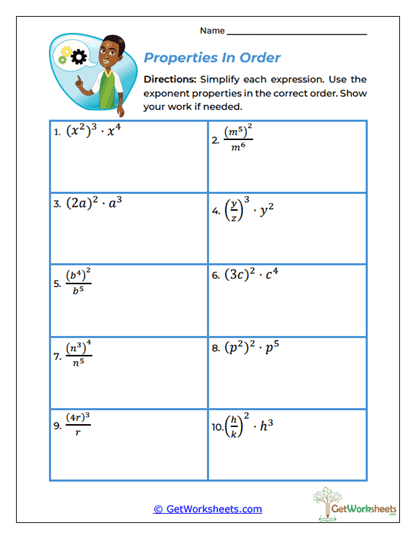
Properties in Order
Multi-step expressions require students to apply more than one exponent property in a logical sequence. Learners work through grouping symbols, products, quotients, matching bases, and powers of powers one step at a time. Showing intermediate work helps students keep track of how the expression changes after each rule is used. The activity prepares learners for more complicated algebraic simplification and reinforces the value of organized mathematical work.
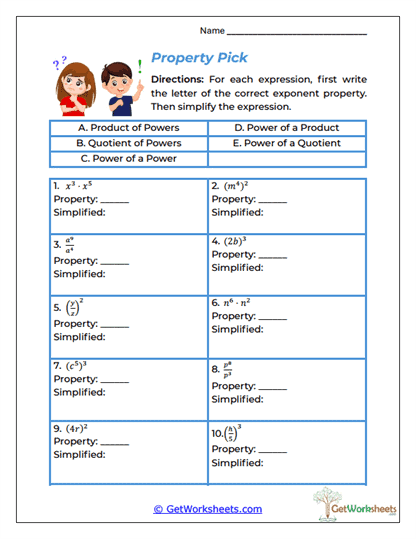
Property Pick
Students identify the power property that matches each expression before simplifying it. They distinguish among products, quotients, powers of powers, powers of products, and powers of quotients by looking for structural clues such as matching bases and grouping symbols. Choosing the rule first encourages stronger decision-making and reduces careless application of the wrong property. This page works particularly well after students have learned the individual rules and are ready to compare them.
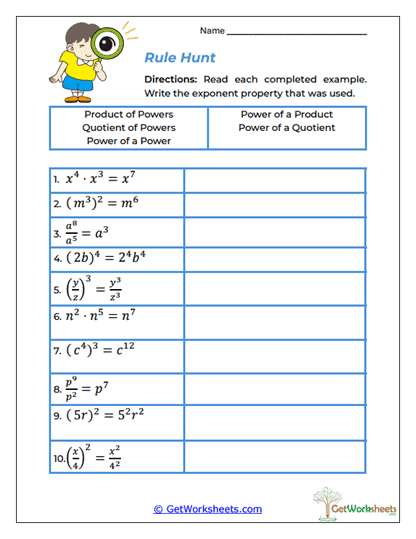
Rule Hunt
Completed examples become clues as students determine which exponent property explains each result. Learners compare bases, powers, grouping symbols, multiplication, and division to identify the underlying rule. Because the calculations are already shown, students can concentrate on recognizing patterns and using the correct mathematical vocabulary. The activity is useful for review, guided discussion, or checking whether students can distinguish closely related properties.
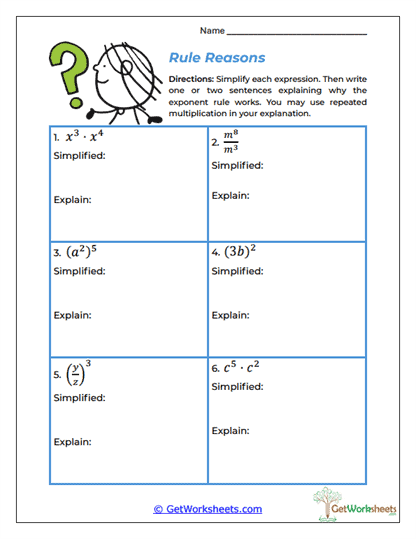
Rule Reasons
Students simplify exponent expressions and then explain why the rule they used works. Repeated multiplication can be used to support explanations involving matching bases, products, quotients, and grouped expressions. Writing about the process helps learners move beyond memorized shortcuts and demonstrate genuine understanding. This activity also strengthens mathematical vocabulary and communication. It is especially helpful for assessing whether students can justify their reasoning as well as calculate accurately.
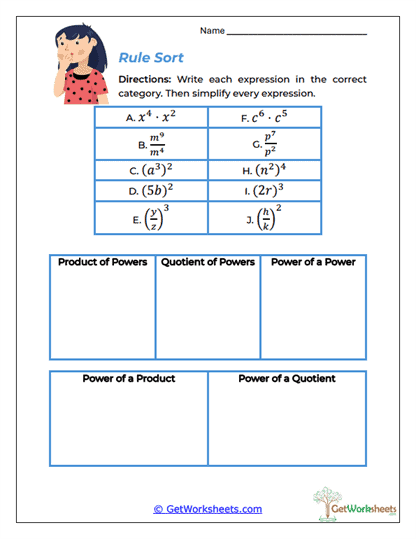
Rule Sort
Exponent expressions are classified into categories based on the property they represent. Students sort products, quotients, powers of powers, powers of products, and powers of quotients before simplifying them. Organizing the expressions by type helps learners notice important visual differences among rules that can otherwise look very similar. The sorting format encourages the useful habit of identifying the problem structure before choosing a procedure.
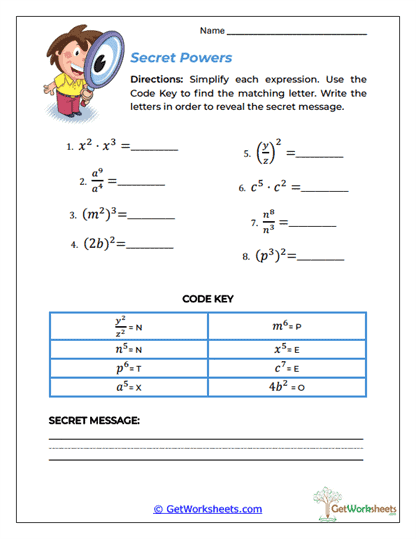
Secret Powers
A code-breaking format gives students an engaging reason to simplify each exponent expression carefully. Learners solve problems involving products, quotients, grouped expressions, and other power rules, then use their answers to reveal a hidden message. If the code does not make sense, students have a natural reason to revisit their work. The activity combines mixed practice with built-in motivation and self-checking.
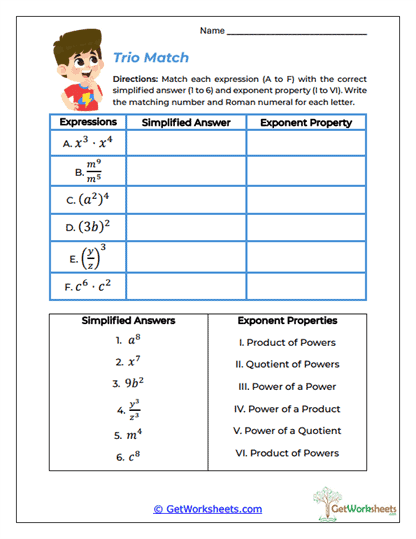
Trio Match
Students connect three related pieces of information: an original exponent expression, its simplified form, and the property that explains the change. Matching all three requires learners to understand both the computation and the reasoning behind it. The format encourages careful comparison and makes it easier to see whether a student understands the rule, the simplification, or both. It works well for partner practice, centers, intervention, or review.
Bookmark Us Now!
New, high-quality worksheets are added every week! Do not miss out!