Negative Exponents Worksheets
About This Worksheet Collection
Negative exponents help students understand how powers behave when an exponent drops below zero. Rather than making a value negative, a negative exponent indicates a reciprocal relationship, so a factor with a negative power can be rewritten using a positive power in the denominator or numerator. Understanding this idea helps learners connect exponent patterns, fractions, reciprocals, and later algebraic simplification.
This collection gives students several ways to practice negative exponents and reciprocal relationships. Activities include studying exponent patterns, rewriting negative powers as fractions, matching equivalent forms, solving missing-power problems, correcting misconceptions, simplifying expressions with positive exponents only, explaining reciprocal reasoning, and applying negative exponents in scientific contexts. The worksheets can be used for classroom lessons, guided practice, homework, tutoring, intervention, enrichment, or homeschool instruction.
As students work through the collection, they strengthen reciprocal reasoning, fraction fluency, exponent vocabulary, algebraic thinking, and expression simplification. They also practice distinguishing negative exponents from negative values, moving factors across fraction bars correctly, recognizing equivalent forms, analyzing errors, and combining several exponent laws in multi-step problems. These activities help learners understand why the rule works instead of treating negative exponents as another isolated shortcut.
Detailed Descriptions Of These Worksheets
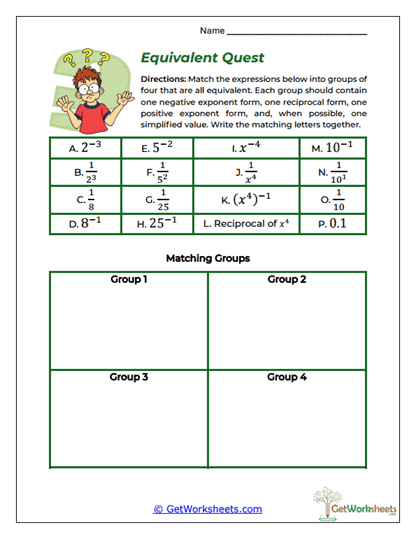
Equivalent Quest
Students group together different expressions that represent the same value. Negative powers, reciprocal forms, positive-power fractions, and numerical values must all be matched correctly. The activity encourages learners to compare bases and exponents carefully rather than relying on appearance alone. It builds flexible understanding by showing that one quantity can be written in several equivalent ways.
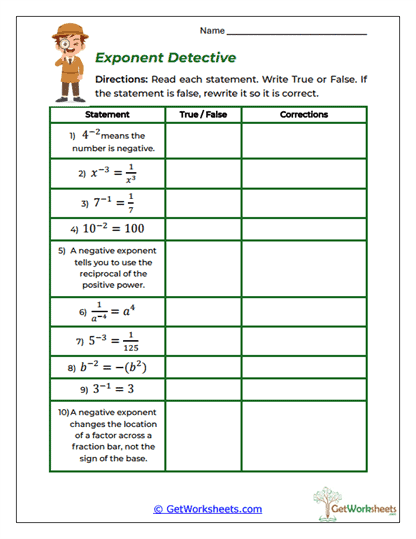
Exponent Detective
True-or-false statements challenge students to decide whether negative exponent rules have been used correctly. Learners identify misconceptions, such as assuming a negative exponent makes the entire value negative, and then rewrite incorrect statements. This format encourages close reading of bases, powers, reciprocals, and fraction notation. It also strengthens students' ability to explain why a statement is mathematically valid or invalid.
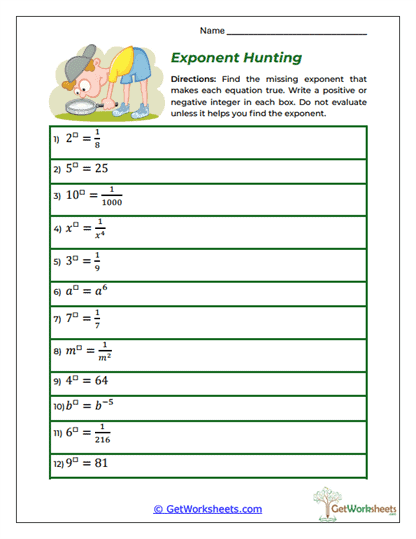
Exponent Hunting
Missing-exponent equations ask students to work backward and determine which positive or negative power makes each relationship true. Learners compare equivalent forms, reciprocals, fractions, and numerical values to solve each blank. Reverse reasoning makes this activity more challenging than straightforward rewriting. It also provides useful preparation for algebraic equations involving unknown values.
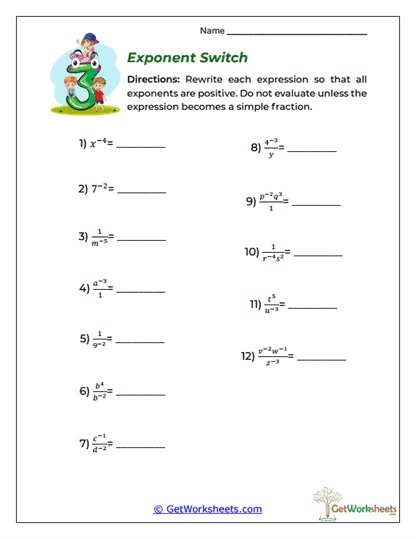
Exponent Switch
Students rewrite expressions so that every exponent is positive. Negative-power factors may need to move between the numerator and denominator while keeping the expression equivalent. Repeated practice helps learners develop a dependable routine for working with reciprocals and fraction structure. This worksheet provides an important bridge toward simplifying rational algebraic expressions.
Lawful Positives
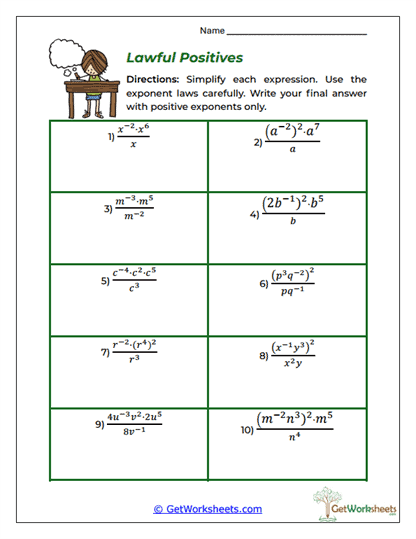
More complex rational expressions require students to combine several exponent laws while ensuring that all final powers are positive. Learners simplify products, quotients, grouped variables, and powers of powers one stage at a time. The layered problems encourage organized work because an error in one step can affect the rest of the solution. This page is especially appropriate for students ready for a greater algebraic challenge. It helps develop the patience and accuracy needed for higher-level rational expressions.
Mistake Mission
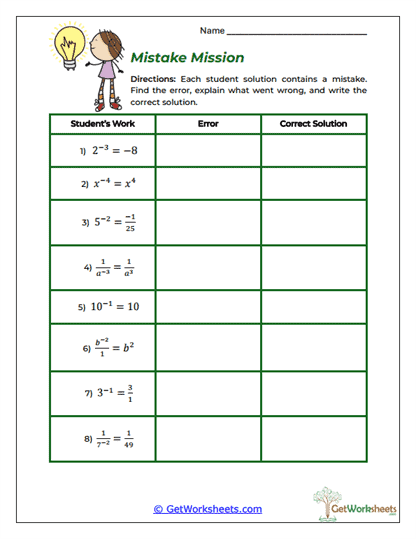
Incorrect solutions give students the opportunity to diagnose common negative-exponent errors. Learners identify what went wrong, explain the misunderstanding, and replace the result with a correct reciprocal or positive-power form. Seeing believable mistakes makes misconceptions easier to recognize in their own work. The activity builds mathematical reasoning along with stronger self-checking habits.
Only Positives
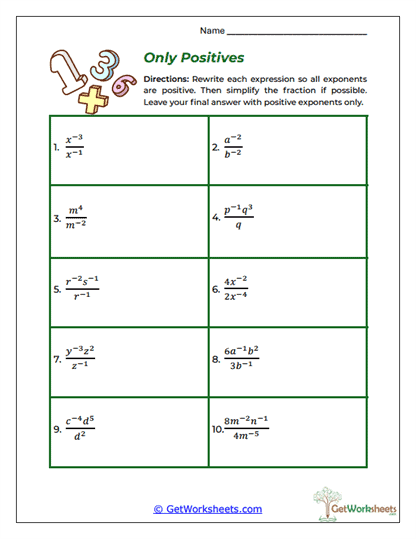
Mixed expressions challenge students to remove negative exponents and simplify the remaining factors completely. Learners work with products, quotients, variables, and fraction bars, often using more than one rule in a single problem. The final answer must contain positive exponents only, so students need to check both placement and simplification. This activity closely resembles the type of rational-expression work they will encounter in algebra.
Reciprocal for Negatives
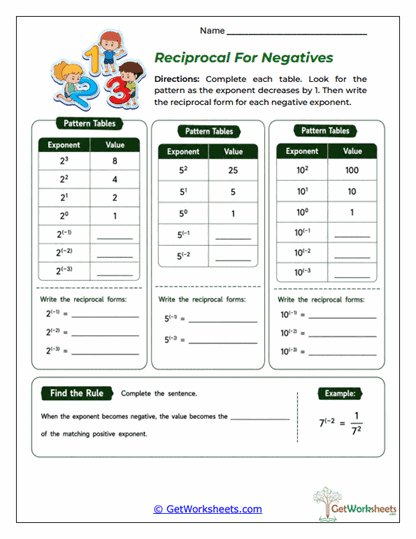
Pattern tables help students discover why negative exponents create reciprocals. Learners follow powers from positive values through zero and into negative exponents while observing how each step involves division by the base. Seeing the pattern develop makes the reciprocal rule feel logical rather than arbitrary. The worksheet is particularly useful for introducing the concept before students begin using the rule more quickly.
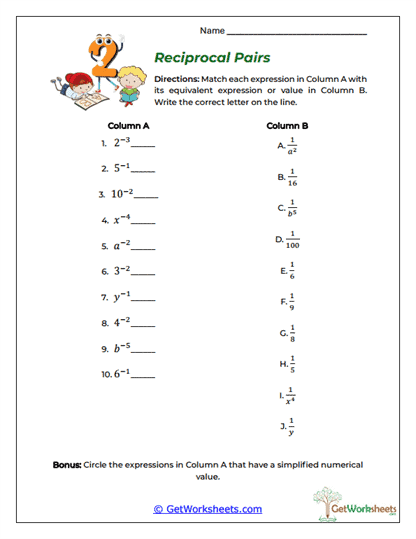
Reciprocal Pairs
A matching format asks learners to connect negative powers with their equivalent positive-power and fractional forms. Students work with both numerical and variable bases, which helps prevent the rule from becoming tied to one type of example. Matching encourages careful comparison without requiring every expression to be evaluated numerically. The activity provides useful fluency practice with reciprocal relationships.
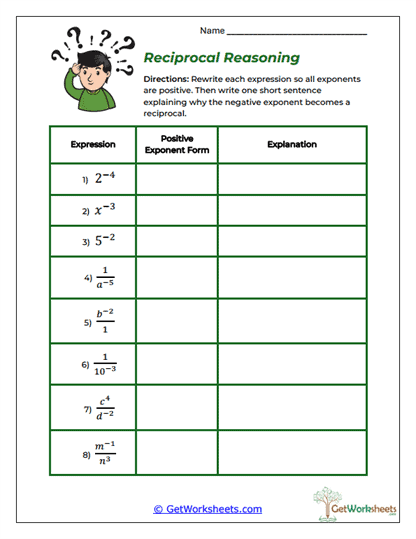
Reciprocal Reasoning
Students rewrite negative-power expressions with positive exponents and then explain why the transformation works. The written portion encourages learners to use terms such as reciprocal, numerator, denominator, base, and exponent accurately. Combining procedure with explanation makes it easier to see whether a correct answer reflects genuine understanding. This worksheet strengthens both algebraic reasoning and mathematical communication.
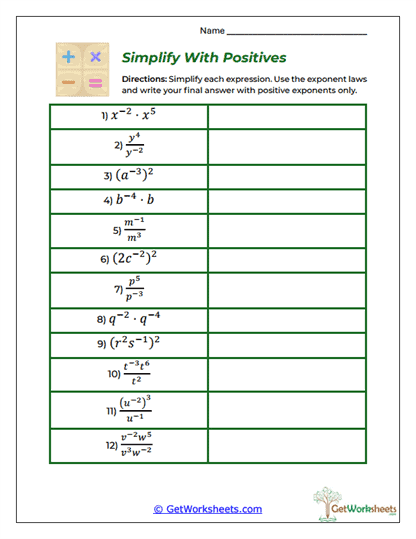
Simplify With Positives
Students clean up mixed expressions by applying exponent laws, moving negative-power factors when necessary, and simplifying the result. Problems may involve products, quotients, variables, powers of powers, and fractions. Because more than one property can appear in the same expression, learners must organize their work carefully. The page provides strong preparation for increasingly complex algebraic simplification.
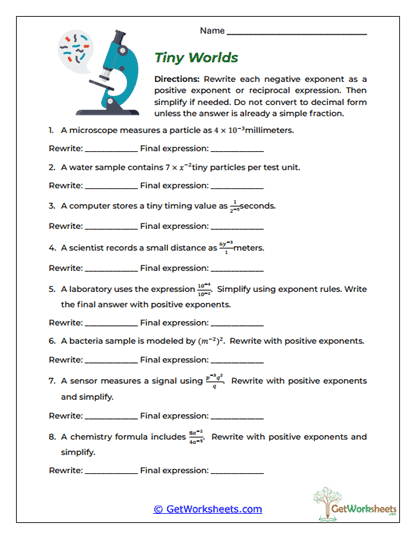
Tiny Worlds
Science-based situations show how negative exponents can describe extremely small quantities and measurements. Students interpret each context, rewrite the negative power as a reciprocal with a positive exponent, and simplify when appropriate. Connecting the notation with microscopic distances, tiny particles, and other small-scale values gives the skill a practical purpose. The activity also strengthens students' ability to move between written situations and symbolic mathematical expressions.
Bookmark Us Now!
New, high-quality worksheets are added every week! Do not miss out!